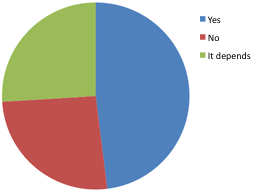
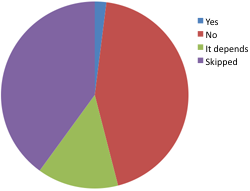
Another Quick and Dirty Completely Unscientific Survey [tm]. Today was #followamuseum day on Twitter, and it's all lovely and stuff, but I noticed some comments tagged #followavisitor #followamember or #MuseumsFollowYouBack suggesting that museums should follow you back. Now, I personally hate it* when an institution I've followed or mention follows me – particularly when I've only mentioned them in twitter conversation and not actually directed a comment at their username. Ugh, creepy.
So we clearly have two different sets expectations about our relationships with institutional accounts. I wanted to know what the expectations 'out there' were, so I whipped up a quick survey and tweeted it, asking 'Friendly or stalkerish?'. I've also asked the question on Facebook, where my network is much less museum-y and social network-y**. You can go add your opinion now: http://www.surveymonkey.com/s/CSVXVCM
A supplementary question I didn't add: "if a museum follows you back, do you really think they have time to read your tweets, or just respond to @ replies?"
* nearly all the time, anyway. I'd never think 'ooh, they're interested in me as an individual', even though, y'know, I'm really interesting and stuff.
** You can tell, because my brother thought it was hilarious to respond: "You should go further and, whenever anyone visits the museum, pay them a return visit to check out all the stuff at their place. Imagine that! They'll love it!", but someone, somewhere, is adding that to their museum marketing plan.
Find out who won our Cosmic Collections competition.
Cosmic Champions
Last October, we launched a competition to release hundreds of stories from the Cosmos & Culture exhibition on to the web. We invited astronomy enthusiasts, designers and web developers to create their own websites with our objects – and the results are now in.
There were two competitions, to create websites for adults and for the 11-16 age group. We didn’t get enough entries in the second group to award a prize, but the quality of the entries in the adult group was so high that we’ve decided to award an extra prize for that.
Overall winner (£1000 prize)
Simon Willison and Natalie Down Entry at http://cosmos.natimon.com/ The judges felt that Simon and Natalie’s entry made the best use of our collections data, as it allows users to browse objects by people, places and celestial body, making links between them. Judge Chris Lintott describes it as 'having a wikipedia-like quality of sucking the user in for just one more click'.
Runner-up (£750 prize)
Ryan Ludwig Entry at http://www.serostar.com/cosmic/ The judges were really impressed with the visual appeal of Ryan’s entry, particularly the image gallery with thumbnails and zoom function.
The judges also commended Ray Shah’s entry (http://collection.thinkdesign.com/), particularly the function for users to add their own data.
What happens next?
We’ll be working with our winners to incorporate the best aspects of their entries into a finished product. We will be launching it on the Science Museum’s website in February, so watch this space!
Notes
1) The competition judges were:
Christian Heilmann A geek and hacker at heart, Christian Heilmann has been a professional web developer for about eleven years. He has been nominated "standards champion of the year 2008" by .net magazine in the UK and he currently sports the fashionable job title "International Developer Evangelist" spending his time speaking and training people on systems provided by Yahoo and other web companies that want to make this web thing work well for everybody.
Chris Lintott Chris Lintott is a post-doctoral researcher in the Department of Physics at the University of Oxford. His research looks at the analysis of star formation, including being principal investigator for the Galaxy Zoo project. He is also co-presenter on the Sky at Night program alongside Sir Patrick Moore.
2) Entries to the competition were assessed under the following categories:
Use of collections data
Creativity
Accessibility
User experience
Ease of deployment and maintenance
3) The Cosmos & Culture exhibition is supported by the Patrons of the Science Museum with additional support from the Science & Technology Facilities Council, STFC.
A conversation has sprung up on twitter about why museums prefer Flickr Commons to Wikimedia Commons after Liam Wyatt, Vice President of Wikimedia Australia posted "Flickr Commons is FULL for 2010. GLAMs, Fancy sharing with #Wikimedia commons instead?" and I responded with "has anyone done audience research into why museums prefer Flickr to Wikimedia commons?". I've asked before because I think it's one of those issues where the points of resistance can be immensely informative.
Kasja: Photos from collections have ended up at wikipedia without permission, that never happened with Flickr, could be one reason [and] Or museums are more benevolent when it happens at Flickr, it's seen more as individuals' actions rather than an organisations'?
Nick: Flickr lets you choose CC non-commercial licenses, whereas Wikimedia Commons needs to permit potential commercial use?
Janet: Apart fr better & clear CC licence info, like Flickr Galleries that can be made by all! [and] What I implied but didn't say before: Flickr provides online space for dialogue about and with images.
Richard: Flickr is so much easier to view and search than WM. Commons, and of course easier to upload.
Twitter can be a bit of an echo chamber at times, so I wanted to ask you all the question in a more accessible place. So, is it true that museums prefer Flickr Commons to Wikimedia Commons, and if so, why?
Also, for those interested in wikimedia/wikipedia* and museums, there's going to be a workshop 'for exploring and developing policies that will enable museums to better contribute to and use Wikipedia or Wikimedia Commons, and for the Wikimedia community to benefit from the expertise in museums', Wikimedia@MW2010, at Museums at the Web 2010. There's already a thread, 'Wikimedia Foundation projects and the museum community' with some comments. I'd love to see the 'Incompatible recommendations' section of the GLAM-Wiki page discussed and expanded.
* I'm always tempted to write 'wiki*edia' where * could be 'm' or 'p', but then it sounds like South Park's plane-rium in my head.]
[I should really stop updating, but I found Seb Chan's post on the Powerhouse Museum blog, Why Flickr Commons? (and why Wikimedia Commons is very different) useful, and carlstr summed up a lot of the issues neatly: "One of the reasons is that Flickr is a package (view, comment search aso). WC is a archive of photos for others to use. … I think Wikipedia/Wikimedia have potential for the museum sector, but is much more complex which can be deterrent.".]
For various reasons, the announcement of the winners of our mashup competition has been a bit low key – but we're working on a site that combines the best bits of the winners, and we'll make a bit more of a song and dance about it when that's ready.
I'd like to take the opportunity to personally thank the winners – Simon Willison and Natalie Down in first place, and Ryan Ludwig as runner-up – and equally importantly, those who took part but didn't win; those who had a play and gave us some feedback; those who helped spread the word, and those who cheered along the way.
I have a cheeky final request for your time. I would normally do a few interviews to get an idea of useful questions for a survey, but it's not been possible lately. I particularly want to get a sense of the right questions to ask in an evaluation because it's been such a tricky project to explain and 'market', and I'm far too close to it to have any perspective. So if you'd like to help us understand what questions to ask in evaluation, please take our short survey http://www.surveymonkey.com/s/5ZNSCQ6 – or leave a comment here or on the Cosmic Collections wiki. I'm writing a paper on it at the moment, so hopefully other museums (and also the Science Museum itself) will get to learn from our experiences.
And again – my thanks to those who've already taken the survey – it's been immensely useful, and I really appreciate your honesty and time.
On the BBC/BM 'A History of the World': "Since this is radio, we are not allowed to see the objects, thus enhancing the status of their custodian as interceding priest. … Authenticity is essential and there must be no copies or representations – in MacGregor's case not so much as a picture." Well, you could look online.
And if is to be true "[i]t does not matter if no one ever sees the shard. Most museum objects are seen only by their guardians, albeit financed by tithes from taxpayers", we'd probably better hide the 230,000 Science Museum, National Railway Museum and National Media Museum objects online. On the other hand, I do like a good 'museum as church' argument, cos if it was true the office wouldn't have bundles of excited kids on the other side of the door and it might be be quieter.
On a more serious note, whenever I come across articles like this it reminds me how far we have to go in helping people realise exactly how accessible, enjoyable, potentially challenging and just plain interesting our (your, their) museums are.
Inspired by the Yahoo! Design Pattern Library and expanding on situations particular to museum content (particularly exhibitions and catalogues), audiences and context (from stereotypes of museums as boring and dry to issues around authority and trust in cultural heritage)…
These design patterns might be useful for coming up with common data structures that could inform a shared schema for linking across collections, help provide a framework for sharing audience evaluation and comparing visitation figures, etc.
A bit of an experiment – let's see if it sticks.
If you're using design patterns already, do any that particularly need adapting come to mind? Or can you share some behaviours you've noticed that are typical of museum audiences?
Suggestions for simple starting points also welcome! I've put some very initial rough thoughts below – with any luck there are existing current typologies out there that could replace this.
Design patterns
Encouraging debate, comments
Participation rates on museum blogs and other commenting sites are often low, perhaps lower than the equivalent content might attract on a non-museum site. How have the most successful sites encouraged participation and comment?
Typology of museum sites (as a context for more specific design patterns)
NB: many sites will contain a mixture of types, though often collections or exhibition sites are presented as 'microsites'.
Brochure-ware
Do these still exist?
Experiential exhibitions sites
From shiny interactive/multimedia brochureware to games tied to the gallery experience/content.
Exhibition catalogue sites
Presentations of exhibition content, usually replicating curatorial or physical organisation methods used in the physical gallery or a translation of the print catalogue into a website.
Online-only exhibition site
Is this just about the level of interpretation – narratives, thematic contexts etc wrapped around object records?
Collections catalogue sites
Online catalogue, generally with organisation structures that replicate the management structures or subjects of the museum.
I've been doing an informal survey of how institutions present their online collection, and how they handle decisions like "advanced search", stemming of keywords, and whether they use an implicit AND or OR between multiple keywords. Hopefully I can summarize some of that into a few design patterns? If nothing else maybe I'll post the table here and let others go at it!
Just today. A day late to help my paper, alas! I've read a bunch of Morville's blog – he's pretty good at presenting the big ideas in an understandable way and that new book and site seem awesome. I'll have to see if I can get the Walker to pay for a copy for me… :)
Mia, Do you have a sense of the granularity you are looking for? The pattern libraries I've been using seem to focus on smaller snippets of interface (e.g. how to do a button, or an ordered list, etc. or Morville's search patterns). Would it be useful to re-frame the question of cultural heritage patterns at the same level? e.g. the Image/Tombstone pattern, which maybe used across different types of sites (or site functions). The point of this is to provide other developers re-usable/re-mixable code/style patterns, no?
I have some thoughts on this from a more research/analysis focus, but I don't think that's what you're getting at here. I can post more if that's of interest.
That's a good question – I don't actually mean the patterns are that broad, just that the application and desirability of a pattern will depend on the type of site, or the section of the site. For example, you could possibly build a pattern around providing the basic when/where/how much information – if successful, the visitor would be able to find that and be on their way to the actual museum within a few seconds. But if you'd spent a lot of time creating video content about an exhibition, you'd hope the visitor would stick around long enough and see enough to be convinced to take the next step, whether that's booking tickets or whatever.
And yes, please do post more! I think, to my mind, even image/tombstone depends on context – how big should the image be, how many images, interpretative or qualified dates in the tombstone data, etc.
I've fallen into the now-familiar trap of posting interesting links on twitter and neglecting my blog, but twitter is currently so transitory I figure it's worth collecting the links for perusal at your leisure. Sometimes I'll take advantage of the luxury of having more than 140 characters and add comments [in brackets].
'vision video' for Project Natal – lots of UX challenges but the hardware and software sound amazing already http://procrastineering.blogspot.com/2009/06/project-natal.html [physical and gestural interfaces, spatial, facial recognition – all kinds of "we're living in the future" stuff]
Thoughtful piece on twitter and nature of engagement at confs When Social Technologies Become AntiSocial (HT @jtrant) [part of an on-going debate about whether the 'backchannel' should be made public during conference presentations. My gut feeling is that it's distracting, and as in this case, sometimes particularly unfair on the speaker. I do think twitter displays elsewhere in a conference work really well. The backchannel is so useful for all the social and peer connection stuff at conferences, but ultimately you're in a session to listen to the speakers and most of us find concentrating on one thing for a long period of time difficult enough these days so might need all the help we can get.]
No public back channel – 'My vote would be to take the toy away from the kids until they can act old enough to use it.' http://bit.ly/2GbzmH [public back channel again]
research gems: 'it's like a vicious circle, except it's not that vicious, it's just a circle' http://is.gd/53noQ [just plain funny]
Brilliant for cultural heritage RT @givp RT @yunilee Unbelievable software turns average webcam into 3D scanner. http://tinyurl.com/ykpzc2e [not real time, I assume – but it could be brilliant for quick and dirty object digitisation]
Aren't museums already broadcasters, on the internet? Or does TV trump YouTube? "Museums and broadcasters must work together" [I do have a blind spot around the 'museums as broadcasters' idea – maybe I already take it as a given, or maybe it's because I don't have a TV? @NickPoole1 has been tweeting about it a bit, but I think I prefer 'museums as platform' to 'museums as broadcasters'. Spaces for learning, discussion, reflection. Possibly related to Clay Shirky's talk at the Smithsonian – 'If you think of every artefact as a latent community, much of social values comes from convening platforms available for people to start sharing value in communities of practice. … If you think value is only things that you buy and manage and control… being a platform increases value for and the loyalty of the people who go there.']
Amazed by these stats 'MSN Hotmail’s remained the most popular email service provider' at 33%, Yahoo 14%, Gmail 6% [It really annoys me that Nomensa don't link to the original source for their stories. They post great content, but it's unusable without proper attribution]
The 'What is keeping women out of technology?' article confuses 'technology' with 'networking' http://bit.ly/2hcLTz [The 'phone, handbag' thing is ridiculous – even if it's true, it doesn't matter why you don't answer the phone, and I'm pretty sure we have some methods for asynchronous communication these days – ooh, like voicemail, email, direct message… It's a shame the author doesn't really get around to addressing his original question, except to say that he doesn't want to hear any of the reasons commonly given. Why ask then?]
“this is my freaking HOUSE” – issues with 'the gathering clouds of a location-based privacy storm' http://tr.im/EvTX [and] social media makes your privacy leaky, because as careful as you are, even geek friends can be unsavvy about privacy and social media
Excellent insight into problems with large sites RT @bwyman: American Airlines fires UX designer for caring too much http://is.gd/4O6q2
I can't believe this kid is only 16. 'Digital Open Winners: Australian Teen Crafts "Sneaky" Games' http://bit.ly/2FzBoz
no idea where this link came from so no HT but wow! AR with movable screen shows what church would look like un-destroyed http://tr.im/E4BM
A response to A N Wilson in the Mail 'An uncertain scientist’s guide to taking risks' http://tr.im/E4xP Also good on climate change action [earlier tweet: "Ha ha ha, hilarious article by A N Wilson about the trouble with scientists. http://bit.ly/3jCVUc HT @benosteen"]
such a simple but brilliant accessibility idea – magnifier application in Nokia phones for help with fine print http://is.gd/4McVg
Excellent post – IMA's Rob Stein on benefits and challenges of transparency and museums http://is.gd/4McL8
ALA on websites for learners… they 'need an environment that is narrative, interactive, and discoverable.' http://bit.ly/2FfzSL
And stuff I really must find time to read properly:
I really should group those tweets and replace all the shortened links with the full URLs but it's already taken a surprisingly long time to put this post together.
I originally posted this on the Science Museum developers blog, filed under: API,competition,cosmosandculture,mashups — mia @ 7:03 pm
The Cosmic Collections competition has been running for a few weeks now, and while we’ve been sucked into a vortex of other projects, I’ve been keeping an eye out for feedback from the public.
As a result, I’ve realised that there may be some mismatch between the way mashups tend to work, and the scope we’ve suggested for entries to our competition. The types of interfaces someone might produce with the API may lend themselves more to exploring one particular idea in depth than produce something suitable for the broadest range of our audiences.
So I’m proposing to change the scope for entries to the competition, to make it more realistic and a better experience for entrants: I’d like to ask you to build a section of a site, rather than a whole site. The scope for entrants would then be: “create something that does one thing, and does it well”. Our criteria – use of collections data, creativity, accessibility, user experience and ease of deployment and maintenance – are still important but we’ll consider them alongside the type of mashup you submit.
This might mean producing a mashup for one particular way of exploring the objects, or exploring a sub-set of the objects. It’d then be up to us to combine the winning mashups into a larger site that works for our audiences.
What do you think? If there aren’t any huge objections, I’ll go ahead and update the criteria. Of course, if you’ve been working on something and feel it’s unfair to change the criteria at this stage, let me know and we’ll work something out.
If you make it along to the launch at the Science Museum on Saturday, make sure you say hello – I should be easy to find cos I'm giving a quick talk at some point.
Right now the laziest thing I could do is to give you a list of places where you can find out more:
Btw – if you want an idea of how slowly museums move, I think I first came up with the idea in January (certainly before dev8D because it was one of the reasons I wanted to go) and first blogged about it (I think) on the museum developers blog in March. The timing was affected by other issues, but still – it's a different pace of life!
A Requirements Engingeering lecture at uni yesterday discussed 'satisfaction arguments' (a way of relating domain knowledge to the introduction of a new system in an environment), emphasising the importance of domain knowledge in understanding user and system requirements – an excellent argument for the importance of cultural heritage technologists in good project design. The lecture was a good reminder that I've been meaning to post about 'cultural heritage technologists' for a while. In a report on April's Museums and the Web 2009, I mentioned in passing:
…I also made up a new description for myself as I needed one in a hurry for moo cards: cultural heritage technologist. I felt like a bit of a dag but then the lovely Ryan from the George Eastman House said it was also a title he'd wanted to use and that made me feel better.
Museum technologists are not merely passive participants in the online publication process. We have skills, expertise and experience that profoundly shape the delivery of services. In Jacob Nielsen's terms, we are double domain experts. This brings responsibilities on two fronts – for us, and for the museums that employ us.
Nielsen describes 'double usability specialists' or 'double experts' as those with expertise in human-computer interaction and in the relevant domain or sector (e.g. ref). He found that these double experts were more effective at identifying usability issues, and I've extrapolated from that to understand the role of dual expertise in specifying and developing online and desktop applications. Commenters in the final session of MW2009 conference described the inability of museums to recognise and benefit from the expertise of their IT or web staff, instead waiting until external gurus pronounced on the way of the future – which turns out to be the same things museum staff had been saying for years. (Sound familiar?)
So my post-MW2009 'call to arms' said "museums should recognise us (museum technologists) as double domain experts. Don’t bury us like Easter eggs in software/gardens. There’s a lot of expertise in your museum, if you just look. We can save you from mistakes you don't even know you're making. Respect our expertise – anyone can have an opinion about the web but a little knowledge is easily pushed too far".
However, I'm also very aware of our responsibilities. A rough summary might be:
Museum technologists have responsibilities too. Don’t let recognition as a double domain expert make you arrogant or a ‘know it all’. Be humble. Listen. Try to create those moments of understanding, both yours from conversation with others, and others from conversation with you – and cherish that epiphany. Break out of the bubble that tech jargon creates around our discussions. Share your excitement. Explain how a new technology will benefit staff and audiences, show them why it's exciting. Respect the intelligence of others we work with, and consider it part of our job to talk to them in language they understand. Bring other departments of the museum with us instead of trying to drag them along.
Don't get carried away with idea that we are holders of truth; we need to take advantage of the knowledge and research of others. Yes, we have lots of expertise but we need to constantly refresh that by checking back with our audiences and internal stakeholders. We also need to listen to concerns and consider them seriously; to acknowledge and respect their challenges and fears. Finally, don’t be afraid to call in peers to help with examples, moral support and documentation.
My thoughts on this are still a work in progress, and I'd love to hear what you think. Is it useful, is it constructive? Does a label like 'cultural heritage technologist' or 'museum technologist' help others respect your learning and expertise? Does it matter?
[Update, April 2012: as the term has become more common, its definition has broadened. I didn't think to include it here, but to me, a technologist ia more than just a digital producer (as important as they are) – while they don't have to be a coder, they do have a technical background. Being a coder also isn't enough to make one a technologist as it's also about a broad range of experience, ideally across analysis, implementation and support. But enough about me – what's your definition?]