Notes from 'User-Generated Content' session at MW2008

These are my notes from the User-generated content session at Museums and the Web, Montreal, 2008. All mistakes are mine, any corrections are welcome, my comments are in [square brackets] below.

The papers presented were The Art of Storytelling: Enriching Art Museum Exhibits and Education through visitor narratives by Matthew Fisher, Alexandra Sastre, Beth Twiss-Garrity; The Living Museum: Supporting the Creation of Quality User-Generated Content by Allison Farber, Paul Radensky and Getting 'In Your Face': Strategies for Encouraging Creativity, Engagement and Investment When the Museum is Offline by Martin Lajoie, Gillian McIntyre, Ian Rubenzahl, Colin Wiginton.

The "Art of Storytelling" project at the Delaware Art Museum.
The paper covered visitor-contributed content (VCC), the key factors to success, and the motivations behind allowing visitors to contribute. The paper goes into more of the theoretical foundations.

The key findings of the Art of Storytelling project evaluation:

What's the value to the visitor who contributes? It engages visitors in thinking critically and creatively about and in response to art.
What's the value to the museum? They get feedback and to engage new audiences
What's the value to the other visitors? There is some confusion, but also it can be inspiring, enriching, and encourage others to participate.

It's not appropriate or appealing for all collections, but it's hard to predict which in advance.

[When looking at models of participation:] Allow the motivated to contribute, allow the rest to benefit; don't penalise for non-participation.

Simplicity – remove barriers to entry (engage first, login last if at all).

Promote in traditional and non traditional venues; have a clear invitation to participate.

Motivating factors included curatorial encouragement (have curators there encouraging people), juried selections, stipends for selected storytellers.

What's in it for the audience? They get 15 minutes next to an Andy Warhol. Establish an audience for your visitor-contributors – affiliation with an institution is valued, even if comes with caveats. [Theirs is an art museum – does that work for all audiences, or for all types of content?]

Don't try and create communities beyond the your collections (because others with bigger budgets are after the same eyeballs).

They gave lots of examples from a summary of evaluation of other projects (but the slides were hard to see):
Isabella Stewart Gardner Museum in Boston – thinking through art. Active looking skills.
The Wolfsonian Institute in Miami – Artful Citizenship Project.
Guggenheim – Learning Through Art.
Aldrich Contemporary Art Museum – Round by Halsey Burgund.
Denver Art museum – Frederic Remington exhibit, Hamilton building programming.
Philadelphia area art museums; art, literacy, museums.

They then provided some background information about the Art of Storytelling at the Delaware Art Museum – story telling kiosks in the museum.

Their 'a-ha' moment was realising that the experience was more transformational for the original story tellers (i.e. the adults) than the audience. Transcend traditional ideas re lack of authority.

In conclusion, visitor-contributed content programs are valuable to the original contributors and museums get valuable insight into audiences, but it's an open question as to whether they're valuable for other visitors.

The Museum of Jewish Heritage, supporting the creation of quality user-generated content in the "Living Museum".
The project started as outreach project for Jewish communities without local museum.

The process: students visit a local museum, learn a bit about how museums are structured in terms of display of objects and organisation. The students choose an artefact to represent Jewish heritage at home, then write labels at school. They then organise artefacts into galleries, create gallery title and text panels, then create in-school and online exhibitions. Students research artefacts and tell their own stories. They include measurements because you can't get a sense of scale on the internet. One piece of text tells story of artefact and the other tells significance of artefact to family.

[They aren't promoting it until they feel the site is ready – a familiar story!]

They run seminars with teachers to help them submit quality content, but they still get objects unrelated to Jewish heritage, text with spelling and grammar errors, incomplete labels, unclear photos, factual errors.

The goals included: educational – a connection to Jewish heritage, parental involvements, museology, improve writing and research skills; institutional – high quality images so people can see what they're looking at; privacy of students; motivation of students.

Teachers say students are motivated to get stuff right because it's going online.

Unlike other user-generated content sites, the content is pre-reviewed, as the project has very specific educational goals. They control who creates content on the website (anyone can use but only teachers from Jewish schools can post content) and check that kids can't be identified. They are trying not to expose the kids and their personal stories to comment or modification by other users.

They are going to implement a spell checker.

How can they help users to contribute quality content? Convey expectations, consider needs of both kinds of users, offer support, concentrate on process and product of exhibition creation, review submitted content and offer recommendations.

"In Your Face", Art Gallery of Ontario
In Your Face: The People's Portrait Project.
While the Art Gallery of Ontario building was under construction, they were interested in rethinking the way the organisation worked, and how to keep people connected to the institution.

They got the idea from UK's National Portrait Gallery BP prize, but they didn't want a contest.

They advertised on back of the national paper for a few weeks as they had free space. They wrote a copyright statement that people had to sign, specified a size, and said they would hang every piece that came in. They received 17,000 portraits.

First they got lots of entries from rural areas, then the rest of Canada and the world. There was an extraordinary variety in portraits, and also in the parcels. They also arrived with stories.

It was a one way thing – people knew they weren't going to get the portraits back. It mattered to them to get them exhibited in the AGO.

There was more diversity in portraits and in the people who came to see them than usually seen in the gallery. People paid money to see the portraits as they were 'after the gate'. It was lots of work for staff on top of their normal job cos it turned out to be huge, but gave them (the staff) energy. It also made their audiences real for the staff and helped make the institution inclusive.

Contemporary artists from their collection also sent in portraits, but their names weren't shown so it was all egalitarian.

They also created a Flickr group (but weren't able to get that projected in the gallery). It now has 10,000 portraits in it.

They had a parallel project – Collection X. It was an online project where visitors could make their own exhibition. Collect, connect and create. 'Open source museum' [- the online paper goes into more detail, including the use of RSS.]

Partly [?] as a result of the project, guiding principles developed for institution include relevance, responsiveness, creativity, transparency, diversity and forum.

Questions asked:
How do you balance museum's agenda with visitor expectations? Is it possible to assert control and foster programming that is open-ended? How do we think about expertise, quality and standards? How do we integrate and manage creativity in ways that are dynamic and long-term? Is curatorial expertise or audience experience paramount? Some things curators are uneasy about. Dynamism also means some volatility – how does that work?

Lessons learned:
Take risks, experiment and be willing to make mistakes
Museums can function as catalysts for creativity [my emphasis, this was the meme that ran through the whole session, for me]
A critical mass of creativity asserts its own kind of aesthetic
There is value in integrating user-generated content that is actual as well as virtual
Museum and the public can function as producers and consumers of culture to create a shared sense of ownership
The public will be invested if programming is authentic and they feel respected.
Notes from 'Object-Orientated Democracies: Contradictions, Challenges And Opportunities' in 'Theoretical Frameworks' session, MW2008

These are my notes from the first paper, 'Object-Orientated Democracies: Contradictions, Challenges And Opportunities' in the Theoretical Frameworks session chaired by Darren Peacock at Museums and the Web 2008. I'll post the others later because the 'real world' is calling me to a 30th now.

I didn't blog these at the time because I wanted to read the papers properly before talking about them. I probably still need a bit longer to digest them, but the longer I leave it the more vague my memory will get and the less likely I am to revisit the papers, so please excuse (and contact me to correct!) any mistakes or misinterpretations. I'm not going to summarise the papers because you can go read them for yourself at the links below (one of the truly fantastic things about the Museums and the Web conferences, IMO), I'm just pulling out the bits that pinged in my brain for whatever reason. My comments on what was said are in [square brackets] below.

The papers were Object-centred democracies: contradictions, challenges and opportunities by Fiona Cameron, Who has the responsibility for saying what we see? mashing up Museum and Visitor voices, on-site and online by Peter Samis and The API as Curator by Aaron Straup Cope.

Darren introduced the session theme as 'the interplay between theory and practice'.

Fiona Cameron, Object-orientated democracies.

Museums use currently collections to produce stable, ordered, certain meanings. Curators are the gateway to a qualified interpretation of the object. [Classification and ordering as a wish-fulfilment exercise in 'objective', scientific recording, regardless of social or cultural context?]

However, the 'networked' (online, digital?) object overturns hierarchical museum classifications and closed museum-specific interpretive paradigms.

Online objects taking 'active role in social networks and political agendas'. [Objects re-appropriated in role as cultural signifiers by the communities they came from – cool!]

'Heritage significance is where the museum meets pop culture.'

Collection information becomes fluid when released into network, flow, subject to interactions with other resources and ideas.

From the paper: "Clearly, the more technology facilitates a networked social structure and individual cultural expression, as seen most recently with Web 2.0, the more difficult it becomes for museums to produce universal or consensual meanings for their collections."

[Why would museums want to (claim to) produce universal meanings anyway? One of the exciting possibilities of linking from each of our online objects to its instance in various museum projects is the potential to expose the multiplicity of interpretations and narrative contexts produced around any single object, even within the same museum. Also, projects like 'Reassessing What We Collect' are an acknowledgement that a 'universal' reading is in fact problematic.]

Bruno La Tour: object-orientated democracies. "For too long, objects have been wrongly portrayed as matters of fact."

Objects as mediators in assertion of associations, not just cultural symbols. How are competing readings inscribed in collections documentation context?

Collections wikis – how interactions between museum and public culture might inform new collection spaces.

Test cases for 'Reconceptualising Heritage Collections' – politically charged objects – coin and wedding dress. Wiki and real time discussion with curators, Palestinian Australians, Jewish readings of the same objects – many different readings.

Placing objects in open/public wiki was seen as problematic – assault on Palestinian culture. Role of museums in this… protection, 'apolitical gatekeeper', governance?

Collections as complex systems. [Complexity as problem to be smoothed out in recording.]

Objects derive meaning and significance from a large number of elements, multi/inter/disciplinary or from outside the museum walls. [Too much on that slide to read!]

Curators as expert groups within proposed systems; group boundaries are permeable. Static museum categories become more ambiguous as objects are interpreted in unexpected, interesting ways. Role in mapping social world around a collections item. Equilibrium vs chaos?

"Objects are able to perform at a higher level of complexity."

Issues re: museum authority and expertise, tensions between hierarchical structures and flexible networks, sustainable documentation practice, manage complexity.

[I think one of the reasons I liked this so much on a personal level is that it has a lot of parallels to the thinking I had to do about recording structures for post-processual archaeology at Çatalhöyük Archaeological Project – relational archaeological databases as traditionally conceived don't support the recording of ambiguity, uncertainty, plurality, multiplicity or of interpretative context.

I also like the sense of possibilities in a system that at first might seem to undermine curatorial or organisational authority – "Objects are able to perform at a higher level of complexity". The role of museums, and the ways curators work, might change, but both museums and curators are still valued.]

Nielson on 'should your website have concise or in-depth content?'

Long pages with all the text, or shorter pages with links to extended texts – this question often comes up in discussions about our websites. It's the kind of question that can be difficult to answer by looking at the stats for existing sites because raw numbers mask all kinds of factors, and so far we haven't had the time or resources to explore this with our different audiences.

In Long vs. Short Articles as Content Strategy Jakob Nielsen says:

  • If you want many readers, focus on short and scannable content. This is a good strategy for advertising-driven sites or sites that sell impulse buys.
  • If you want people who really need a solution, focus on comprehensive coverage. This is a good strategy if you sell highly targeted solutions to complicated problems.

But the very best content strategy is one that mirrors the users' mixed diet. There's no reason to limit yourself to only one content type. It's possible to have short overviews for the majority of users and to supplement them with in-depth coverage and white papers for those few users who need to know more.

Of course, the two user types are often the same person — the one who's usually in a hurry, but is sometimes in thorough-research mode. In fact, our studies of B2B users show that business users often aren't very familiar with the complex products or services they're buying and need simple overviews to orient themselves before they begin more in-depth research.

Hypertext to the Rescue
On the Web, you can offer both short and long treatments within a single hyperspace. Start with overviews and short, simplified pages. Then link to long, in-depth coverage on other pages.

With this approach, you can serve both types of users (or the same user in different stages of the buying process).

The more value you offer users each minute they're on your site, the more likely they are to use your site and the longer they're likely to stay. This is why it's so important to optimize your content strategy for your users' needs.

So how do we adapt commercial models for a cultural heritage context? Could business-to-business users who start by familiarising or orienting themselves before beginning more in-depth research be analogous to the 'meaning making modes' for museum visitors – browsers and followers, searchers or researchers – identified by consultants Morris, Hargreaves, McIntyre?

Is a 'read more' link on shorter pages helpful or disruptive of the visitors' experience? Can the shorter text be written to suit browsers and followers and the 'read more' link crafted to tempt the searchers?

I wish I could give the answer in the next paragraph, but I don't know it myself.

Museums and Clayton's audience participation

A comment Seb left on Nate's blog post about "master" metadata got me thinking about cognitive dissonance and whether museums who say they're open to public participation and content really act as if they are. Are we providing a Clayton's call for audience participation?

If what you do – raise the barrier to participation so high that hardly anyone is going to bother commenting or tagging – speaks louder than what you say – 'sure, we'd love to hear what you have to say' – which one do you think wins?

To pick an example I've seen recently (and this is not meant to be a criticism of them or their team because I have no idea what the reasons were) the London Transport Museum have put 'all Museum objects and stories on display in the new Museum' on their collections website, which is fantastic. If you look at a collection item, the page says, "Share a story with us – comment on this image", which sounds really open and inviting.

But, if you want to comment, they ask for a lot of information about you first – check this random example.

So, ok. There are lots of possible reasons for this. UK museums have to deal with the Data Protection Act, which might complicate things, and their interpretation of the DPA might mean they ask for more information rather than less and add that scary tick box.

Or maybe they think the requirement to give this information won't deter their audience. I'd imagine that London Transport Museum's specialist audiences won't be put off by a registration form – some of their users are literally trainspotters and at risk of believing a stereotype, if they can bear the kind of weather that requires anoraks, they're probably not put off by a form.

Or maybe they're trying to control spam (though email addresses are no barrier to spam, and it's easy to use Akismet or moderation to trap spam); or maybe it's a halfway house between letting go and keeping control; or maybe they're tweaking the form in response to usage and will lower the barriers if they're not getting many comments.

Or maybe it's because the user-generated content captured this way goes directly into their collection management system and they want to record some idea of the provenance of the data. From a post to the UK Museums Computer Group list:

We have just launched the London Transport Online Museum. Users can view
every object, gallery and label text on display in our new museum in Covent Garden.

Following on from the current discussion thread we have incorporated into this new site, the facility for users to leave us memories / stories on all objects on display. Rather than a Wiki submission these stories are made directly on the website and will be fed back into our collection management system. These submissions can be viewed by all users as soon as they have passed through moderation process.

We will closely monitor how many responses we get and feedback to the group.

Please have a look, and maybe even leave us a memory?

[My emphasis in bold]

Moving on from the example of the London Transport Museum…

Whether the gap between their stated intentions and the apparent barriers to accepting user-generated content is the result of internal ambivalence about or resistance to user-generated content, concern about spam or 'bad data', or a belief that their specialist audiences will persist despite the barriers doesn't really make a difference; ultimately the intentionality matters less than the effect.

By raising the barrier to participation, aren't they ensuring that the casual audience remains exactly that – interested, but not fully engaged?

And as Seb pointed out, "Remembering that even tagging on the PHM collection – 15million views in 2007, 5 thousand tags . . . – and that is without requiring ANY form of login."

It also reminds me of what Peter Samis said at Museums and the Web in Montreal about engaging with museum visitors digitally: "We opened the door to let visitors in… then we left the room".

(If you're curious, the title is a reference to an Australian saying: Clayton's was "the drink you have when you're not having a drink", as as Wikipedia has it 'a compromise which satisfies no-one'. 'Ersatz' might be another word for it.)

Explaining the semantic web: by analogy and by example

Explaining by analogy: Miko Coffey summarises the semantic web as:

  • Web 1.0 is like buying a can of Campbell's Soup
  • Web 2.0 is like making homemade soup and inviting your soup-loving friends over
  • The semantic web is like having a dinner party, knowing that Tom is allergic to gluten, Sally is away til next Thursday and Bob is vegetarian.

And she's got a great image in the same post to help explain it.

To extend the analogy, it's also as if the semantic web could understand that when your American aunt's soup recipe says 'cilantro', you'd look for 'coriander' in shops in Australia or the UK.

Explaining by doing: this review 'Why I Migrated Over to Twine (And Other Social Services Bit the Dust)' of Twine gives lots of great examples of how semantic web stuff can help us:

So for example when Stanley Kubrick is mentioned in the bookmarklet fields, or in the document you upload, or in the email you send into Twine — the system will analyze and identify him as a person (not as a mere keyword). This is called entity extraction and is applied to all text on Twine.

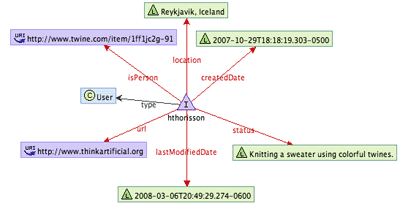
Under the hood, a person is defined in a larger ontology in relation to other things. Here’s an example of a very small portion of my own graph within Twine:

Hrafn Th. Thorissons RDF graph in Twine

Some may not find the point of this clear. So to explain: Just as HTML enables computers to display data — this extra semantic information markup (RDF, OWL, etc.) enables computers to understand what the data is they’re displaying. And moreover, to understand what things are in relation to other things.

Example Search
For an example, when we search for “Stanley Kubrick” on regular search engines, the words “Stanley” and “Kubrick” are usually regarded as mere keywords: a series of letters that the search engine then tries to find pages with those series of letters. But in the world of semantic web, the engines know “Stanley Kubrick” is a person. This results in a lot less irrelevant items from the search’s results….

If you weren’t already aware, the systems I just described above are the basic semantic web concept: Encapsulating data in a new layer of machine processable information to help us search, find and organize the overwhelming and ever-growing sea of pictures, videos, text and whatever else we’re creating.

I think these are both useful when explaining the benefits of the semantic web to non-geeks and may help overcome some of the fear of the unknown (or fear of investment in the pointless buzzword) we might encounter. If we believe in the semantic web, it's up to us to explain it properly to other people it's going to effect.

I also discovered a good post by Mike on the 'Innovation Manifesto'.

It's a wonderful, wonderful web

First, the news that Google are starting to crawl the deep or invisible web via html forms on a sample of 'high quality' sites (via The Walker Art Center's New Media Initiatives blog):

This experiment is part of Google's broader effort to increase its coverage of the web. In fact, HTML forms have long been thought to be the gateway to large volumes of data beyond the normal scope of search engines. The terms Deep Web, Hidden Web, or Invisible Web have been used collectively to refer to such content that has so far been invisible to search engine users. By crawling using HTML forms (and abiding by robots.txt), we are able to lead search engine users to documents that would otherwise not be easily found in search engines, and provide webmasters and users alike with a better and more comprehensive search experience.

You're probably already well indexed if you have a browsable interface that leads to every single one of your collection records and images and whatever; but if you've got any content that was hidden behind a search form (and I know we have some in older sites), this could give it much greater visibility.

Secondly, Mike Ellis has done a sterling job synthesising some of the official, backchannel and informal conversations about the semantic web at MW2008 and adding his own perspective on his blog.

Talking about Flickr's 20 gazillion tags:

To take an example: at the individual tag level, the flaws of misspellings and inaccuracies are annoying and troublesome, but at a meta level these inaccuracies are ironed out; flattened by sheer mass: a kind of bell-curve peak of correctness. At the same time, inferences can be drawn from the connections and proximity of tags. If the word “cat” appears consistently – in millions and millions of data items – next to the word “kitten” then the system can start to make some assumptions about the related meaning of those words. Out of the apparent chaos of the folksonomy – the lack of formal vocabulary, the anti-taxonomy – comes a higher-level order. Seb put it the other way round by talking about the “shanty towns” of museum data: “examine order and you see chaos”.

The total “value” of the data, in other words, really is way, way greater than the sum of the parts.

So far, so ace. We've been excited about using the implicit links created between data as people consciously record information with tags, or unconsciously with their paths between data to create those 'small ontologies, loosely joined'; the possibilities of multilingual tagging, etc, before. Tags are cool.

But the applications of this could go further:

I got thinking about how this can all be applied to the Semantic Web. It increasingly strikes me that the distributed nature of the machine processable, API-accessible web carries many similar hallmarks. Each of those distributed systems – the Yahoo! Content Analysis API, the Google postcode lookup, Open Calais – are essentially dumb systems. But hook them together; start to patch the entire thing into a distributed framework, and things take on an entirely different complexion.

Here’s what I’m starting to gnaw at: maybe it’s here. Maybe if it quacks like a duck, walks like a duck (as per the recent Becta report by Emma Tonkin at UKOLN) then it really is a duck. Maybe the machine-processable web that we see in mashups, API’s, RSS, microformats – the so-called “lightweight” stuff that I’m forever writing about – maybe that’s all we need. Like the widely accepted notion of scale and we-ness in the social and tagged web, perhaps these dumb synapses when put together are enough to give us the collective intelligence – the Semantic Web – that we have talked and written about for so long.

I'd say those capital letters in 'Semantic Web' might scare some of the hardcore SW crowd, but that's ok, isn't it? Semantics (sorry) aside, we're all working towards the same goal – the machine-processable web.

And in the meantime, if we can put our data out there so others can tag it, and so that we're exposing our internal 'tags' (even if they have fancier names in our collections management systems), we're moving in the right direction.

(Now I've got Black's "Wonderful Life" stuck in my head, doh. Luckily it's the cover version without the cheesy synths).

Right, now I'm off to the Museum in Docklands to talk about MultiMimsy database extractions and repositories. Rock.

Calling geeks in the UK with an interest in cultural heritage content/audiences

You might be interested in BathCamp – a bar camp in Bath on a Saturday (with overnight stay) in late August. This is an initial open call so head along to the website (BathCamp) and check it out. Ideally you would have an interest in cultural heritage content, audiences or applications, but we love the idea of getting fresh perspectives from a wide range of people so we don't expect that you would have worked with the cultural heritage sector (museums, galleries, libraries, archives, archaeology) before.

Questions from 'Beyond Single Repositories' at MW2008

I'm still working on getting my notes from Museums and the Web in Montreal online.

These are notes from the questions at the 'Beyond Single Repositories' session. This session was led by Ross Parry, and included the papers Learning from the People: Traditional Knowledge and Educational Standards by Daniel Elias and James Forrest and The Commons on Flickr: A Primer by George Oates.

This clashed with the User-Generated Content session that I felt I should see for work, but I managed to sneak in at the end of Ross's session. I expected this room to be packed, but it wasn't. I guess the ripples of user-generated content and Web 2.0-ish stuff are still spreading beyond the geeks, and the pebbles of single repositories and the semantic web have barely dropped into the pond for most people. As usual, all mistakes are mine – if you asked a question and I haven't named you or got your question wrong, drop me a line.

Quite a lot of the questions related to 'The Commons'.

There was a question about the difference between users who download and retain context of images, versus those who just download the image and lose all context, attribution, etc. George: Flickr considered putting the metadata into EXIF but it was problematic and wasn't robust enough to be useful.

Another question: how to link back to institution from Flickr? George: 'there's this great invention called the hyperlink'. And links can also go to picture libraries to buy prints.

[I need to check this but it could really help make the case for Commons in museums if that's the case. We might also be able to target different audiences with different requirements – e.g. commercial publications vs school assignments. I also need to check if Flickr URLs are permanent and stable.]

Seb Chan asked: how does business model of having images on Flickr co-exist with existing practices?

Flickr are cool with museums putting in content at different resolutions – it's up to institution to decide.

"It's so easy to do things the correct way" so please teach everyone to use CC licence stuff appropriately.

Issues are starting to be raised about revenue sharing models.

[I wonder if we could put in FOI requests to find out exactly how much revenue UK museums make from selling images compared to the overhead in servicing commercial picture libraries, and whether it varies by type of image or use. It'd be great if we could put some Museum of London/MoLAS images on Commons, particularly if we could use tagging to generate multilingual labels and re-assess images in terms of diversity – such an important issue for our London audiences; or to get more images/objects geo-located. I also wonder if there are any resourcing issues for moderation requirements, or do we just cope with whatever tags are added?]

Update: following the conference, Frankie Roberto started a discussion on the Museums Computer Group list under the subject 'copyright licensing and museums'. You have to be a member to post but a range of perspectives and expertise would really help move this discussion on.

Some feedback to MW2008 and other conferences

There's a thread on the Museums and the Web conference site asking for suggestions for MW2009. I was a bit zombie-like by the time I filled out the feedback form, so I'd added some more comments.

I'm posting them here because I think they apply to lots of conferences and these are things I'd like to see generally. It might look like a lot of comments but I'm probably inspired to write because overall the conference was so good.

There were suggestions to have Pecha Kucha style sessions for people to talk about their projects. I think that'd be really useful – people in the early stages of a project could get a range of feedback and suggestions from some of the best researchers and most experienced 'doers' around; and the vast majority of projects that will never be written up as big conference papers can still pass on a few valuable lessons in a few minutes. It'd also help build a pool of people who had some experience presenting.

I also suggested having afternoon versions of the Birds of a Feather breakfasts. I'm one of those people who's not at all sociable in the morning, but an afternoon session in a coffee shop or pub would be perfect. It'd also give you a way to meet people and maybe go on to dinner or drinks – it must be really difficult if you don't know anyone there and are a bit shy. I'd imagine you could find people who are interested in the same topics more easily this way because it offers a bit more structure than just drinks.

I don't know if there are any guidelines when writing papers but I'd like to suggest one – it's really useful when people talk about how their projects worked in their institutions/sector, as it helps everyone work out how to champion and implement similar ideas when they get back from the conference. Or maybe that's a thread for one of the museum geeks lists…

It would be really useful if each session listed the audience (managers, technologists, educators, etc) and the level of experience it was aimed at (e.g. absolute beginners, practitioners, people looking for a practical learning session) in the program. A lot of the papers did a really good job covering a range of potential audiences, but I might have skipped other sessions if I'd realised they were aimed at an introductory level.

Museums and the Web conferences are brilliant because they put the papers online, so this is a minor quibble, but it would be handy if the papers were available as pdf (or similar) downloads so I could load them onto my phone or laptop beforehand. That way I could follow them during the presentations if there isn't any network connectivity, or review them afterwards.

Finally, it would be so helpful if all presenters had to put their slides online somewhere, tagged with the conference tag and linked from the conference site. The one paper I've blogged about so far had their slides online, and it helped me immensely when writing up as I could check my notes against theirs. As more people blog about conferences, you might need tags for each session – a bit more overhead, but I'm sure you'd get great conversations between people who blogged about the same sessions and hopefully with presenters too.

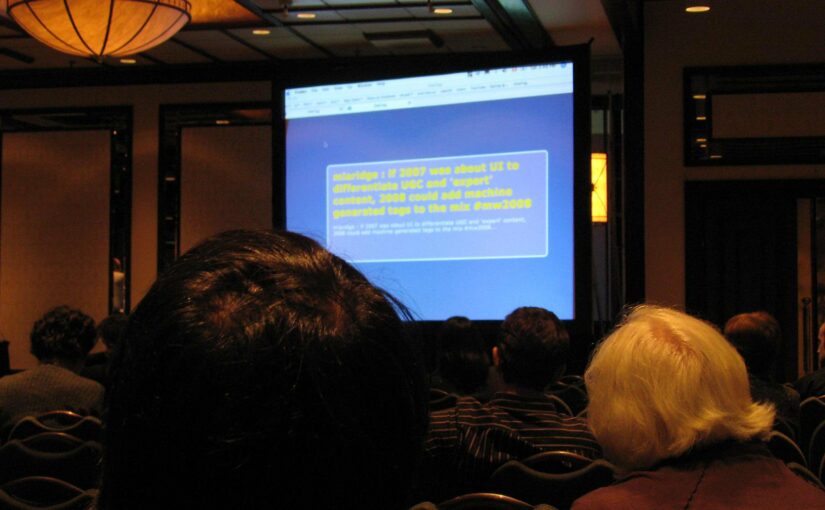
A slide projected in a 'fancy hotel'-style conference room. The text says: 'miaridge: if 2007 was about UI to differentiate UCG and 'expert' content, 2008 could add machine generated tags to the mix #mw2008'
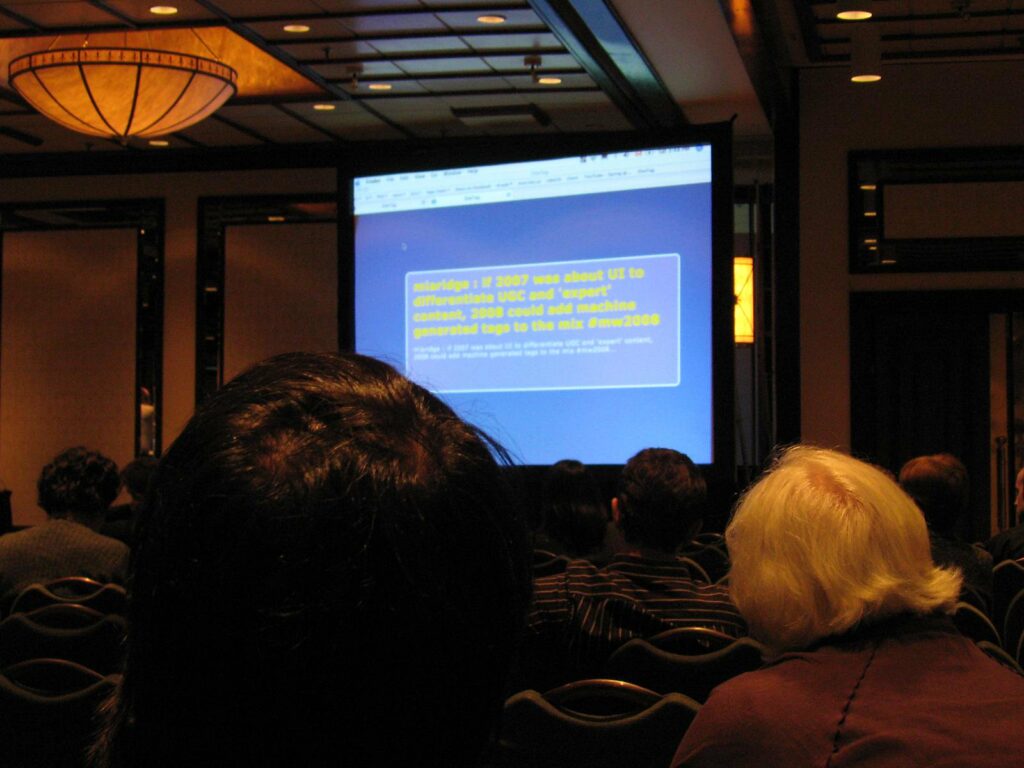
A tweet projected, the text says: 'miaridge: if 2007 was about UI to differentiate UCG and 'expert' content, 2008 could add machine generated tags to the mix #mw2008'