Notes from EuropeanaTech 2011

Some very scrappy notes from the EuropeanaTech conference held in Vienna this week as I prepare a short talk for the Open data in cultural heritage (LODLAM-London) event tonight… For a different perspective there's an overview post at EuropeanaTech – är det här framtidens kulturarv? and I'll link to any others I find.  I've also put up some photos of ten questions attendees asked about Europeana, with written answers from the break-out exercise.  I'll tidy up and post my keynote notes in a few days, and I'll probably summarise things a bit more then.

Max Kaiser: Europeana is like a cruise ship with limited room to move, hackathons inject Europeana with a bit more agility… Build real stuff for real people with real business requirements – different to building prototypes and proofs of concept – requires different project culture.

Bill Thompson: pulling the analogue past into the digital future… We don't live in a digital world and never will – the physical world is not going to vanish. We'll remain embodied minds; will have co-existing analogue and digital worlds.Digital technologies shaping the possibilities we decide to embrace. … Can't have a paradigm shift in humanities because no basic set of beliefs to argue with… But maybe the shift to digital is so fundamental that it could be called a paradigm shift. … Even if you don't engage online, you'll still live in a world shaped by the digital.  Those who are online will come to define the norms. … Revolutionary vanguard in our midst – hope lies with the programmers, the coders – the only weapon that matters is running code. Have to build on technologies that are open, only way to build diverse online culture that allows all voices to be heard. … Means open data in a usable form – properly formulated so can be interpreted by anyone or any program that wants it; integrate them into the broader cultural space. Otherwise just disconnected islands.

Two good reasons to endorse open linked data. We're the first generation that's capable of doing this – have the tools, network, storage, processes. Within our power to digitise everything and make it findable. We may also be the only generation that wants to do it – later generations will not value things that aren't visible on the screen in the same way – they'll forget the importance of the non-digital. So we'd better get on with it, and do it properly. LOD is a foundation that allows us to build in the future.

Panel discussion…

Qu: how does open theme fit with orgs with budget cuts and need to make more money?
BT: when need to make money from assets, openness is a real challenge. There are ways of making assets available to people that are unlikely to have commercial impact but could raise awareness e.g. low-res for public access, high-res for commercial use [a model adopted by many UK museums].

Jill Cousins: there's a reputational need to put decent resolution images online to counter poor quality versions online.

Max: be clever – don't make an exclusive contract with digitisation partners – make sure you can also give free access to it.
Jill Cousins: User always been central to Europeana though got slightly lost along the way as busy getting data.  …  Big stumbling block – licenses. Not just commercial reasons, also about reputational risk, loss of future earnings, fear of giving away something that's valuable in future. Without CC licence, can't publish as linked open data. Without it, commercial providers like INA can't take the API. Can't use blogs that have advertising on them. Couldn't put it on Wikipedia. Or ArtFinder.  …  New [UK?] Renaissance report – metadata related to the digitised objects by cultural heritage orgs should be widely and freely available for re-use.
Workshops with content holders: Risks – loss of quality, loss of control, attribution, brand value, potential income ('phantom income'), unwanted spillover effects – misuse/juxtaposition of data. Rwards: increasing relevance, increasing channels to end users, data enrichment, brand value, specific funding opportunties, discoverability, new customers, public mission, building expertise, desired spillover effects. … You are reliant on user doing the right thing with attribution….
Main risks: unwanted spillover effects, loss of attribution, loss of potential income. Main rewards: new customers, increasing relevance, public mission. But the risks diminshed as the rewards gain more prominence – overall outweighed the risks.  But address those 3 areas of risk.
What next? Operationalise some of the applications developed.  Yellow Kitchen Maid paper on the business of open data. Working together on difficulties faced by institutions and licensing open data.
[notes from day 2 to follow!]
Ten questions about Europeana…
10 questions (and one general question)
The general question was, what can the community building with domain experts, developers and researchers/R&D/innovation work package in Europeana 2.0 do?  (Something like that anyway, it was all a bit confusing by that point)
You had to pick a question and go into a group to try and answer it – I've uploaded photos of the answer sheets.
1 Open source – if Europeana using open source software and is open software, should it also become a community-driven development project?
2 Open source – are doubts about whether OSS provides quality services justified? What should be done to ensure quality?
3 Aggregation and metadata quality – what will be the role of aggregators, and what is role of Europeana in LOD future?
4 What can Europeana do which search engines can't that justifies the extra effort of creating and managing structured metadata?
5 Is EDM [Europeana Data Model] still too complicated? If yes, what to simplify.
6 What is the actual value of semantic contexualisation, and could that not be produced by search engines?
7 enhance experience of exploring, discovering [see photo – it was too long to type in time!]
8 How important is multilingual access for discovery in Europeana? Which elements are the most important?
9 Can Europeana drive end-user engagement on the distributed sites and services of contributing archives?
10 How can we benefit from existing (local, international) communities in enriching the user experience on Europeana?

Conference notes: Museums and Galleries Scotland's 'Collaborate to Compete'

My really quite rough-and-ready notes from Museums and Galleries Scotland's 'Collaborate to Compete' conference.  I've already posted my introductory notes for the session on 'Entrepreneurship and Social Media', so these notes are about the keynotes and the other sessions I attended.

The first speaker was Jeremy Johnson from Australia's Sovereign Hill, on 'Engaging with China: the new horizon for cultural and heritage tourism'.  He talked about their research-led marketing program aimed at getting Chinese visitors to Sovereign Hill, which included marketing work in China, hiring Chinese-speaking staff, and developing tailored tours and experiences.  They've also hosted Chinese student[?] teachers in their education department and organised touring exhibitions.  They also had to deal with talking about racism in the past treatment of Chinese Australians in Sovereign Hill – their technique is apparently to 'tell it how it was', but because Chinese Australians were 'extraordinary contributors to society' it was easy to focus on the many success stories.  In general, they've developed some experiences to meet the expectations of Chinese visitors, but still, 'the museum product has to be respected'.

Top quotes included:

  • 'you must be able to answer the question "what would make someone visit your museum?"' – there must be a compelling reason to visit
  • China is like 56 countries wrapped up into one. 'Saying you're going to China is like saying you're going to Europe'
  • 'Develop a market strategy to deliver visitor experiences at the right price'. The best marketing strategy can be undone if visitor experience does not meet the promise. Cultural awareness training essential for all staff and volunteers.
  • 'Bear in mind China isn't a democracy, not everyone gets access to Google'.

I then went to the first 'New Partnerships' seminar, where I heard lessons from the 'Curious' project at Glasgow Museums, including the possibility that 'sustainability can be about working with different people at different stages rather than the one group of people working with the museum during the whole process', and that 'people put together objects in ways that curators never would' (e.g. a ceramist put together objects from different parts of the world based on the presence of finger marks in the clay); partnership successes: mutual benefits, increased understanding, new opportunities, positive feedback; partnership challenges: managing expectations (also finding the right people to talk to), organisational structures, a draw on resources, tracking increases in visits.

In the same session, people from the 'Smart Collaborations' project talked about conceptual frameworks for collaboration, with a focus on attracting and retaining visitors within an area – it was hard to see the slides, but it seemed to be about designing experiences for tourists. The top tip was: don't be afraid to use offers, vouchers, or other deals to attract customers; and capture data when getting people in.

The plenary talk before lunch was Stuart Dempster (JISC's Strategic Content Alliance) on 'Sustaining Digital Resources' [earlier report at Business modelling and sustainability, new one will go live there next month ?]. If the digital age is a game-changer for institutions, how can bricks-and-mortar organisations not only be on the web, but of the web. What skills, licensing need to be in place? They've been looking at business models, including the effects of economic downturn and government cuts. Funded projects must deliver value to users, not just driven by curatorial concerns; a key concern is how to generate new forms of income with integrity.

Tips for communicating value to adminstrators: have a seat at the table whenever decisions are made about digital resources; engage administrators early to develop shared sense of responsibility for the project; have an advocacy campaign with users outside the institution so you've got voices of support when needed; identify different types of stakeholders and work appropriately with each – identify champions if you can.  Sustainable projects: empower leadership to define the mission and take action; create a strong value proposition; creatively manage costs; cultivate diverse sources of revenue; have a system of accountability.  Collaborations need consensus, communication, capacity, trust, metrics…

After lunch, Alphonse Umulisa, Director General of The Institute of National Museums of Rwanda spoke on 'Repositioning Cultural Tourism'. Previously at the Museum of London, his job is to raise awareness about Rwanda's history and heritage sites – difficult when Rwanda's history is so painful. They're trying to look forward to the future, and forget the past, but even knowing where to start was hard.  He said you can't learn history in schools in Rwanda – it's not taught – but you can learn Rwandan history in museums. The museums had to change from research institutions to learn how to attract tourists, and they had to get Rwandans visiting museums again. His talk was both utterly humbling – the Rwandan government's vision for 2020 is for every family to have a cow – and inspiring – his motto is: 'discover your museums, cherish your heritage'.

Tony Butler has posted his own notes from his inspiring talk on how the Museum of East Anglian Life transformed itself from a failing organisation to a thriving enterprise, and about his aim to make it a participative institution, a space for co-creation or to help people look at the world differently and to place the museum in the rhythm of daily life.

After my session on 'Entrepreneurship and Social Media', I went to a workshop on 'Smarter Museums' with Anne Murch (who prefers the concepts of resilience or entrepreneurship to 'sustainability').  The workshop covered the principles of a 'thinking environment': appreciation, attention, equality, incisive questions. We did a really interesting (and at first, challenging) exercise in pairs, where you had to either just listen, or just talk, for three minutes, before swapping with your partner.  It's hard – if you're meant to be listening, you want to encourage the person talking, or if you're talking, you want to stop and let the other person have a go.  We did it again later, and it was much easier.  We were also asked to consider "if we knew that together we can have a thriving museum that provides the very best experience for our visitors, what would the org look and feel like? What is the shift we need to make to deliver this?", and the importance of diversity as both the identity of the people that are shaping the future plans and the ideas that are generated. A team that takes a 'diagonal slice' across and down through the museum can be effective – the people with least power are often most creative and least encumbered. Another suggestion for better meetings was to frame each agenda item as a question.

The event closed with the launch of the National Strategy Consultation by Fiona Hyslop, Scottish Cabinet Secretary for Cultural & External Affairs National Strategy Consultation, with a speech that was a lovely celebration of the contribution of museums and cultural heritage to Scottish life.  The document itself outlines the context, guiding principles, vision, themes and objectives of the proposed sector consultation process, which will lead to the national strategy for Scotland’s Museums and Galleries.  (Interestingly, Australia is also running a 'Digital Culture Public Sphere' consultation for input into National Cultural Policy.)

'Entrepreneurship and Social Media' and 'Collaborating to Compete'

[Update: I hope the presentations from the speakers are posted, as they were all inspiring in their different ways.  Bristol City Council's civic crowdsourcing projects had impressive participation rates, and Phil Higgins identified the critical success factors as: choose the right platform, use it at the right stage, issue must be presented clearly. Joanne Orr talked about museum contexts that are encapsulating the intangible including language and practices (and recording intangible cultural heritage in a wiki) and I could sense the audience's excitement about Andrew Ellis' presentation on 'Your Paintings' and the crowdsourcing tagger developed for the Public Catalogue Foundation.]

I'm in Edinburgh for the Museums Galleries Scotland conference 'Collaborating to Compete'. I'm chairing a session on 'Entrepreneurship and Social Media'. In this context, the organisers defined entrepreneurship as 'doing things innovatively and differently', including new and effective ways of working. This session is all about working in partnerships and collaborating with the public. The organisers asked me to talk about my own research as well as introducing the session. I'm posting my notes in advance to save people having to scribble down notes, and I'll try to post back with notes from the session presentations.

Anyway, on with my notes…

Welcome to this session on entrepreneurship and social media. Our speakers are going to share their exciting work with museum collections and cultural heritage.  Their projects demonstrate the benefits of community participation, of opening up to encourage external experts to share their knowledge, and of engaging the general public with the task of improving access to cultural heritage for all.  The speakers have explored innovative ways of working, including organisational partnerships and low-cost digital platforms like social media.  Our speakers will discuss the opportunities and challenges of collaborating with audiences, the issues around authority, identity and trust in user-generated content, and they'll reflect on the challenges of negotiating partnerships with other organisations or with 'the crowd'.

You'll hear about two different approaches to crowdsourcing from Phil Higgins and Andy Ellis, and about how the 'Intangible Cultural Heritage' project helps a diverse range of people collaborate to create knowledge for all.

I'll also briefly discuss my own research into crowdsourcing through games as an example of innovative forms of participation and engagement.

If you're not familiar with the term, crowdsourcing generally means sharing tasks with the public that are traditionally performed in-house.

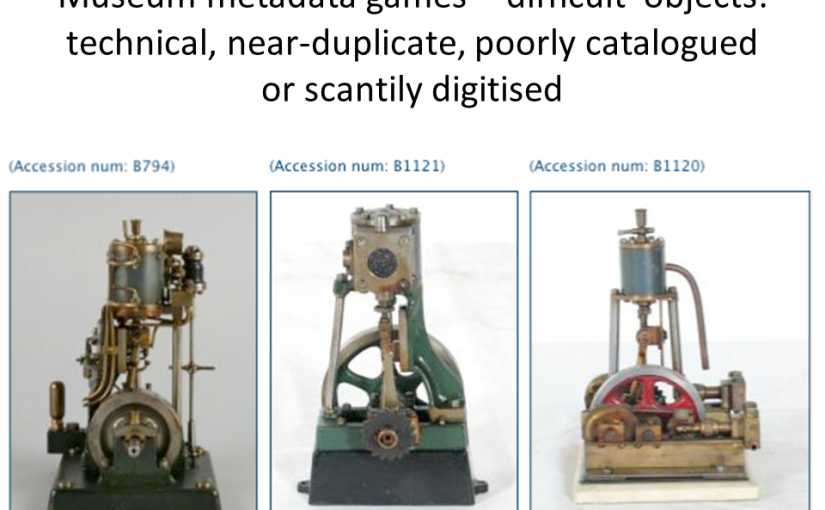
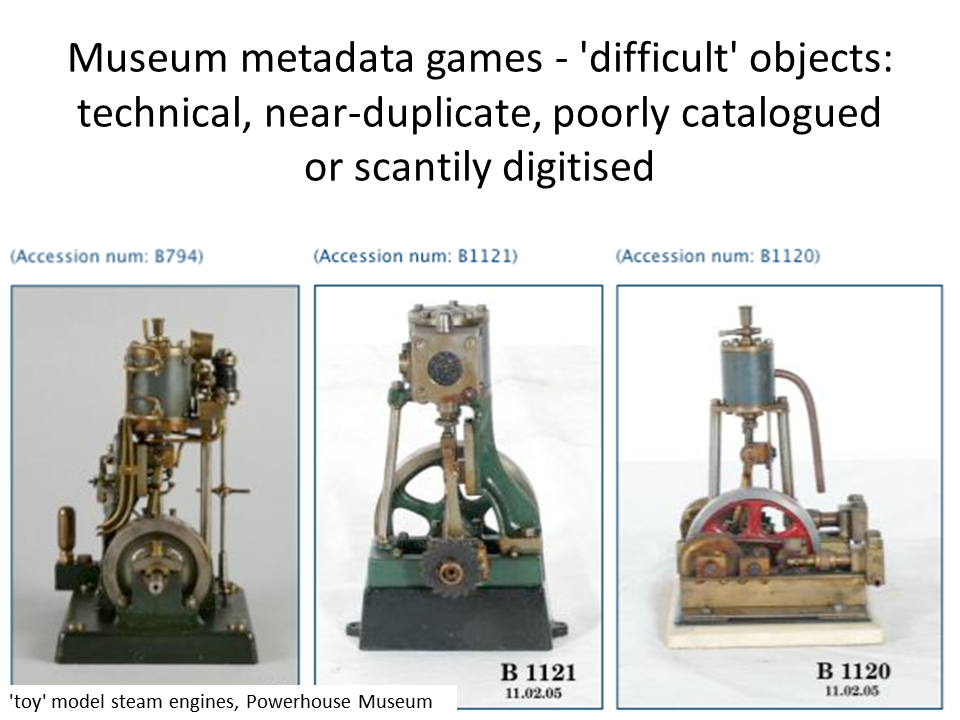
Until I left to start my PhD, I worked at the Science Museum in London, where I spent a lot of time thinking about how to make the history of science and technology more engaging, and the objects related to it more accessible. This inspired me when I was looking for a dissertation project for my MSc, so I researched and developed 'Museum Metadata Games' to explore how crowdsourcing games could get people to have fun while improving the content around 'difficult' museum objects.

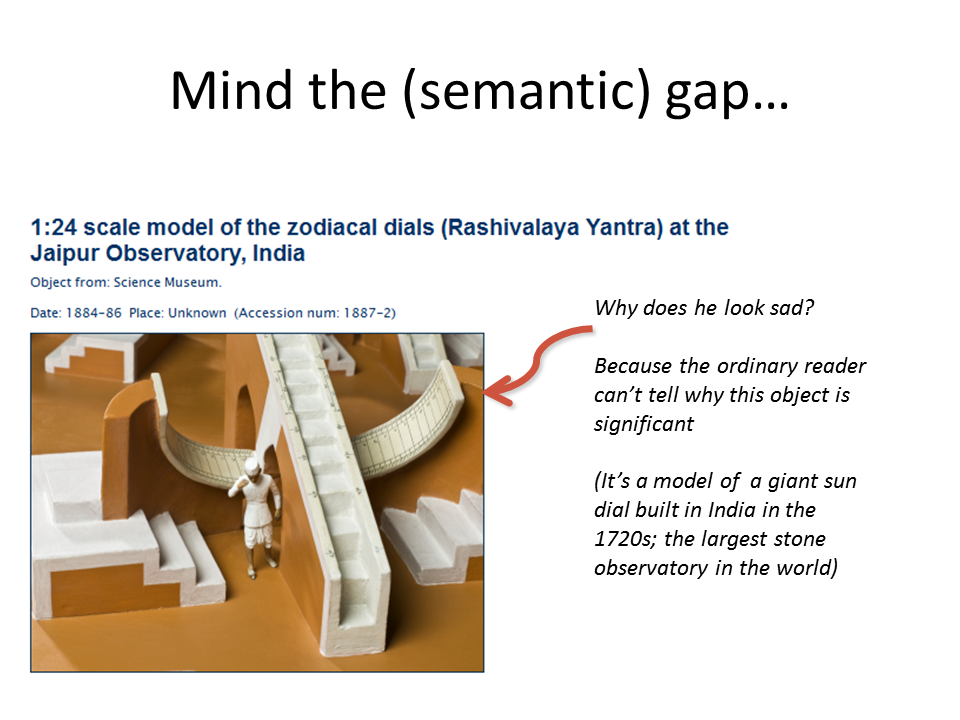
Unfortunately (most) collections sites are not that interesting to the general public. There's a 'semantic gap' between the everyday language of the public and the language of catalogues.

Projects like steve.museum showed crowdsourcing helps, but it can be difficult to get people to participate in large numbers or over a long period of time. Museums can be intimidating, and marketing your project to audiences can be expensive. But what if you made a crowdsourcing interface that made people want to use it, and to tell their friends to use it? Something like… a game?

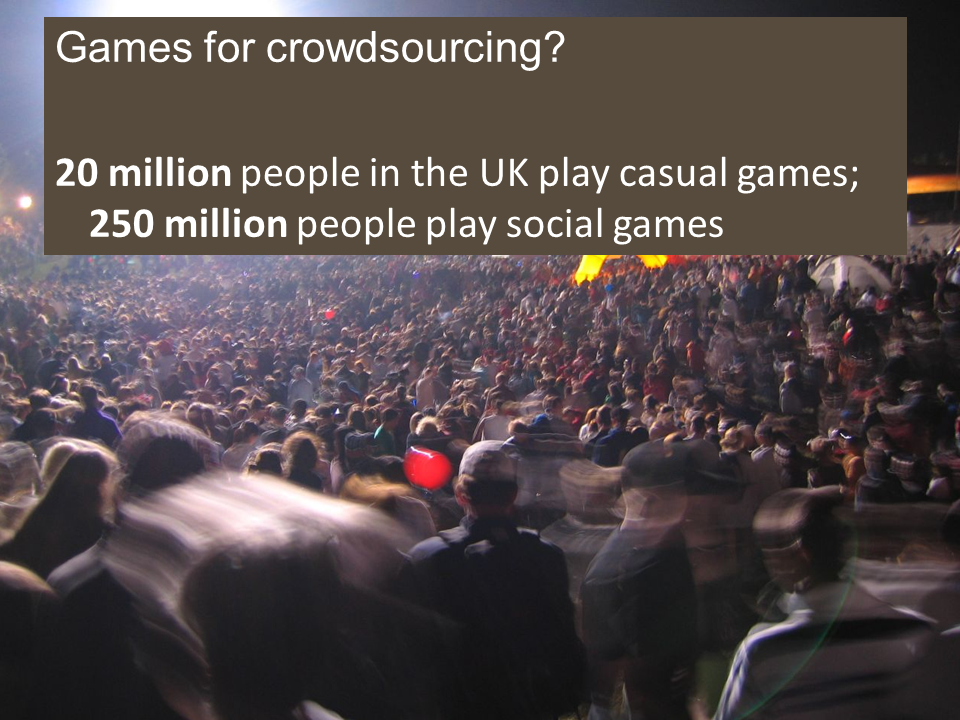
A lot of people play games… 20 million people in the UK play casual games. And a lot of people play museum games. Games like the Science Museum's Launchball and the Wellcome Collection's High Tea have had millions of plays.

Crowdsourcing games are great at creating engaging experiences. They support low barriers to participation, and the ability to keep people playing. As an example, within one month of launching, DigitalKoot, a game for National Library of Finland, had 25,000 visitors complete over 2 million individual tasks.

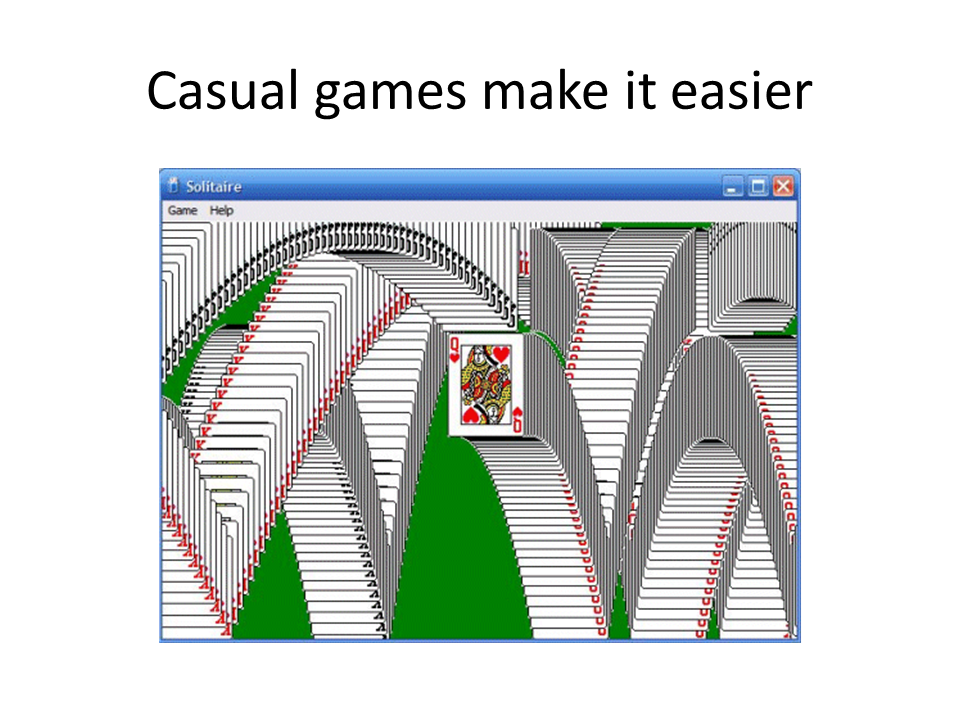
Casual game genres include puzzles, card games or trivia games. You've probably heard of Angry Birds and Solitaire, even if you don’t think of yourself as a 'gamer'.

Casual games are perfect for public participation because they're designed for instant gameplay, and can be enjoyed in a few minutes or played for hours.

Easy, feel-good tasks will help people get started. Strong game mechanics, tested throughout development with your target audience, will motivate on-going play and keep people coming back.

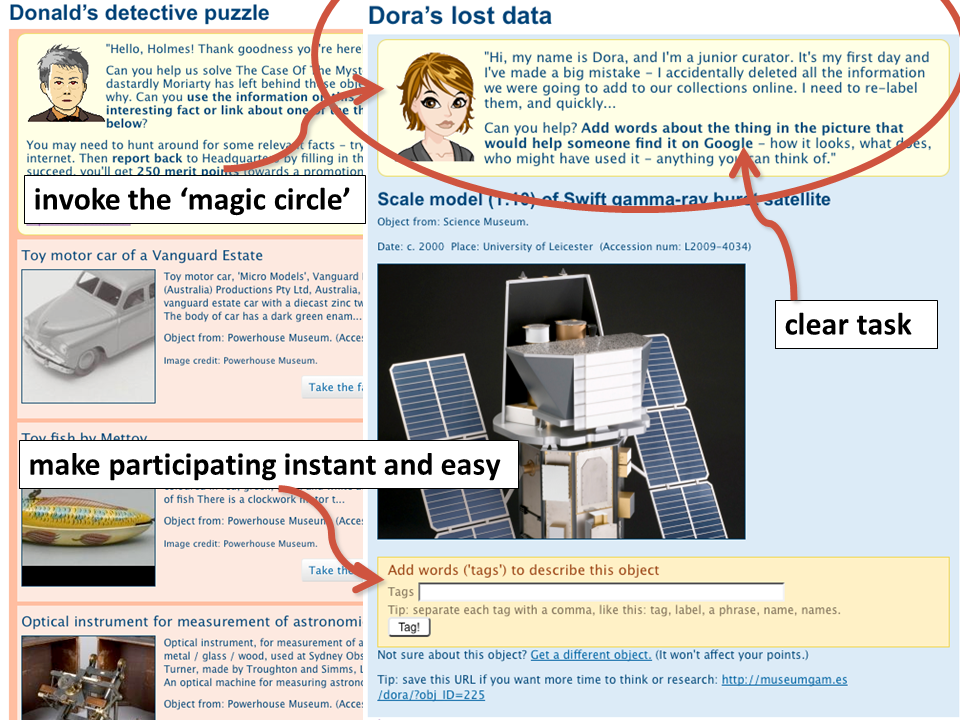
Here’s a screenshot of the games I made.

In the tagging game 'Dora's lost data', the player meets Dora, a junior curator who needs their help replacing some lost data. Dora asks the player to add words that would help someone find the object shown in Google.

When audiences can immediately identify an activity as a game – in this the use of characters and a minimal narrative really helped – their usual reservations about contributing content to a museum site disappear.

The brilliant thing about game design is that you can tailor tasks and rewards to your data needs, and build tutorials into gameplay to match the player’s skills and the games’ challenges.

Fun is personal – design for the skills, abilities and motivations of your audience.

People like helping out – show them how their data is used so they can feel good about playing for a few minutes over a cup of tea.

You can make a virtue of the randomness of your content – if people can have fun with 100 historical astronomy objects, they can have fun with anything.

To conclude, crowdsourcing games can be fun and useful for the public and for museums. And now we're going to hear more about working with the public… [the end!]

The rise of the non-museum (and death by aggregation)

A bit of an art museum/gallery-focussed post… And when I say 'post', I mean 'vaguely related series of random thoughts'… but these ideas have been building up and I might as well get them out to help get them out of 'draft'.

Following on from various recent discussions (especially the brilliantly thought-provoking MCG's Spring meeting 'Go Collaborate') and the launches over the past few months of the Google Art Project, Artfinder and today's 'Your Paintings' from the BBC and the Public Catalogue Foundation, I've been wondering what space is left for galleries online.  (I've also been thinking about Aaron's "you are about to be eaten by robots" and the image of Google and Facebook 'nipping at your heels' to become 'the arbiter of truth for ideas' and the general need for museums to make a case for their special place in society.)  Between funding cuts on the one hand, and projects from giants like Google and the BBC and even Europeana on the other, what can galleries do online that no-one else can?

So I asked on twitter, wondering if the space that was left was in creating/curating specialist interest and/or local experiences… @bridgetmck responded "Maybe the space for museums to work online now is meaning-making, intellectual context, using content to solve problems?"  The idea of that the USP of an museum is based on knowledge and community rather than collections is interesting and something I need to think about more.

The twitter conversation also branched off into a direction I've been thinking about over the past few months – while it's great that we're getting more and more open content [seriously, this is an amazing problem to have], what's the effect of all this aggregation on the user experience?  @rachelcoldicutt had also been looking at 'Your Paintings' and her response was to my 'space' question was: "I think the space left is for curation. I feel totally overwhelmed by ALL THOSE paintings. It's like a storage space not a museum".  She'd also just tweeted "are such enormous sites needed when you can search and aggregate? Phaps yes for data structure/API, but surely not for *ppl*" which I'm quoting because I've been thinking the same thing.

[Update 2, July 14: Or, as Vannevar Bush said in 'As We May Think' in 1945: "There is a new profession of trail blazers, those who find delight in the task of establishing useful trails through the enormous mass of the common record."]

Have we reached a state of 'death by aggregation'?  Even the guys at Artfinder haven't found a way to make endless lists of search results or artists feel more like fun than work.

Big aggregated collections are great one-stop shops for particular types of researchers, and they're brilliant for people building services based on content, but is there a Dunbar number for the number of objects you can view in one sitting?  To borrow the phrase Hugh Wallace used at MuseumNext, 'snackable' or bite-sized content seems to fit better into the lives of museum audiences, but how do we make collections and the knowledge around them 'snackable'?  Which of the many ways to curate that content into smaller sets – tours, slideshows, personal galleries, recommender systems, storytelling – works in different contexts?  And how much and what type of contextual content is best, and what is that Dunbar number?  @benosteen suggested small 'community sets' or "personal 'threads'" – "interesting people picking 6->12 related items (in their opinion) and discussing them?".  [And as @LSpurdle pointed out, what about serendipity, or the 'surprising beauty' Rachel mentioned?]

I'm still thinking it all through, and will probably come back and update as I work it out.  In the meantime, what do you think?

[Update: I've only just remembered that I'd written about an earlier attempt to get to grips with the effects of aggregation and mental models of collections that might help museums serve both casual and specialist audiences in Rockets, Lockets and Sprockets – towards audience models about collections? – it still needs a lot of thought and testing with actual users, I'd love to hear your thoughts or get pointers to similar work.]

'Share What You See' at hack4europe London

A quick report from hack4europe London, one of four hackathons organised by Europeana to 'showcase the potential of the API usage for data providers, partners and end-users'.

I have to confess that when I arrived I wasn't feeling terribly inspired – it's been a long month and I wasn't sure what I could get done at a one-day hack.  I was intrigued by the idea of 'stealth culture' – putting cultural content out there for people to find, whether or not they were intentionally looking for 'a cultural experience' – but I couldn't think of a hack about it I could finish in about six hours.  But I happened to walk past Owen Stephen's (@ostephens) screen and noticed that he was googling something about WordPress, and since I've done quite a lot of work in WordPress, I asked what his plans were.  After a chat we decided to work together on a WordPress plugin to help people blog about cool things they found on museum visits.  I'd met Owen at OpenCulture 2011 the day before (though we'd already been following each other on twitter) but without the hackday it's unlikely we would have ever worked together.

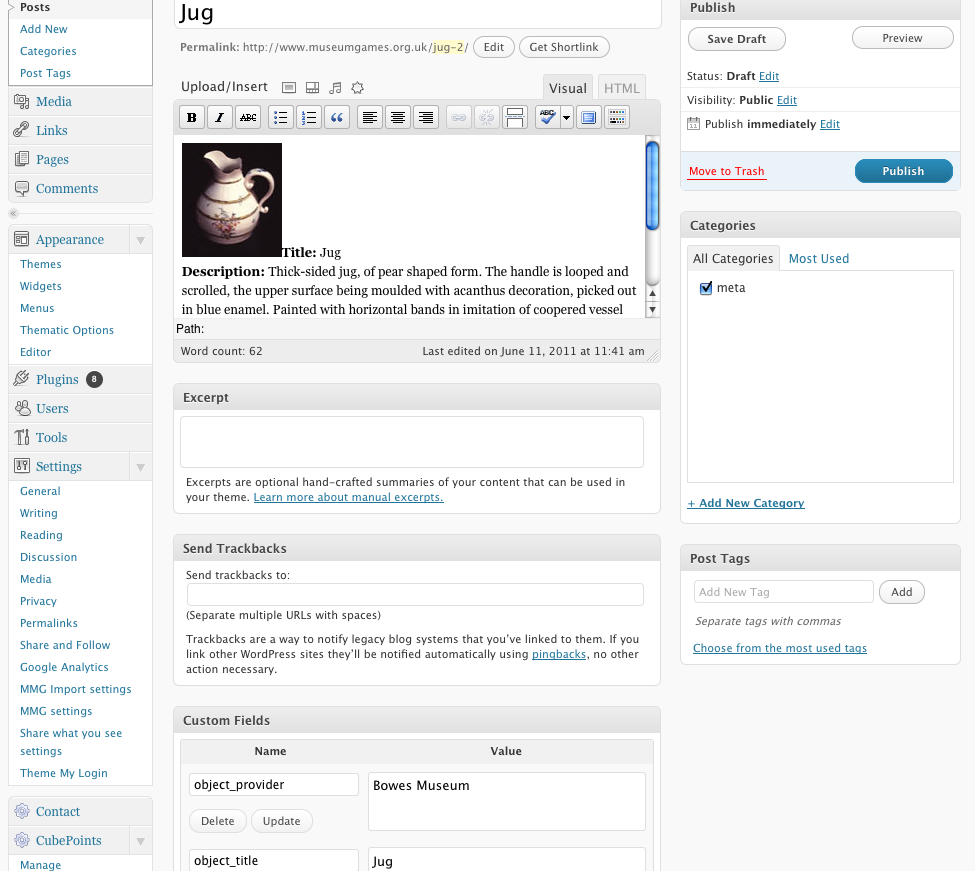
So what did we make?  'Share What You See' is a plugin designed to make a museum and gallery visit more personal, memorable and sociable.  There's always that one object that made you laugh, reminded you of friends or family, or was just really striking.  The plugin lets you search for the object in the Europeana collection (by title, and hopefully by venue or accession number), and instantly create a blog post about it (screenshot below) to share it with others.

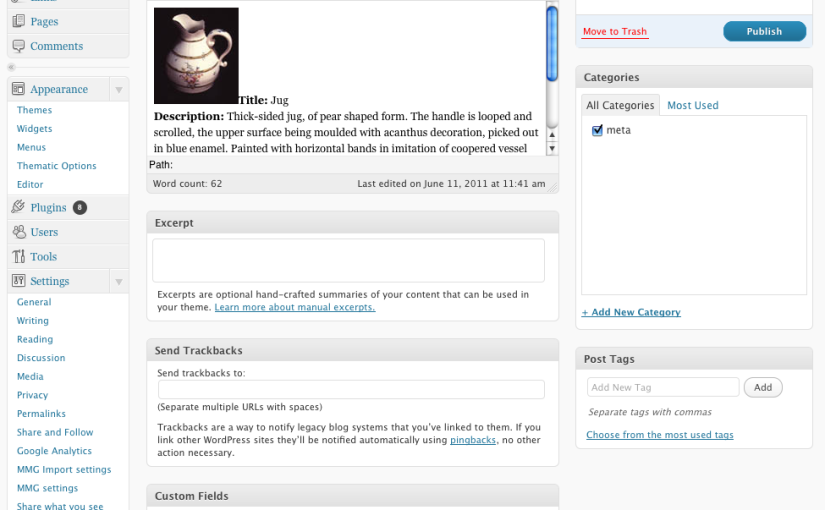
Screenshot: post pre-populated with information about the object. 

Once you've found your object, the plugin automatically inserts an image of it, plus the title, description and venue name.

You can then add your own text and whatever other media you like.  The  plugin stores the originally retrieved information in custom fields so it's always there for reference if it's updated in the post.  Once an image or other media item is added, you can use all the usual WordPress tools to edit it.

If you're in a gallery with wifi, you could create a post and share an object then and there, because WordPress is optimised for mobile devices.  This help makes collection objects into 'social objects', embedding them in the lives of museum and gallery visitors.  The plugin could also be used by teachers or community groups to elicit personal memories or creative stories before or after museum visits.

The code is at https://github.com/mialondon/Share-what-you-see and there's a sample blog post at http://www.museumgames.org.uk/jug/.  There's still lots of tweaks we could have made, particularly around dealing with some of the data inconsistencies, and I'd love a search by city (in case you can't quite remember the name of the museum), etc, but it's not bad for a couple of hours work and it was a lot of fun.  Thanks to the British Library for hosting the day (and the drinks afterwards), the Collections Trust/Culture Grid for organising, and Europeana for setting it up, and of course to Owen for working with me.  Oh, and we won the prize for "developer's choice" so thank you to all the other developers!

Define your purpose or others will define you (and you may not like the results)

[A re-post, as the blogger outage seems to have eaten the first version. I'm incredibly grateful to Ben W. Brumfield @benwbrum for sending me a copy of the post from his RSS reader. I've set blogger up to email me a copy of posts in future so I won't have to go diving into my Safari cache to try and retrieve a post again!]

There's a lot of this going around as the arts and cultural heritage face on-going cuts: define yourself, or be defined, a search for a new business model that doesn't injure the unbusinesslike values at the core of public cultural institutions. Mark Ravenhill in the Guardian, Global art: nice canapes, shame about the show:

Many of our UK institutions operate under a strange contradiction: most of the signals we give out suggest that we offer the international glamour, the pampering loveliness, the partnerships with banks and brands… But at the same time, we agonise about access: we want everyone to be let into the business lounge.

In a modern world that buys and sells information and luxury, the arts deal in something very different: wisdom, a complex, challenging, lifelong search that can make you happy and furious, discontented and questioning, elated or bored.

What we need now, more than ever, is a clear message about what we do and why we do it. The government has opted for swift deficit reduction and a good hack at the arts: it's up to us to set the long-term agenda for the role of the arts in public life over the next decade and beyond if we're not going to be cut, cut and cut again. Boom and bust are here to stay: capitalism will always be in a permanent state of crisis.

Nick Poole has also written on A New Way Forward for Museums, saying:

It is entirely possible to be commercially savvy, operate sharply and make sophisticated uses of licensing as an artefact of control all in the name of serving a public cultural purpose. Equally, it is possible to throw open the doors and make content universally accessible in the name of driving commercial value to the bottom-line. The cultural and commercial imperatives are not in opposition, but coexist along a spectrum of activity which runs from non-commercial, through non-transactional (things like brand equity and audience engagement) to strictly financially transactional.

If the financial future of museums lies in becoming commercially acute, then a key part of true sustainability will lie in recognising our place in the supply-chain of culture to consumers, and in truly understanding and embracing our core competence and their value.

…we need to recognise that focussing on our core competencies and using them to create cultural assets and experiences which we can monetise (and therefore sustain) in partnership with the private sector is a story of success and advantage, not failure or loss.

His post has some interesting suggestions, so do go read it (and comment).

Nick also describes a vision "of a world in which museums have renegotiated the social contract with the public so that people everywhere understand that museums are places where culture is made and celebrated, rather than preserved and hidden from view" – it's easy, in my happy little bubble, to forget that many people don't see the point of museums. Some I've talked to might make an allowance for the big national institutions, but won't have any time for smaller or local museums. Working out how to deal with this might mean changing the public offer of these museums – or is it too late? There's a silent cull of museums happening in the UK right now, and yet I don't hear about big campaigns to save them. What do you think?

Thoughts towards the future of museums for #kulturwebb

Last week I was in Stockholm to give a talk on 'Museum Crowdsourcing Games: Improving Collections Through Play (and some thoughts on re-inventing museums)'.  Again, my thanks to @kajsahartig and @nordiskamuseet for the invitation to speak, and to all the lovely people I met for sharing their own stories with me, and for listening to a talk in English. The quote of the day came from @charlotteshj during a panel discussion on museums and innovation at the end of the day: digital museum collections should be 'shareable, spreadable and nerd-friendly'.

Based on what I learnt about the audience I ended up including more explanatory material on museum crowdsourcing games and didn't really have time for the 're-inventing museums' bits, so I thought I'd share those notes here.  It's still very much a work-in-progress but since there are so many smart people thinking about the same subject, it's worth sharing for comment… (Also because Jasper Visser, who is also thinking about the future of museums, asked me what I was going to say. Btw, Jasper's #kulturwebb talk inspired the whole room, watch the video on his post about it.)

I know the future of museums lies in fitting into people's lives as well as being a destination; being the cathedral and being in the bazaar. Cultural heritage needs to be 'out there' to help people value and make time for visits the physical place.  It's about new types of engagement and outreach. It's not all digital, but as the world is networked and mobile and social, we should be too.

I was thinking about new metaphors for museums – what if we were Amazon? A local newspaper? A specialist version of Wikipedia? A local pub? A student blog? A festival, a series of lectures, or a film group? A pub quiz? Should a museum be at the heart of village life, a meeting place for art snobs, a drop-in centre, a café, a study space, a mobile showroom?

But I realised that the answer to the question of the future of museums is deeply personal to any museum, because museums exist in the intersection of their collections, their fans and their local audiences. This is good, because it means you can apply your existing knowledge about what your audiences love about you.  The answer to the question 'what would your museum be if it was invented in 2011?' is up to you…

Every time I approach the question of the future of museums, or of how the future of museums will be informed by what's happening the world today, I seem to come at it from a different angle. Today I'm wondering about the implications of the fact that there are no (g-rated) offline activities anymore – people will do almost anything with their mobile in one hand, and could be doing anything from googling to find out more about the museum object in front of them to looking up the lyrics of that one-hit wonder from that summer they went camping with friends.  Their head could be in any space as well as in your space.

I'm also thinking about outreach, whether improving wikipedia articles, snippets of local history on the back of pub toilet doors or putting a museum exhibition in a truck and taking it to kids in the outer suburbs.  Tomorrow I'll wake up with some new 'what if?' in my head. And I'm curious – what are you thinking about the future of museums?

Thinking aloud: does a museum's obsession with polish hinder innovation?

I'm blogging several conversations on twitter around the subject of innovation and experimentation that I thought were worth saving, not least because I'm still thinking about their implications.

To start with, Lynda Kelly (@lyndakelly61) quoted @sebchan at the Hot Science conference on climate change and museums:

'Museums want everything to be slick and polished for mass audience, we lose capacity to be experimental and rapid'

 which lead me to tweet:

'does big museum obsession with polish hinder innovation? ('innovation' = keeping up with digital world outside)'.

which lead to a really interesting series of conversations.  Erin Blasco responded (over several tweets):

We can't pilot if it's not perfect. … Need to pilot 15 quick/dirty QR codes but we can't put ANY up unless there are 50 & perfectly, expensively designed & impressive. … So basically not allowed to fail and learn = not allowed to pilot = we spend a bunch of $ and fail anyway? … To clarify: it's a cross-dept project. One dept ok with post-it notes & golf pencils. Two others are not. Kinda deadlock.

I think this perfectly illustrates the point and it neatly defines the kind of 'polish' that slows things down – the quality of the user experience with the QR codes would rest with the explanatory text, call to action and the content the user finds at the other end, not the weight and texture of the paper or vinyl they're printed on.  Suddenly you've got extra rounds of emails and meetings for those extra layers of sign-off, a work request or contract for design time, plus all the stakeholder engagement that you already, but does that extra investment of time and resources result in a better experiment in audience research?

But kudos to Erin for gettings things this far!  (An interesting discussion followed with Erin and @artlust about possible solutions, including holding stakeholder evaluations of the prototypes so they could see how the process worked, and 'making the pilot-ness of it a selling point in the design, letting audiences feel they're part of something special', which made me realise that turning challenges into positives is one of my core design techniques.)

For Linda Spurdle, the barriers are more basic:

Innovation costs, even my plans to try things cheap/free get scuppered by lack of time. For me less about risk more about resources

Which also rings perfectly true – many potential museum innovators were in this position before the museum funding cuts took hold, so innovating your way out of funding-related crises must be even more difficult now.

On the topic of innovation, Lindsey Green said the 'definite reluctance to pilot and fail impacts innovation'. Rachel Coldicutt had just blogged about 'digital innovation in the arts' in Making Things New, pointing out that the question 'privileges the means of delivery over the thing that’s being delivered', and tweeting that 'innovating a system and innovating art aren't the same thing and perhaps there's more impact from innovating the system'.

If the quest is to, as Rachel problematises in her post, 'use digital technologies to remake the Arts Establishment', then (IMO) it's doomed to failure. You can't introduce new technologies and expect that the people and processes within a cultural organisation will magically upgrade themselves to match. More realistically, people will work around any technology that doesn't suit them (for entirely understandable reasons), and even the best user experience design will fail if it doesn't take account of its context of use. If you want to change the behaviour of people in an organisation, change the metrics they work to. Or, as Rachel says, '[r]ather than change for change’s sake, perhaps we should be identifying required outcomes'.  Handily, Bridget McKenzie pointed out that 'The Museums for the Future toolkit includes new eval framework (GEOs = Generic Environmental Outcomes)', so there's hope on the horizon.

The caveats: it's not that I'm against polish, and I think high production values really help our audiences value museum content. But – I think investing in a high level of polish is a waste of resources during prototyping or pilot stages, and a focus on high production values is incompatible with rapid prototyping – 'fail faster' becomes impossible. Usability researchers would also say polished prototypes get less useful feedback because people think the design is set (see also debates around the appearance of wireframes).

It's also worth pointing out my 'scare quotes' around the term 'innovation' above – sadly, things that are regarded as amazing innovations in the museum world are often delayed enough that they're regarded as pretty normal, even expected, by our more digitally-savvy audiences. But that's a whole other conversation…

So, what do you think: does a museum's obsession with polish hinder innovation?

Update, January 2013: Rob Stein has written 'Museum Innovation: Risk, Experimentation and New Ideas', which resonated strongly:

A common pitfall for museums is an unhealthy addiction to monumental undertakings. When massive projects loom with ties to outside support and countless staff hours invested in a single deliverable, it becomes very difficult to admit the possibility of failure. As a result, we shy away from risk, mitigate the probability of embarrassment, and crush innovation in the process.

Sharing hard-won wisdom about museum games – introducing 'Lift your (museum) game'

One outcome from MW2011 was the creation of 'Lift your (museum) game', a site for people who make museum games to share their hard-earned wisdom – project evaluation, research, references, methods, rants, lessons learnt from real projects – about making museum games.  Inspired by a question from Martha Henson about whether any sites already existed to gather resources like those discussed during the panel discussion after the Games session at Museums and the Web 2011 (with Dave Schaller, Elizabeth Goins and Coline Aunis), I created the wiki during the closing plenary and watched in awe as Kate Haley Goldman immediately started populating it with links.
Museum games have to compete in a highly competitive market, especially for casual and social games, and I suspect 'worthy' will only take us so far these days.  I'm hoping the dialogue around this site will help people avoid the pitfalls of 'death by museum committee' when designing games and push for excellent gameplay in museum games.  There are some great museum game projects and research going on, and pooling resources could help multiply the benefits of that work and provide a resource for people just starting out.  Also, if you're a games agency or designer, this could be a great place to pass on any tips or links (or warnings) you'd like potential museum clients to know about.  I've got a few papers on crowdsourcing games for museums coming up, so I'll be adding links and resources as I go – it's easy to add your resources or questions, just sign up at http://museumgames.pbworks.com.
One of the key themes of MW2011 for me was 'standing on the shoulders of giants' – there's so much good work going on in the museum digital sector, and so many amazing people are willing to share what they've learnt along the way, and hopefully this museum games wiki is a contribution to helping us all see further and do better.

Founding visions (and learning from the past for the future of museums)

I've got a few presentations coming up that explore a re-imagining of museums, so I've been thinking about the original founding visions of specific museums (based on e.g. What would a digital museum be like if there was never a physical museum?), and whether there's dissonance between mission statements based in institutional history and those you might write if we were inventing museums today.

For an example of where my thoughts are wondering, check this out (from the excellent 'Museums should not fear the art snobs'):

…it was only with the emergence of aestheticism and competition from universities in the late 19th century that curators started making exhibitions for each other and for people of their class. Most earlier Victorian museums were educational institutions (not just institutions with education departments). In Britain, both the Liberal Henry Cole (founding Director of the V&A) and the Tory John Ruskin created museums that aimed to achieve the widest possible audience in the name of public education. The Met was founded “for the purpose…of encouraging and developing the study of the fine arts, and the application of arts to manufacture and practical life…and, to that end, of furnishing popular instruction.” In 1920, the Met’s president Robert de Forest wrote that it was “a public gallery for the use of all people, high and low, and even more for the low than for the high, for the high can find artistic inspiration in their own homes”.

So I'm curious, and if you're up for it, I have a little task for you (yes, you, over there) – what was the founding statement for your museum, and what is your current mission statement? And if you're feeling creative, what would you like your favourite museum's mission statement to be?