How things change: the Google Art Project (again)

The updated Google Art Project has been launched with loads more museums contributing over 30,000 artworks.  The interface still seems a bit sketchy to me (sometimes you can open links in a new tab, sometimes you can't; mystery meat navigation; the lovely zoom option isn't immediately discoverable; the thumbnails that appear at the bottom don't have a strong visual connection with the action that triggers their appearance; and the only way I could glean any artist/title information about the thumbnails was by looking at the URL), but it's nice to see options for exploring by collection (collecting institution, I assume), date or artist emphasised in the interface. 

Anyway, it's all about the content – easy access to high-quality zoomable images of some of the world's best artworks in an interface with lots of relevant information and links back to the holding institution is a win for everyone.  And if the attention (and traffic) makes museums a little jealous, well, it'll be fascinating to see how that translates into action.  After all, keeping up with the Joneses seems to be one way museums change…

Reading some online stories about the launch, I was struck by how far conversations about traditional and online galleries have come.  From one:

As users explore the galleries they can also add comments to each painting and share the whole collection with friends and family. Try doing that in the Tate Modern. Actually, don’t.

Although, of course, you can – it's traditionally known as 'having a conversation in a museum'. 
But in 2012, is visiting a website and sharing links online seen as a reasonable stand-in for the physical visit to a museum, leaving the in-person gallery visit for 'purists' and enthusiasts?  (This might make blockbuster exhibtions bearable.)  Or, as the consensus of the past decade has it, does it just whet the appetite and create demand for an experience with the original object, leading to more visits?

Sunrise to sunset on the day of digital humanities

[I've copied my post from the official Day of DH ('A Day of the Life of the Digital Humanities') 2012 site so it can be integrated with my other posts on digital humanities and general blogging.]

Gumtrees in carparks. Just one of the things I miss about Australia.

I feel like a bit of a cheat, as through an accident of timing my Day of Digital Humanities has been far, far more glamorous than my usual working day (which tends to involve sitting at a desk in Oxford or Milton Keynes analysing websites; reading books, blog posts and articles; or interviewing people for my PhD).

But today I happened to be in Australia so it was all a bit more exciting…  I left for Sydney’s Central station as the sun was rising, heading for the 8am bus to Canberra. On the bus I tidied my Digital Humanities Australasia 2012 (DHA2012) conference paper and slides for tomorrow’s presentation on historians and crowdsourcing, and wrote a blog post about the week just past (Geek for a week: residency at the Powerhouse Museum).

After checking into my room at the ANU (Australian National University), I scanned my email for anything vital, uploaded my draft blog post and hit publish, then tweeted the link as I headed over to the National Museum of Australia where I was taking part in a playtest for a new game called Sembl.

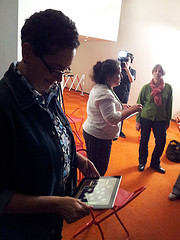
photo
Play-testing Sembl on iPads

After the playtest was over we walked back to the ANU campus for a DHA2012 drinks reception and a LODLAM (linked open data in libraries, archives and museums) mini-bar meetup. An early night for me so I’m sorted for the first day of DHA2012 tomorrow!

Defining Digital Humanities
I was asked to define ‘digital humanities’ when I signed up for this site, came as a bit of a surprise and I don’t think I did a terribly good job. So here’s another, very personal definition based on my work in digital history and digital heritage:

Digital humanities is thinking through making, as well as writing… for me, it’s currently about thinking critically about the impact of digitality on scholarly practice in addition to applying digital techniques to the concerns of the humanities.

Geek for a week: residency at the Powerhouse Museum

I've spent the last week as 'geek-in-residence' with the Digital, Social and Emerging Technologies team at the Powerhouse Museum. I wasn't sure what 'geek-in-residence' would mean in reality, but in this case it turned out to be a week of creativity, interesting constraints and rapid, iterative design.

When I arrived on Monday morning, I had no idea what I'd be working on, let alone how it would all work. By the end of the first day I knew how I'd be working, but not exactly what I'd focus on. I came in with fresh questions on Tuesday, and was sketching ideas by lunchtime. The next few days were spent getting stuck into wireframes to focus in on specific issues within that problem space; I turned initial ideas into wireframes and basic copy; and put that through two rounds of quick-and-dirty testing with members of the public and Powerhouse volunteers. By the time I left on Friday I was able to handover wireframes for a site called 'conversations about collections' which aims to record people's memories of items from the collection. (I ran out of time to document the technical aspects of how the site could be built in WordPress, but given the skills of the team I think they'll cope.)

The first day and a half were about finding the right-sized problem. In conversations with Paula (Manager of the Visual & Digitisation services team) and Luke (Web Manager), we discussed what each of us were interested in exploring, looking for the intersection between what was possible in the time and with the material to hand.

After those first conversations, I went back to Powerhouse's strategy document for inspiration. If in doubt, go back to the mission! I was looking for a tie-in with their goals – luckily their plan made it easy to see where things might fit. Their strategy talked about ideas and technology that have changed our world and stories of people who create and inspire them, about being open to 'rich engagement, to new conversations about the collections'.

I also considered what could be supported by the existing API, what kinds of activities worked well with their collections and what could be usefully built and tested as paper or on-screen prototypes.  Like many large collections, most of the objects lack the types of data that supports deeper engagement for non-experts (though the significance statements that exist are lovely).

Two threads emerged from the conversations: bringing social media conversations and activity back into the online collections interfaces to help provide an information scent for users of the site; and crowdsourcing games based around enhancing the collections data.
The first was an approach to the difficulties in surfacing the interesting objects in very large collections. Could you create a 'heat map' based on online activity about objects to help searchers and browsers spot objects that might be more interesting?

At one point Nico (Senior Producer) and I had a look at Google Analytics to see what social media sites were sending traffic to the collections and suss out how much data could be gleaned. Collection objects are already showing up on Pinterest, and I had wild thoughts about screen-scraping Pinterest (they have no API) to display related boards on the OPAC search results or object pages…

I also thought about building a crowdsourcing game that would use expert knowledge to data to make better games possible for the general public – this would be an interesting challenge, as open-ended activities are harder to score automatically so you need to design meaningful rewards and ensure an audience to help provide them. However, it was probably a bigger task than I had time for, especially with most of the team already busy on other tasks, though I've been interested in that kind of dual-phased project since my MSc project on crowdsourcing games for museums.

But in the end, I went back to two questions: what information is needed about the collections, what's the best way to get it?  We decided to focus on conversations, stories and clues about objects in the collections with a site aimed at collecting 'living memories' about objects by asking people what they remember about an object and how they'd explain it to a kid.  The name, 'Conversations about collections' came directly from the strategy doc and was just too neat a description to pass up, though 'memory bank' was another contender.
I ended up with five wireframes (clickable PDF at that link) to cover the main tasks of the site: to persuade people (particularly older people) that their memories are worth sharing, and to get the right object in front of the right person.  Explaining more about the designs would be a whole other blog post, but in the interests of getting this post out I'll save that for another day… I'm dashing out this post before I head out, but I'll update in response to questions (and generally things out when I have more time).

My week at the Powerhouse was a brilliant chance to think through the differences between history of science/social history objects and art objects, and between history and art museums, but that's for another post (perhaps when if I ever get around to posting my notes from the MCN session on a similar topic).

It also helped me reflect on my interests, which I would summarise as 'meaningful audience participation' – activities that are engaging and meaningful for the audience and also add value for the museum, activities that actually change the museum in some way (hopefully for the better!), whether that's through crowdsourcing, co-curation or other types of engagement.

Finally, I owe particular thanks to Paula Bray and Luke Dearnley for running with Seb Chan's original suggestion and for their time and contributions to shaping the project; to Nicolaas Earnshaw for wireframe work and Suse Cairns for going out testing on the gallery floor with me; and to Dan Collins, Estee Wah, Geoff Barker and everyone else in the office and on various tours for welcoming me into their space and their conversations.


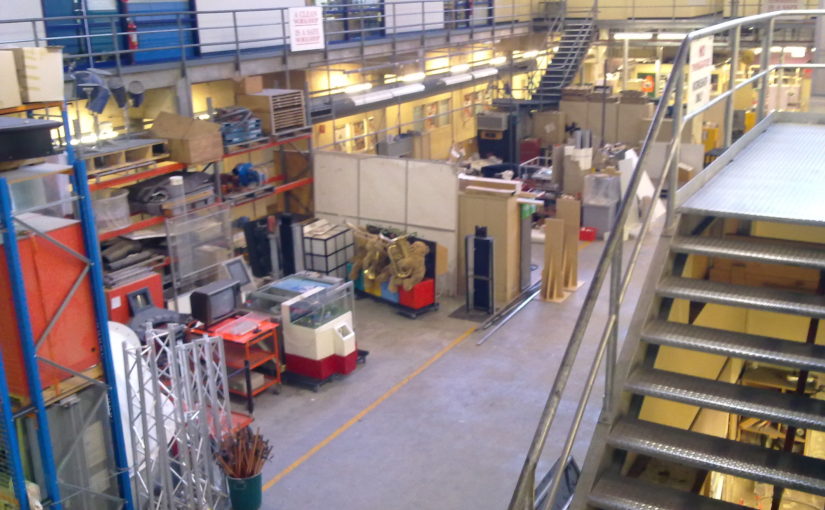
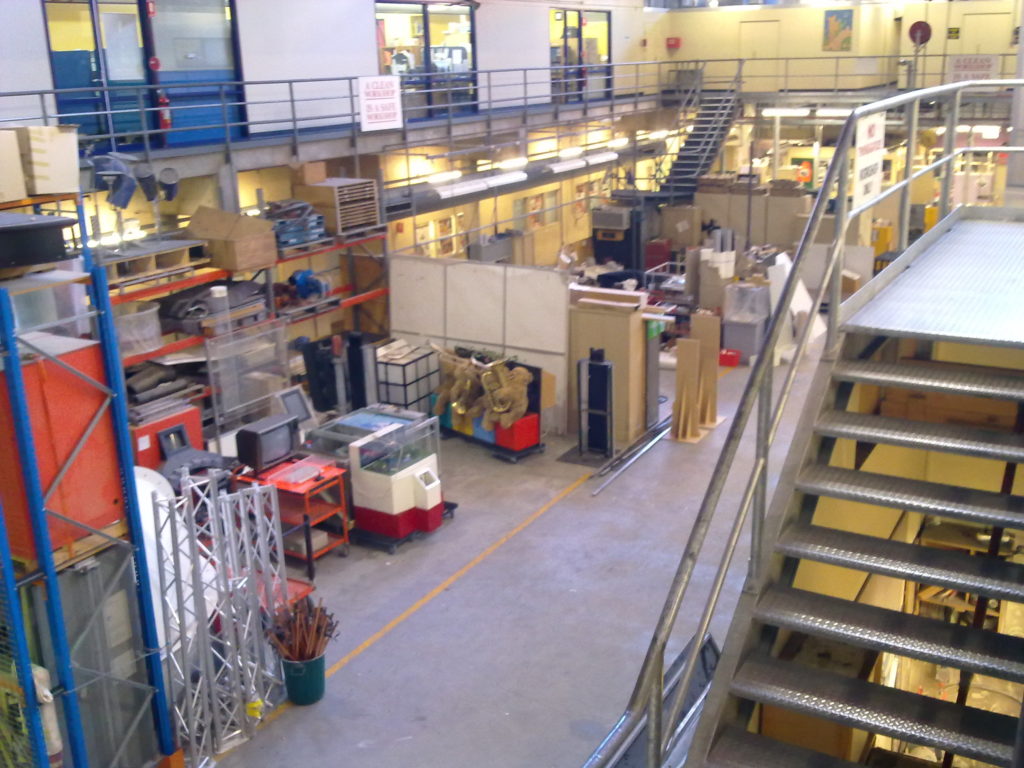
Photo: behind the scenes at the (then) Powerhouse Museum, Sydney

'I see, I feel, hence I notice, I observe, and I think'

More and more open and/or linkable cultural heritage data is becoming available, which means the next big challenge for memory institutions is dealing with 'death by aggregation: creating meaningful, engaging experiences of individual topics or objects within masses of digital data.  With that in mind, I've been wondering about the application of Roland Barthes' concepts of studium and punctum to large online collections.  (I'm in the middle of research interviews for my PhD, and it's amazing what one will think about in order to put off transcribing hours of recordings, but bear with me…)

Studium, in Wikipedia's definition, is the 'cultural, linguistic, and political interpretation of a photograph'.  While Barthes was writing about photography, I suspect studium describes the average, expected audience response to well-described images or objects in most collections sites – a reaction that exists within the bounds of education, liking and politeness.  However, punctum – in Barthes' words, the 'element which rises from the scene, shoots out of it like an arrow, and pierces me' – describes the moment an accidentally poignant or meaningful detail in an image captures the viewer.  Punctum is often personal to the viewer, but when it occurs it brings with it 'a power of expansion': 'I see, I feel, hence I notice, I observe, and I think'.  You cannot design punctum, but can we design collections interfaces to create the serendipitous experiences that enable punctum?  Is it even possible with images of objects, or is it more likely to occur with photographic collections?

While thinking about this, I came across an excellent post on Understanding Compelling Collections by John Coburn (@j0hncoburn) in which he describes some pilots on 'compelling historic photography' by Tyne & Wear Archives & Museums. The experiment asked two questions: 'Which of our collections best lends themselves to impulse sharing online?' and 'Which of our collections are people most willing to talk about online?'.  It's well worth reading both for their methods and their results, which are firmly grounded in the audiences' experience of their images: a 'key finding from our trial with Flickr Commons was that the mass sharing of images often only became possible when a user defined or redefined the context of the photograph', 'there’s a very real appetite on Facebook for old photography that strongly connects to a person’s past'.

Coming back to Barthes, their quest for images that 'immediately resonated with our audience on an emotional level and without context' is almost an investigation of enabling punctum; their answer: 'anything that How To Be a Retronaut would share', is probably good enough for most of us for now.  To summarise, they're 'era-specific, event-specific, moment-specific' images that 'disrupt people’s model of time', that 'tap into magic and the sublime', and that 'stir your imagination, not demand prior knowledge or interest'.  They're small, tightly-curated, niche-interest sets of images with evocative titles.

That's not how we generally think about or present online collections.  But what if we did?

[Update, May 16, 2012.

This post, from Flickr members co-curating an exhibition with the National Maritime Museum, offers another view – is the public searching for punctum when they view photographic collections, and does the museum/archive way of thinking about collections iron out the quirks that might lead to punctum?

'It is frightening to imagine what treasures will never see the light of day from the collection at the Brass Foundry. I got the sense that the Curators and the National Maritime Museum in general see these images as closely guarded historical documents and as such offer insight location, historical events and people in the image. There seems to be a lack of artistic appreciation for the variety of unusual and standalone images in the collection, raising an important question concerning the value attributed to each photograph when interpreted by an audience with different aesthetic interests. … In my opinion it is the ‘unknown’ quality of photography that initially inspires engagement and subsequently this process encourages an exploration of our own identity and how we as individuals create meaning.'  Source: 'The Brass Foundary Visit 19/04/2012']

Report from 'What's the point of a museum website' at MCN2011

A really belated report from the 'What's the point of a museum website?' panel I was part of with Koven Smith (@5easypieces), Eric Johnson (@ericdmj), Nate Solas (@homebrewer) and Suse Cairns (@shineslike) at last November's Museum Computer Network (MCN2011) conference.  I've written up some of my own thoughts at Brochureware, aggregators and the messy middle: what's the point of a museum website? – this post is about the discussion during the panel itself.  There was a lot of audience participation (in the room and on twitter), which made tackling a summary of the discussion really daunting, so I've given up on trying to capture every thread of conversation and am just reporting from the notes I took at the time.

It's all bit of a blur now so it's hard to remember exactly how the conversations went, but from my notes at the time, it included: Clay Shirky on social objects as a platform for conversation; games and other online experiences as big draws for museum sites (trusted content is a boon for parents); the impact of social media making the conversations people have always had about exhibitions and objects visible to curators and others; and the charisma of the physical object. From the audience Robin White Owen mentioned the potential for mobile apps to create space, opportunity for absorption and intimate experiences with museum content, leading me to wonder if you can have a Stendhal moment online?

Is discoverability is the new authority for museum websites?  As Nate said, authority online lies in being active online, though we also need to differentiate between authority about objects and narratives, and cite our sources for statements about online collections.  (See also Rob Stein on the difference between being authoritarian and authoritative). But maybe that's challenging too – perhaps museums aren't good at saying there is no right answer because we like to be the one with the right answer. Someone mentioned 'communities of passion' gathered around specific objects, which is a lovely phrase and I'm sorry I can't remember who said it.  Someone else from the audience wisely said, it's 'not how do I drive people to my collection, but how do I drive my collection to them'.  Andrew Lewis talked about 'that inspiration moment' triggered in a museum that sends you hurrying back home to make art or craft something.

I talked about my dream of building a site that people would lose themselves in for hours, just as you can do on Wikipedia now after starting with one small query.  How can we build a collections online site where people can follow one interesting-looking object or story after another?  We can't do that without a critical mass of content, and I suspect this can only be created by bringing different museum collections together digitally (or as Koven called it, digital repatriation), which also gets around the random accidents of collecting history that mean related objects are isolated in museums and galleries around the world.  Also, we're only ever part of the audience's session online – we might be the start, or the end, but we're more likely to be somewhere in the middle. We should be good team players and use our expert knowledge to help people find the best information they can.

Looking back, a lot of the conversation appears to be about how to create the type of rich experience of being in the presence of an object – a moment in time as well as in space – from the currently flat experience of looking at an object in an online catalogue (particularly when the online environment has all the distractions of kitten videos and social media notifications).  Can storytelling or bite-sized bits of content about objects act as 'hooks' to enable reflection and learning online?  Hugh Wallace has used the phrase 'snackable content' for readily available content that fits into how people use technology, and I think (with my conversational, social history bias) that stories-as-anecdotes can be a great way of sharing information about collections while creating that self-contained moment in time.  (And yes, I am side-stepping Walter Benjamin's statement that 'that which withers in the age of mechanical reproduction is the aura of the work of art'. Not that he was in the room, but he does tend to haunt these conversations.)

As with many conversations about online visitors, the gap between what we know and what we should know is frustratingly large, and we still don't know how large the gap between what (particularly) collections online are and what they could be.  Someone said that we're (measuring, or talking about) what users currently do with what we give them, not what they really want to do.  Bruce Wyman tweeted, 'current visitors most frequently give *incremental* ideas. You need different folk to take those great leaps forward. That's us'. Rob Stein said he didn't care about measuring time online, but wanted to be able to measure epiphanies – an excellently provocative statement that generated lots of discussion, including comments that epiphany needs agency, discourse, and serendipity. Eric said we murder epiphany by providing too much information, but others pointed out that epiphanies are closely tied to learning, so maybe it's a matter of the right information at the right time for the right person and a good dose of luck.

So (IMO) it was a great panel session, but did we come up with an answer for 'what's the point of a museum website'?  Probably not, but it's clearly a discussion worth having, and I dare say there were a few personal epiphanies during the session.

I'm collecting other posts about the session and will update this as I find them (or let me know of them in the comments): Suse's Initial takeaways from MCN2011.  I also collated some of the tweets that used the session hashtag 'wpmw' in a document available (for now) via my dropbox.

Finally, thank you to everyone who attended or followed via twitter, and particular thanks to my fellow panelists for a great discussion.

Brochureware, aggregators and the messy middle: what's the point of a museum website?

MCN 2011, Hyatt Regency Atlanta, What's The Point of a Museum Website, November 17th
Photo: nealstimler

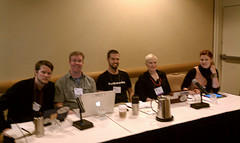
Back in November I attended the Museum Computer Network (MCN2011) conference for the first time.  I was lucky enough to get a scholarship (for which many, many thanks).  During the conference I was part of a panel discussing 'What's the point of a museum website?' with (from l-r in the photo) Koven Smith (@5easypieces), Eric Johnson (@ericdmj), Nate Solas (@homebrewer) and Suse Cairns (@shineslike).  I've posted about some of the ideas covered in the WPMW session, but this post is my attempt to think through 'what is the point of a museum website?' in the context of our MCN session.  I'm not lying when I say 'attempt' – this post is a draft, but since it's been a draft for months now, I'm going to take a deep breath and post it.  I'd love to hear your thoughts, challenges, props, whatever, and I'll update the post in response.

I've started thinking of museum websites as broadly fitting into three categories:

1. The practicalities. Unashamed brochureware may be enough for some museums (and may be all other museums, such as local authority museums tied to larger infrastructure, can manage): the practical, get-people-through-the-door stuff: why visit, how to get there, when to visit, what's on. Facebook and Google are competing to host content like this, so presumably visits to these sites are generally going to decrease over time.  This category reflects economic and organisational restrictions more than user requirements.

2. Collections online.  An important, opinionated caveat: unless your 'collections online' interface is a destination in its own right, or adds unique value, I think the point lies in aggregated collections.  Repositories like Europeana (and national aggregators like CultureGrid and Gallica), Collections Australia Network, Digital NZ, and the future Digital Public Library of America bring heavy-weight resources, SEO and discoverability and sheer scale to the 'collections online' work of a museum website.  But this scale brings new problems – these big, chaotic pots of content can be difficult to use.  Their sheer size makes it hard to highlight interesting objects or content.  Meaningful search results are difficult*, even for the patient, expert researcher, because they tend to contain so many different kinds of content about a range of subjects, taken from a variety of source museums, libraries, archives with hugely variable metadata quality and schema.  Better search engines, faceted browsing, etc, may help, but aggregators aren't really designed for humans**.  See also: 3a, 'The carefully curated and designed experience based on a particular concept' for a different view on collections online.

3. The messy middle.  This includes all kinds of things that general audiences don't seem to expect on a museum website – exhibition and marketing microsites, educational and family activities, public engagement experiences, games, lists of objects on display, research activities, etc.  It's a pretty safe guess that some of this content is online because it reflects the internal structure or requirements of the museum, is re-purposed from exhibitions, or is designed for specialist users (who may, however, also under-use it unless the collection is notably comprehensive or is one of the top hits for a Google search).  For museums, the point of a museum website may be editorial voice, control, metrics, or an attempt to monetise their images.

We know that lots of the messy middle really works for our audiences – for example, good games and other activities have metrics through the roof.  But without more research it's hard to know whether the content that audiences should love is less used than it might be because it's not easily discoverable by non-visitors to the website, isn't well advertised or consistently available on museum sites, or is competing with other groups that meet the same needs.  Does the trust people place in museums translate into trusted online content – how much do audiences really know or care whether an online experience, mobile app or the answer to their kid's homework question was provided by a museum?  Do they value 'authority' as much as we do?  When does museum content go from being 'on your website' to 'being on the web', and does it still matter?

For one potential point for museum websites, I need to refer back to the collection aggregators.  In an ideal world, the availability of images, reusable data licenses, organisational processes, and machine-readable data that populate these mega-collections would make it easy to create more tightly-defined cross-collection experiences based on carefully chosen sub-sets of aggregated collections.  In other words…

3a. The carefully curated and designed experience based on a particular concept.  From the Google Art Project to Europeana's Weddings In Eastern Europe, sites that draw on digital objects and expert knowledge to create audience-focused experiences could be the missing link between the in-gallery exhibitions museums love and the audience-focused born-digital experiences that are appropriately rich and/or snackable, and could be the source of the next great leap forward in museums on the web.  Museums can take the lessons learnt from years of topic-specific cross-institutional projects and research on existing audiences, and explore new models for audience engagement with museums online.  And perhaps more importantly, work out how to fit that into places our audiences already hang out online and let them share it promiscuously.

So, what's the point of a museum website?  At the simplest level, the point of a museum website is to get visitors into venues, and maybe to sell them tickets or products.  Ideally, the point of aggregators is to surface content hidden in the deep web so it's discoverable on your Google search results page and can be put into context with other resources.  The very messiness of messy middle category makes it harder to answer the question – it's the fun stuff, but most of it is also hardest to measure or to justify in terms of return on investment.

This is where asking more specific questions becomes more useful: not just, 'what's the point?' but 'the point for whom?'.  In the cold light of the budget cuts, perhaps it's better to ask 'how do you prioritise your museums' web work?'.  Both the 'practicalities' and the aggregators are broadly about access – getting people into the galleries or to catalogue records so they can discover and make the most of your collections.  The messy middle bit is broadly about engagement, which I suspect is key to broadening access by providing better ways for more people to access our collections.

As a museum technologist it hurts to say this, but if your museum isn't genuinely interested in online engagement or just can't resource it, then maybe the point of your website is to meet the practicalities as well as you can and push your content up into an aggregator.  I think we're still working to understand the role of online content in the relationship between museums and their audiences, but despite my final note of doom and gloom, I hope museums keep working at it.  As Bruce Wyman tweeted at the MCN session, "current visitors most frequently give *incremental* ideas. You need different folk to take those great leaps forward. That's us". 

Do we lose more than we gain by separating 'museum as venue' from 'museum as holder of collections' and 'museum as space for engaging with culture, science and history'?  And is it acceptable for some museums to stick to brochureware if they can't manage more?  What do you think?  


* The aggregation model also potentially applies to museum shops and picture libraries (ArtFinder, Culture Label, etc) but, perhaps because commercial profits are riding on the quality of the user experience, they tend to have more carefully tended information architecture and they're closer to the 'curated experience'.

** I've also written about audience issues with aggregation (boo) and the potential for 'Museum data and the network effect' (yay!) in 'Museums meet the 21st century'The rise of the non-museum (and death by aggregation)Rockets, Lockets and Sprockets – towards audience models about collections? and (back in 2009) Happy developers + happy museums = happy punters.  One reason aggregated collections aren't a great user experience is that paucity of museum collection data, though that can be improved with crowdsourcing, which as a bonus appears to be a great way to engage audiences.

[Update: there's a post on the Huffington Post (I know, but what can you do?) on 'What Makes for Compelling Museum Websites? When to Break the Rules' that posits 'Viewer Focused', 'Mirror' and 'Augmented' design principles for exhibition microsites.  This model seems to be about how strictly the microsite matches the objects in the exhibition, and whether the visitor can comment or use a variety of methods for navigating through the content.]
Can you capture visitors with a steampunk arm?

Credits: Science Museum

This may be familiar to you if you've worked on a museum website: an object will capture the imagination of someone who starts to spread the link around, there's a flurry of tweets and tumblrs and links (that hopefully you'll notice in time because you've previously set up alerts for keywords or URLs on various media), others like it too and it starts to go viral and 50,000 people look at that one page in a day, 20,000 the next, furious discussions break out on social media and other sites… then they're gone, onto the next random link on someone else's site.  It's hugely exciting, but it can also feel like a missed opportunity to show these visitors other cool things you have in your collection, to address some of the issues raised and to give them more information about the object.

There are three key aspects to riding these waves of interest: the ability to spot content that's suddenly getting a lot of hits; the ability to respond with interesting, relevant content while the link is still hot (i.e. within anything from a couple of hours to a couple of days); and the ability to put that relevant content on the page where fly-by-night visitors will see it.

For many museums, caught between a templated CMS and layers of sign-off for new content , it's not as easy as it sounds.  When the Science Museum's 'steampunk artificial arm' started circulating on twitter and then made boingboing, I was able to work with curators to get a post on the collections blog about it the next day, but then there was no way of adding that link to the Brought to Life page that was all most people saw.

In his post on “The Guardian’s Facebook app”, Martin Belam discusses how their Facebook app has helped archived content live again:

Someone shares an old article with their friends, some of their friends either already use or install the app, and the viral effect begins to take hold. … We’ve got over 1.3 million articles live on the website, so that is a lot of content to be discovered, and the app means that suddenly any page, languishing unloved in our database, can become a new landing page. When an article becomes popular in the app, we sometimes package it with content. Because we know the attention has come at a specific time from a specific place, we can add related links that are appropriate to the audience rather than to the original content. …when you’ve got the audience there, you need to optimise for them

As a content company with great technical and user experience teams, the Guardian is better placed to put together existing content around a viral article, but still, I'm curious: are any museums currently managing to respond to sudden waves of interest in random objects?  And if so, how?

Can ugly babies save museums?

Since coming across Ugly Renaissance Babies, I've been wondering: is Tumblr* the best thing to happen to broad public engagement with art history**?  They're dead simple posts – an image and a short comment, but they spread widely (as you can see from the number of re-posts), and arguably make renaissance art more interesting to people who wouldn't normally view it.  Can sites that curate content from across different collections like this create serendipity through decontextualisation, and bring art history to the masses?

Like image macros, they can bring history and popular culture together in amusing ways (e.g. Joseph Ducreux, the Bayeux Tapestry and song lyrics), but is this irreverent commentary and re-contextualisation exactly the kind of thing that skeptical curators worried about when we were all getting excited about online collections?  So I also have an entirely different question – does it matter to museums, galleries if (like the V&A) your painting appears in Ugly Renaissance Babies?

 Attributed to Master of the Kress Epiphany, The Expulsion of the Money-Changers (detail), around 1480-1500; We wants it, we needs it. Must have the precious.
Attributed to Master of the Kress Epiphany, The Expulsion of the Money-Changers (detail), around 1480-1500
'We wants it, we needs it. Must have the precious.'

Is it ok to point out 'bad' art like this?  Visitors often make rude comments about the ugly babies or whatever as they pass through museum galleries, but unless someone is there to hear them their comments are ephemeral.

And does it matter if the site author doesn't link back to the holding collection or image source?  [I think it does – for context and finding related items more than ownership, but I've been told that's a museum-y way of looking at it.]

I posted the tumblr link and asked some of these questions a while ago on Twitter, but frustratingly, I can't get back as far as the original post in the @-mentions page so I'm missing any comments I didn't reply directly to at the time.  (The reliability of free social media services is a whole other post…)  The one set of comments I can retrieve was from Erika Taylor (@erikajoy), who said, 'surely you would be proud as punch having an original renaissance ugly baby in your collection? May change the significance perhaps' … 'an interesting additional social significance to add to whatever the existing significance is' and best of all,

'also, how cool would it be if museums collected memes of their paintings back into their collection.' 

Finally, since this is presumably my last post for the year, I'd like to thank you for reading and commenting, and for inspiring conversations at conferences and on twitter – may your 2012 bring wondrous things to you and yours.

* insert your favourite social media service here.
** I suspect artistic objects are more 'portable' than social history or science objects, as they make visual sense without a story explaining what they are or why they're important.

Why do people rally to save libraries but not museums?

An experiment capturing a conversation with Storify…

Huge thanks to everyone who contributed and let me share their comments. P.S. You know your sector is loved when there's a Ryan Gosling 'hey girl' tumblr about you…