[A re-post, as the blogger outage seems to have eaten the first version. I'm incredibly grateful to Ben W. Brumfield @benwbrum for sending me a copy of the post from his RSS reader. I've set blogger up to email me a copy of posts in future so I won't have to go diving into my Safari cache to try and retrieve a post again!]
There's a lot of this going around as the arts and cultural heritage face on-going cuts: define yourself, or be defined, a search for a new business model that doesn't injure the unbusinesslike values at the core of public cultural institutions. Mark Ravenhill in the Guardian, Global art: nice canapes, shame about the show:
Many of our UK institutions operate under a strange contradiction: most of the signals we give out suggest that we offer the international glamour, the pampering loveliness, the partnerships with banks and brands… But at the same time, we agonise about access: we want everyone to be let into the business lounge. … In a modern world that buys and sells information and luxury, the arts deal in something very different: wisdom, a complex, challenging, lifelong search that can make you happy and furious, discontented and questioning, elated or bored. … What we need now, more than ever, is a clear message about what we do and why we do it. The government has opted for swift deficit reduction and a good hack at the arts: it's up to us to set the long-term agenda for the role of the arts in public life over the next decade and beyond if we're not going to be cut, cut and cut again. Boom and bust are here to stay: capitalism will always be in a permanent state of crisis.
It is entirely possible to be commercially savvy, operate sharply and make sophisticated uses of licensing as an artefact of control all in the name of serving a public cultural purpose. Equally, it is possible to throw open the doors and make content universally accessible in the name of driving commercial value to the bottom-line. The cultural and commercial imperatives are not in opposition, but coexist along a spectrum of activity which runs from non-commercial, through non-transactional (things like brand equity and audience engagement) to strictly financially transactional. … If the financial future of museums lies in becoming commercially acute, then a key part of true sustainability will lie in recognising our place in the supply-chain of culture to consumers, and in truly understanding and embracing our core competence and their value.
…we need to recognise that focussing on our core competencies and using them to create cultural assets and experiences which we can monetise (and therefore sustain) in partnership with the private sector is a story of success and advantage, not failure or loss.
His post has some interesting suggestions, so do go read it (and comment).
Nick also describes a vision "of a world in which museums have renegotiated the social contract with the public so that people everywhere understand that museums are places where culture is made and celebrated, rather than preserved and hidden from view" – it's easy, in my happy little bubble, to forget that many people don't see the point of museums. Some I've talked to might make an allowance for the big national institutions, but won't have any time for smaller or local museums. Working out how to deal with this might mean changing the public offer of these museums – or is it too late? There's a silent cull of museums happening in the UK right now, and yet I don't hear about big campaigns to save them. What do you think?
Based on what I learnt about the audience I ended up including more explanatory material on museum crowdsourcing games and didn't really have time for the 're-inventing museums' bits, so I thought I'd share those notes here. It's still very much a work-in-progress but since there are so many smart people thinking about the same subject, it's worth sharing for comment… (Also because Jasper Visser, who is also thinking about the future of museums, asked me what I was going to say. Btw, Jasper's #kulturwebb talk inspired the whole room, watch the video on his post about it.)
I know the future of museums lies in fitting into people's lives as well as being a destination; being the cathedral and being in the bazaar. Cultural heritage needs to be 'out there' to help people value and make time for visits the physical place. It's about new types of engagement and outreach. It's not all digital, but as the world is networked and mobile and social, we should be too.
I was thinking about new metaphors for museums – what if we were Amazon? A local newspaper? A specialist version of Wikipedia? A local pub? A student blog? A festival, a series of lectures, or a film group? A pub quiz? Should a museum be at the heart of village life, a meeting place for art snobs, a drop-in centre, a café, a study space, a mobile showroom?
But I realised that the answer to the question of the future of museums is deeply personal to any museum, because museums exist in the intersection of their collections, their fans and their local audiences. This is good, because it means you can apply your existing knowledge about what your audiences love about you. The answer to the question 'what would your museum be if it was invented in 2011?' is up to you…
Every time I approach the question of the future of museums, or of how the future of museums will be informed by what's happening the world today, I seem to come at it from a different angle. Today I'm wondering about the implications of the fact that there are no (g-rated) offline activities anymore – people will do almost anything with their mobile in one hand, and could be doing anything from googling to find out more about the museum object in front of them to looking up the lyrics of that one-hit wonder from that summer they went camping with friends. Their head could be in any space as well as in your space.
I'm also thinking about outreach, whether improving wikipedia articles, snippets of local history on the back of pub toilet doors or putting a museum exhibition in a truck and taking it to kids in the outer suburbs. Tomorrow I'll wake up with some new 'what if?' in my head. And I'm curious – what are you thinking about the future of museums?
I'm blogging several conversations on twitter around the subject of innovation and experimentation that I thought were worth saving, not least because I'm still thinking about their implications.
'does big museum obsession with polish hinder innovation? ('innovation' = keeping up with digital world outside)'.
which lead to a really interesting series of conversations. Erin Blasco responded (over several tweets):
We can't pilot if it's not perfect. … Need to pilot 15 quick/dirty QR codes but we can't put ANY up unless there are 50 & perfectly, expensively designed & impressive. … So basically not allowed to fail and learn = not allowed to pilot = we spend a bunch of $ and fail anyway? … To clarify: it's a cross-dept project. One dept ok with post-it notes & golf pencils. Two others are not. Kinda deadlock.
I think this perfectly illustrates the point and it neatly defines the kind of 'polish' that slows things down – the quality of the user experience with the QR codes would rest with the explanatory text, call to action and the content the user finds at the other end, not the weight and texture of the paper or vinyl they're printed on. Suddenly you've got extra rounds of emails and meetings for those extra layers of sign-off, a work request or contract for design time, plus all the stakeholder engagement that you already, but does that extra investment of time and resources result in a better experiment in audience research?
But kudos to Erin for gettings things this far! (An interesting discussion followed with Erin and @artlust about possible solutions, including holding stakeholder evaluations of the prototypes so they could see how the process worked, and 'making the pilot-ness of it a selling point in the design, letting audiences feel they're part of something special', which made me realise that turning challenges into positives is one of my core design techniques.)
Innovation costs, even my plans to try things cheap/free get scuppered by lack of time. For me less about risk more about resources
Which also rings perfectly true – many potential museum innovators were in this position before the museum funding cuts took hold, so innovating your way out of funding-related crises must be even more difficult now.
On the topic of innovation, Lindsey Green said the 'definite reluctance to pilot and fail impacts innovation'. Rachel Coldicutt had just blogged about 'digital innovation in the arts' in Making Things New, pointing out that the question 'privileges the means of delivery over the thing that’s being delivered', and tweeting that 'innovating a system and innovating art aren't the same thing and perhaps there's more impact from innovating the system'.
If the quest is to, as Rachel problematises in her post, 'use digital technologies to remake the Arts Establishment', then (IMO) it's doomed to failure. You can't introduce new technologies and expect that the people and processes within a cultural organisation will magically upgrade themselves to match. More realistically, people will work around any technology that doesn't suit them (for entirely understandable reasons), and even the best user experience design will fail if it doesn't take account of its context of use. If you want to change the behaviour of people in an organisation, change the metrics they work to. Or, as Rachel says, '[r]ather than change for change’s sake, perhaps we should be identifying required outcomes'. Handily, Bridget McKenzie pointed out that 'The Museums for the Future toolkit includes new eval framework (GEOs = Generic Environmental Outcomes)', so there's hope on the horizon.
The caveats: it's not that I'm against polish, and I think high production values really help our audiences value museum content. But – I think investing in a high level of polish is a waste of resources during prototyping or pilot stages, and a focus on high production values is incompatible with rapid prototyping – 'fail faster' becomes impossible. Usability researchers would also say polished prototypes get less useful feedback because people think the design is set (see also debates around the appearance of wireframes).
It's also worth pointing out my 'scare quotes' around the term 'innovation' above – sadly, things that are regarded as amazing innovations in the museum world are often delayed enough that they're regarded as pretty normal, even expected, by our more digitally-savvy audiences. But that's a whole other conversation…
So, what do you think: does a museum's obsession with polish hinder innovation?
A common pitfall for museums is an unhealthy addiction to monumental undertakings. When massive projects loom with ties to outside support and countless staff hours invested in a single deliverable, it becomes very difficult to admit the possibility of failure. As a result, we shy away from risk, mitigate the probability of embarrassment, and crush innovation in the process.
I'm never going to have time to tidy these up, so here they are as they were scribbled on a post-it note closer to the Museums and the Web 2011 conference:
Stand on the shoulders of giants – so much great work is better because it's based on the experience and work of others. There's a sea change in attitudes about making the most of existing work, and maybe it's just cos I was hanging out with cool people, but the 'not invented here' syndrome seems to be dead.
The cool kids share failures and mistakes – people's wonderful honesty about things that went wrong is amazing and can be so powerful
Twitter went from back channel to summarising, sending quotable quotes flying out from the conference, and to socialising – finding the hang outs was so much easier because there were lots of open invitations to explore places.
Processes and people over tech – tech is now generally the easy part, and the less interesting part.
Lots of anecdotal evidence about how much audiences love 'behind the scenes' content.
I kept noticing things about the power of storytelling but that could just be because I'm really interested in it.
I've only just figured this one out, but a lot of the conference was about engagement, whether through games, interactions with mobile devices, participatory projects, whatever. Access is dead, long live engagement.
Hopefully I'll grab some time to reflect more on specific sessions and talks, but an imperfect post is more use than a polished draft, so here you go!
One outcome from MW2011 was the creation of 'Lift your (museum) game', a site for people who make museum games to share their hard-earned wisdom – project evaluation, research, references, methods, rants, lessons learnt from real projects – about making museum games. Inspired by a question from Martha Henson about whether any sites already existed to gather resources like those discussed during the panel discussion after the Games session at Museums and the Web 2011 (with Dave Schaller, Elizabeth Goins and Coline Aunis), I created the wiki during the closing plenary and watched in awe as Kate Haley Goldman immediately started populating it with links.
Museum games have to compete in a highly competitive market, especially for casual and social games, and I suspect 'worthy' will only take us so far these days. I'm hoping the dialogue around this site will help people avoid the pitfalls of 'death by museum committee' when designing games and push for excellent gameplay in museum games. There are some great museum game projects and research going on, and pooling resources could help multiply the benefits of that work and provide a resource for people just starting out. Also, if you're a games agency or designer, this could be a great place to pass on any tips or links (or warnings) you'd like potential museum clients to know about. I've got a few papers on crowdsourcing games for museums coming up, so I'll be adding links and resources as I go – it's easy to add your resources or questions, just sign up at http://museumgames.pbworks.com.
One of the key themes of MW2011 for me was 'standing on the shoulders of giants' – there's so much good work going on in the museum digital sector, and so many amazing people are willing to share what they've learnt along the way, and hopefully this museum games wiki is a contribution to helping us all see further and do better.
I've got a few presentations coming up that explore a re-imagining of museums, so I've been thinking about the original founding visions of specific museums (based on e.g. What would a digital museum be like if there was never a physical museum?), and whether there's dissonance between mission statements based in institutional history and those you might write if we were inventing museums today.
…it was only with the emergence of aestheticism and competition from universities in the late 19th century that curators started making exhibitions for each other and for people of their class. Most earlier Victorian museums were educational institutions (not just institutions with education departments). In Britain, both the Liberal Henry Cole (founding Director of the V&A) and the Tory John Ruskin created museums that aimed to achieve the widest possible audience in the name of public education. The Met was founded “for the purpose…of encouraging and developing the study of the fine arts, and the application of arts to manufacture and practical life…and, to that end, of furnishing popular instruction.” In 1920, the Met’s president Robert de Forest wrote that it was “a public gallery for the use of all people, high and low, and even more for the low than for the high, for the high can find artistic inspiration in their own homes”.
So I'm curious, and if you're up for it, I have a little task for you (yes, you, over there) – what was the founding statement for your museum, and what is your current mission statement? And if you're feeling creative, what would you like your favourite museum's mission statement to be?
Today I passed on a query from @fayenicole: '…know anybody who could run a retro-style game design workshop for teenagers at the British Museum?' on twitter and got a bunch of responses. Since people were so generous with their time, I thought I'd take a few minutes to collate them so they're available the next time someone has a similar query. Feel free to add further suggestions in the comments, particularly for people or agencies who are keen to work with museums and cultural heritage organisations.
@guylevans: 'Gameduino' looks interesting, its an Arduino shield which allows for 8 bit gaming experiments http://gameduino.com
Billy Abbott @cowfish: Not sure on the general design but @Pixelh8 is king of beepy tunes and also might know some people.
Nate Cochrane @natecochrane: Is Braybrook available or the Yak?
And of course thanks to @doctorow for retweeting my message so that other people saw it.
In other news, I learned this week that 'MT' means 'modified tweet' and signifies when someone's shortened or otherwise changed something they're retweeting. Mmm, learning.
This is something I wrote for my MSc dissertation ('Playing with difficult objects: game designs for crowdsourcing museum metadata', view the games I built for it at http://museumgam.es/ or check out the paper (Playing with Difficult Objects – Game Designs to Improve Museum Collections) I wrote for Museums and the Web 2011) about the role of 'distinctiveness' in mental models about collections, that's potentially relevant to discussions around telling stories with and collecting metadata about museum collections. I'm posting it here for reference in the conversation about instances vs classes of objects that arose on the UKMCG list after the release of NMSI (Science Museum, National Media Museum, National Railway Museum) data as CSV. One reason I've been thinking about 'distinctiveness' is because I'm wondering how we help people find the interesting records – the iconic objects, the intriguing stories – in a collection of 240,000 objects.
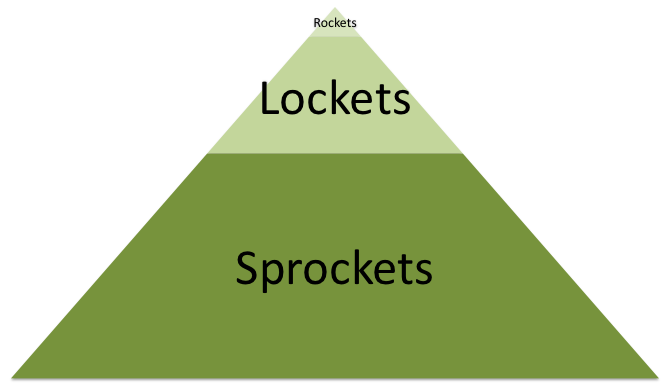
I'm interested in audiences' mental models about when a record refers to the type of object vs the individual object – my sense is that 'rockets', in the model below, are generally thought of as the individual object, and that 'sprockets' are thought of as the type of object, but that it varies for 'lockets', depending how distinctive they are in relation to the person.
I'm also generally curious about the utility of the model, and would love to know of references that might relate to it (whether supporting or otherwise) – if you can think of any, let me know in the comments.
Not all objects are created equal
Both museum objects and the records about them vary in quality. Just as the physical characteristics of one object – its condition, rarity, etc – differ from another, the strength of its associations with important people, events or concepts will also vary. To complicate things further, as the Collections Council of Australia (2009) states, this 'significance' is 'relative, contingent and dynamic'.
When faced with hundreds of thousands of objects, a museum will digitise and describe objects prioritised by 'technical criteria (physical condition of the original material), content criteria (representativeness, uniqueness), and use criteria (demand)' (Karvonen, 2010). In theory, all objects are registered by the collecting institution, so a basic record exists for each. Hopefully, each has been catalogued and the information transcribed or digitised to some extent, but this is often not the case. Records are often missing descriptions, and most lack the contextual histories that would help the general visitor understand its significance. Some objects may only have an accession number and a one word label, while those on display in a museum generally have well-researched metadata, detailed descriptions and related narratives or contextualised histories. Variable image quality (or lack of images) is an issue in collections in general. This project excludes object records without images but does include many poor-quality images as a result of importing records from a bulk catalogue.
This project posits that objects can be placed on a scale of 'distinctiveness' based on their visual attributes and the amount and quality of information about them. Within this project, bulk collections with minimal metadata and distinctiveness have been labelled 'sprockets', the smaller set of catalogued objects with some distinctiveness have been labelled 'lockets', and the unique, iconic objects with a full contextual history have been labelled 'rockets'. This concept also references the English Heritage 'building grades' model (DCMS, 2010). During the project, the labels 'heroic', 'semi-heroic' and 'bulk' objects were also used.
These labels are not concerned with actual 'significance' or other valuation or priority placed on the object, but relate only to the potential mental models around them and data related to them – the potential for players to discover something interesting about them as objects, or whether they can just tag them on visual characteristics.
In theory there is a correlation between the significance of an object and the amount of information available about it; there may be particular opportunities for games where this is not the case.
Project label
Information type
Amount of information
Proportion of collection
Rockets
Subjective
Contextual history ('background, events, processes and influences')
Tiny minority
Lockets
Mostly objective, may be contextual to collection purpose
Catalogued (some description)
Minority
Sprockets
Objective
Registered (minimal)
Majority
Table 1 Objects grouped by distinctiveness
This can also be represented visually as a pyramid model:
Figure 2 A figurative illustration of the relative numbers of different levels of objects in a typical history museum.
References
Department of Media, Culture and Sport (DCMS) (2010) Principles of Selection for Listing Buildings [Online] Available from: http://www.english-heritage.org.uk/content/imported-docs/p-t/principles-of-selection-for-listing-buildings-2010.pdf
Karvonen, M. (2010). "Digitising Museum Materials – Towards Visibility and Impact". In Pettersson, S., Hagedorn-Saupe, M., Jyrkkiö, T., Weij, A. (Eds) Encouraging Collections Mobility In Europe. Collections Mobility. [Online] Available from: http://www.lending-for-europe.eu/index.php?id=167
Russell, R., and Winkworth, K. (2009). Significance 2.0: a guide to assessing the significance of collections. Collections Council of Australia. [Online] Available from: http://significance.collectionscouncil.com.au/
I originally posted this on the Science Museum API documentation wiki.
About this data
These data sets contain information about objects from the collections of the Science Museum, the National Media Museum and the National Railway Museum. These datasets include many items not on display in our galleries, as well as authority records about related people and organisations, events and image files.
The collections include objects relating to aeronautics, agriculture, astronomy, cinematography, medicine, materials, space, television, time measurement, transport and more. They range in size from contact lenses to Concorde 002.
We hope to publish our lists of c9000 people and organisations related to these objects soon, alongside a table linking objects to events.
The data is supplied in CSV (comma-separated format, exported from Excel). The first line of each file contains the field headings. Files may be up to 15mb in size.
The data is released under the Creative Commons Attribution-NonCommercial-ShareAlike (CC BY-NC-SA) licence (http://creativecommons.org/licenses/by-nc-sa/3.0/). Please contact us if you would like to use this data under different conditions.
Why we're releasing the data
We have been providing access to a searchable database of our collections online at http://collectionsonline.nmsi.ac.uk/ for some time now, but through staff attendance at various hack days, we've learned that this interface does not support programmatic search or exploration of the data. We've also learned (through the Cosmos & Culture project) that a number of people found the XML provided by the default .Net service that published the API too complex. CSV is a very simple format, accessible to a wider range of people. We hope that it will be usable by most people.
We're publishing the data in CSV format now as a relatively lightweight experiment. We'd like to understand whether, and if so, how, people would use our data. We'd also like to explore the benefits for the museum and for programmers using our data – your feedback would inform decisions about future investment in more structured data as well as helping shape our understanding of the requirements of those users.
We hope you will be creative with it, but please use it responsibly. If you're not sure whether the museum would be comfortable with your idea, please drop us a line to discuss it.
How you can help
You can help us to improve this resource – let us know if you have any information about our objects, or if you find any errors, though we will probably not republish this data set in the short-term. Please quote the Object Number/s and email: Collections.Online@nmsi.ac.uk
We'd like this experiment to help us understand the needs of potential users but we can only do that with your help – we'd love to hear your comments on how you've used the data, and how we could improve it. If possible, we'd like to feature mashups or other applications made with our data. Please email us at web.team@nmsi.ac.uk, send @sciencemuseum a message on twitter or leave a comment at http://sciencemuseumdiscovery.com/blogs/museumdev.
The unique identifier for a record, based on the museum's own accession number. The number may refer to a single object or (historically) to a collection of objects.
ITEM_NAME
Object name – a simple name or common name. Where possible this is from an established thesaurus (i.e. http://museum-api.pbworks.com/f/NMSI_draft200903_object_name.csv)
TITLE
A short one-line caption or brief description of the object, derived from the existing data. The title should be a summary capturing the essence of an object. Often includes related place and date.
MAKER
The name of the person or company or other organisation that made the object. The Maker field is indexed and linked to the People/Organisation records (to be released shortly) – links should be made by matching strings (internal IDs are not available).
DATE_MADE
The date when an object was made (production date). Dates should be recorded consistently and ranges should be in the format <earlier year>-<later year> e.g. 1671-1700. Approximate dates are written as e.g. c. 1936. This field also contains various strings, including ‘Unknown'.
PLACE_MADE
Place names are indexed in the database and linked into a hierarchy (Getty Thesaurus of Geographic Names with in-house modifications i.e. http://museum-api.pbworks.com/f/NMSI_draft200903_place.csv) and should be recorded consistently because they are derived from a term list. Where known with certainty or reasonable probability the town or city of production is recorded. As a minimum the nation/country of origin or the probable nation/country of production should be recorded. If there is some uncertainty this can be explained in the general description.
MATERIALS
Records what the object is made of and what part of the object is made of that material.
MEASUREMENTS
Record the type of measurements that are most useful for an object, with ‘overall' being the most usual dimensions recorded. Overall will be the amount of space the object takes up when it first arrives in the museum and is stored. Measurements must be recorded consistently in metric units. Compulsory measurements are Size and Weight. The default units of measurement are millimetres and kilograms. Example: overall: 51 mm x 95 mm x 80 mm, 0.371kg,
DESCRIPTION
In this field we try to describe what the what, when, why, where, who information about the object, what it is, what it does, is made of, who made it, where was it made and what makes it unique. This field should be exported as plain text (without markup). The information here is used by the museum to audit an object so it should be described well with each part defined. It should also contain all the information about the object so that an interpreted description can be written (suitable for publication). Technical terms have been avoided as far as possible. Names, dates, places and significant events should be recorded here in a normalized form but will also be recorded in other indexed fields. As far as possible the following are recorded: <number of objects> <name of object, qualifier> <model name, number> <what is the type of object?> <specific information>:<made by…> <type of object> <place made> <date made> <any associated relevant fact> <materials> <colour><serial number><containers> <accessories> <dimensions> <condition and completeness> <identification of parts> <acquisition/provenance information> <story of display, conservation etc.> <other details>
WHOLE_PART
Mostly an internal field.
COLLECTION
A broad subject specialism applied during the Acquisition/ Entry process. NMeM National Media Museum NRM National Railway Museum SCM Science Museum. Collection terms are listed at http://museum-api.pbworks.com/w/page/36515349/NMSI-Collections-list
For more information on authority records, see http://en.wikipedia.org/wiki/Authority_control
You can use it to construct URLs to images of the objects. (The images are hosted on a site built with a third-party solution so the URLs aren't ideal.)
objects.ID_NUMBER is the equivalent to media. OBJECT, giving you a link between the object and media tables (e.g. 1999-719). The media. MEDIAKEY (e.g. 125972) can then be included in a URL, e.g. the image file URL uses the media key: http://collectionsonline.nmsi.ac.uk/grabimg.php?wm=1&kv=125972
Column title
What is it?
MEDIA_ID
e.g. 10327065.jpg
OBJECT
The object ID_NUMBER e.g. 1999-719
MEDIAKEY
e.g. 125972
CAPTION
Optional. E.g. ‘Class 84 locomotive at Barrow Hill, sanding and filling in progress, August 1984'
Currently this data set has fairly random coverage but we would be interested to see whether people find the content useful. If the object was linked to any significant event (historical, political, developmental or other milestone events) or if an object featured at some significant and well-known event or activity, it might be recorded in this table.
Column title
What is it?
Event Name
Includes location and date/date range.
Event Short Name
Event title without location or date (usually)
Event Category
Values include era, war, exhibition, expedition (term list?)
Occurrence Type
E.g. one-time, periodic, annual. Optional
Event Start Date
Single date as year or y/m/d. Mixed formats (sorry!). Also includes BCE dates expressed as negative integers e.g. -3100 Optional
Event End Date
As for Event Start Date. Optional
Display Date
?
Duration
Integer – use with Duration Unit. Optional
Duration Unit
E.g. days, months, years. Use with Duration. Optional
Event Description
Text. Optional
Description Source(s)
May be a URL. Optional
Sort Name
Internal use version of event name
Produced for the Science Museum, London. Last updated by Mia Ridge, March 2011. With thanks to the web, database and documentation teams at NMSI for their support and assistance. Thanks also to @rboulton for testing the documentation.
I originally posted this on the Science Museum API wiki. This version dates to March 2011, as I documented things before leaving to do a PhD.
Documentation for collections data from Science Museum, National Media Museum, National Railway Museum (NMSI) released as CSV
About this data
These data sets contain information about objects from the collections of the Science Museum, the National Media Museum and the National Railway Museum. These datasets include many items not on display in our galleries, as well as authority records about related people and organisations, events and image files.
The collections include objects relating to aeronautics, agriculture, astronomy, cinematography, medicine, materials, space, television, time measurement, transport and more. They range in size from contact lenses to Concorde 002.
We hope to publish our lists of c9000 people and organisations related to these objects soon, alongside a table linking objects to events.
The data is supplied in CSV (comma-separated format, exported from Excel). The first line of each file contains the field headings. Files may be up to 15mb in size.
The data is released under the Creative Commons Attribution-NonCommercial-ShareAlike (CC BY-NC-SA) licence (http://creativecommons.org/licenses/by-nc-sa/3.0/). Please contact us if you would like to use this data under different conditions.
Why we're releasing the data
We have been providing access to a searchable database of our collections online at http://collectionsonline.nmsi.ac.uk/ for some time now, but through staff attendance at various hack days, we've learned that this interface does not support programmatic search or exploration of the data. We've also learned (through the Cosmos & Culture project) that a number of people found the XML provided by the default .Net service that published the API too complex. CSV is a very simple format, accessible to a wider range of people. We hope that it will be usable by most people.
We're publishing the data in CSV format now as a relatively lightweight experiment. We'd like to understand whether, and if so, how, people would use our data. We'd also like to explore the benefits for the museum and for programmers using our data – your feedback would inform decisions about future investment in more structured data as well as helping shape our understanding of the requirements of those users.
We hope you will be creative with it, but please use it responsibly. If you're not sure whether the museum would be comfortable with your idea, please drop us a line to discuss it.
How you can help
You can help us to improve this resource – let us know if you have any information about our objects, or if you find any errors, though we will probably not republish this data set in the short-term. Please quote the Object Number/s and email: Collections.Online@nmsi.ac.uk
We'd like this experiment to help us understand the needs of potential users but we can only do that with your help – we'd love to hear your comments on how you've used the data, and how we could improve it. If possible, we'd like to feature mashups or other applications made with our data. Please email us at web.team@nmsi.ac.uk, send @sciencemuseum a message on twitter or leave a comment at http://sciencemuseumdiscovery.com/blogs/museumdev.
The unique identifier for a record, based on the museum's own accession number. The number may refer to a single object or (historically) to a collection of objects.
ITEM_NAME
Object name – a simple name or common name. Where possible this is from an established thesaurus (i.e. http://museum-api.pbworks.com/f/NMSI_draft200903_object_name.csv)
TITLE
A short one-line caption or brief description of the object, derived from the existing data. The title should be a summary capturing the essence of an object. Often includes related place and date.
MAKER
The name of the person or company or other organisation that made the object. The Maker field is indexed and linked to the People/Organisation records (to be released shortly) – links should be made by matching strings (internal IDs are not available).
DATE_MADE
The date when an object was made (production date). Dates should be recorded consistently and ranges should be in the format <earlier year>-<later year> e.g. 1671-1700. Approximate dates are written as e.g. c. 1936. This field also contains various strings, including ‘Unknown'.
PLACE_MADE
Place names are indexed in the database and linked into a hierarchy (Getty Thesaurus of Geographic Names with in-house modifications i.e. http://museum-api.pbworks.com/f/NMSI_draft200903_place.csv) and should be recorded consistently because they are derived from a term list. Where known with certainty or reasonable probability the town or city of production is recorded. As a minimum the nation/country of origin or the probable nation/country of production should be recorded. If there is some uncertainty this can be explained in the general description.
MATERIALS
Records what the object is made of and what part of the object is made of that material.
MEASUREMENTS
Record the type of measurements that are most useful for an object, with ‘overall' being the most usual dimensions recorded. Overall will be the amount of space the object takes up when it first arrives in the museum and is stored. Measurements must be recorded consistently in metric units. Compulsory measurements are Size and Weight. The default units of measurement are millimetres and kilograms. Example: overall: 51 mm x 95 mm x 80 mm, 0.371kg,
DESCRIPTION
In this field we try to describe what the what, when, why, where, who information about the object, what it is, what it does, is made of, who made it, where was it made and what makes it unique. This field should be exported as plain text (without markup). The information here is used by the museum to audit an object so it should be described well with each part defined. It should also contain all the information about the object so that an interpreted description can be written (suitable for publication). Technical terms have been avoided as far as possible. Names, dates, places and significant events should be recorded here in a normalized form but will also be recorded in other indexed fields. As far as possible the following are recorded: <number of objects> <name of object, qualifier> <model name, number> <what is the type of object?> <specific information>:<made by…> <type of object> <place made> <date made> <any associated relevant fact> <materials> <colour><serial number><containers> <accessories> <dimensions> <condition and completeness> <identification of parts> <acquisition/provenance information> <story of display, conservation etc.> <other details>
WHOLE_PART
Mostly an internal field.
COLLECTION
A broad subject specialism applied during the Acquisition/ Entry process. NMeM National Media Museum NRM National Railway Museum SCM Science Museum. Collection terms are listed at http://museum-api.pbworks.com/w/page/36515349/NMSI-Collections-list
For more information on authority records, see http://en.wikipedia.org/wiki/Authority_control
You can use it to construct URLs to images of the objects. (The images are hosted on a site built with a third-party solution so the URLs aren't ideal.)
objects.ID_NUMBER is the equivalent to media. OBJECT, giving you a link between the object and media tables (e.g. 1999-719). The media. MEDIAKEY (e.g. 125972) can then be included in a URL, e.g. the image file URL uses the media key: http://collectionsonline.nmsi.ac.uk/grabimg.php?wm=1&kv=125972
Column title
What is it?
MEDIA_ID
e.g. 10327065.jpg
OBJECT
The object ID_NUMBER e.g. 1999-719
MEDIAKEY
e.g. 125972
CAPTION
Optional. E.g. ‘Class 84 locomotive at Barrow Hill, sanding and filling in progress, August 1984'
Currently this data set has fairly random coverage but we would be interested to see whether people find the content useful. If the object was linked to any significant event (historical, political, developmental or other milestone events) or if an object featured at some significant and well-known event or activity, it might be recorded in this table.
Column title
What is it?
Event Name
Includes location and date/date range.
Event Short Name
Event title without location or date (usually)
Event Category
Values include era, war, exhibition, expedition (term list?)
Occurrence Type
E.g. one-time, periodic, annual. Optional
Event Start Date
Single date as year or y/m/d. Mixed formats (sorry!). Also includes BCE dates expressed as negative integers e.g. -3100 Optional
Event End Date
As for Event Start Date. Optional
Display Date
?
Duration
Integer – use with Duration Unit. Optional
Duration Unit
E.g. days, months, years. Use with Duration. Optional
Event Description
Text. Optional
Description Source(s)
May be a URL. Optional
Sort Name
Internal use version of event name
Produced for the Science Museum, London. Last updated by Mia Ridge, March 2011. With thanks to the web, database and documentation teams at NMSI for their support and assistance. Thanks also to @rboulton for testing the documentation.