Science Museum API documentation

I originally posted this on the Science Museum API wiki in 2008, this version dates from about March 2011 (when I left the Science Museum Group to start a PhD).

At that point, the APIs available related to various exhibitions, collections etc were: APIs: Collections, Pledges, Countries, Object Wiki, Exhibitions.

Science Museum API documentation

These documents describe the functionality of the Science Museum APIs.

The APIs have been released as a trial. As such, they should be considered 'beta', and things may change without warning.

If you are interested in devloping using these APIs, or want to ask any questions or make any suggestsions about them, please email us at web.team@nmsi.ac.uk or leave a comment at http://sciencemuseumdiscovery.com/blogs/museumdev.

In addition to the APIs documented here, we have an XML-based API with objects from the exhibition Cosmos & Culture at http://www.sciencemuseum.org.uk/objectapi/cosmosculturepublic.svc/MuseumObjects.

‘Things’ and our collections data

I originally posted this on the Science Museum developers blog.

Frankie Roberto has made a web app based on the object records from the collections of the Science Museum, the National Media Museum and the National Railway Museum released yesterday.  In his words:

I thought I’d have a quick play with the data last night, and so managed to import them into a database and built a quick web app called ‘Things’:
http://what-is-this.heroku.com/

The main thing I wanted out of the data was to be able to browse by type-of-thing (eg ‘steam engines’). Given that this information isn’t easily accessible from the existing data, the first thing that ‘Things’ does is ask people to help classify the objects.

It’s sort of like tagging. But easier. :-)

If I get enough things classified I may have a go at seeing if an algorithm can learn from the data and classify the rest.

Let me know what you think.

Source code is here: https://github.com/frankieroberto/things –  patches welcome!

Given the number of crowdsourcing projects around*, the next step for the museum may be working out how to manage and make the most of user-created data we get back from projects like this.  This would be an excellent problem to have.

* I’ve also got lots of data to handover based on tags and facts added by people playing with the astronomy collections on Museum Metadata Games, which was again only possible because the Powerhouse Museum has an API and the Science Museum made an earlier, XML-based API.

Update on collections data and geocoded NRM data

I originally posted this on the Science Museum developers blog, Filed under: collections,data,requestforcomment — mia @ 6:05 pm

I’m glad to see the news about the release of objects from the collections of the Science Museum, the National Media Museum and the National Railway Museum has spread so far and wide already.

A few people have commented on the licence (Creative Commons Attribution-NonCommercial-ShareAlike, CC BY-NC-SA) and on the format (CSV).  As tomorrow is my last day, I can’t really speak for the museum but the intention is to learn from how people use the data – the things they make, the barriers they face, etc – and iterate (as resources allow) until we get to an optimal solution (or solutions). So please get in touch if you’ve got requests or think you can help clear up some of the issues these kinds of projects face, because there’s a good chance you’ll help make a difference.

The licence is a pragmatic solution – it’s clarification of existing terms rather than a change to our terms, because this avoided a need for legal advice, policy review, etc, that would have added several months to the process.

And yes, I know CSV is quick and dirty, but it’s effective. The museum sector is still working out how to match the resources available with the needs of mash-up type developers who work best with JSON and those who are aiming for linked open data; my hope is that your feedback on this will help museums figure out how to support people using open data in various forms. A simple solution like this also means it’s easy for the museum to re-run the export to update the data as time goes on, and that anyone, geek or not, can open the files without being startled by angle brackets and acronyms. Also, did I mention it was quick?

Finally, we’ve already had some useful feedback and even some improved files. Richard Light sent us a geocoded version of records from the National Railway Museum (NRM) (index of locations: http://api.sciencemuseum.org.uk/collections/updates_from_other_people/Richard_Light/nrm-geo-sort.xml (63kb), full file http://api.sciencemuseum.org.uk/collections/updates_from_other_people/Richard_Light/nrm-geo.xml – 20mb, browser-beware).

I’ll let Richard explain in his own words:

I converted the source CSV to XML using my CSV Converter program, which is a home-made program I wrote to do a “mail-merge” on CSV data, with the aim of easily generating other formats such as XML.

The geocoding was carried out by calls to my place URL-ifier program. This uses the standard Geonames query API, but splits a place description into its component place names (e.g. “Swindon, Wiltshire, England” becomes three place names) and searches for a “Swindon” contained within places “Wiltshire” and “England”.

I wrote an XSLT transform which copied the source document, and each time it found a place field, it called out to my URL-ifier using the document() function:

<xsl:template match=”PLACE_MADE[text()!="]“>
<xsl:variable name=”geonames”
select=”document(concat(‘http://light.demon.co.uk/scripts/getPlaceURL.exe
?amp;q=’, text()))/*/text()”/>
<xsl:copy>
<xsl:if test=”$geonames!=””>
<xsl:attribute name=”geonamesId”><xsl:value-of
select=”$geonames”/></xsl:attribute>
</xsl:if>
<xsl:apply-templates/>
</xsl:copy>
</xsl:template>

Where this was successful in inferring a Geonames identifier, it added a “geonamesId” attribute to the PLACE_MADE field. So the result is a copy of the source data, with added geocoding.

All of the NRM data was geocoded in a single XSLT operation, but this operation had to call my URL-ifier, and hence the Geonames API, many times. There are limits on how hard you can hit this service, so care needs to be exercised! (You can get your own Geonames identifier for free, and then have your own allocation of API calls, if you want to use this service in a serious way.)

Now that the data contains Geonames URLs, you have access to all the background information about each place. All Geonames entries have lat/long co-ordinates (which is what you need to stick a pin on a map in your browser, using e.g. KML markup), but in addition will often have info such as population. You just need to make an HTTP request for the Geonames URL, specifying that you want RDF back, e.g.: http://light.demon.co.uk/scripts/cgiforwarder.exe?url=http://sws.geonames.org/2633352/&accept=rdf and process the RDF/XML which comes back.

Personally, this kind of thing makes it all worthwhile – we can’t easy export our entire geographical hierarchy, so being able to geocode the imperfect data we have is really useful.

If you’ve done something interesting with our data we’d love to feature it. We’re also curious to know who’s having a look at it, even if you’re not at the point of having something to share.

Finally, I’d almost forgotten to thank the many wonderful people who’d contributed to the Museums and the machine-processable web site or come along to #linkingmuseums meetups to work out how to get to re-usable museum data. I’ll be keeping up the wiki in future, and can be contacted @mia_out.

Collections data published

I originally posted this on the Science Museum developers blog.

I’m very excited about sharing this with you – we’ve just released 218,822 records about objects from the collections of the Science Museum, the National Media Museum and the National Railway Museum.

The collections include objects relating to aeronautics, agriculture, astronomy, cinematography, medicine, materials, space, television, time measurement, transport and more. They range in size from contact lenses to Concorde 002.

We’ve released the files as a lightweight experiment – we’d like to understand whether, and if so, how, people would use our data. We’d also like to explore the benefits for the museum and for programmers using our data – your feedback will inform decisions about future investment in more structured data as well as helping shape our understanding of the requirements of those users. The files are in CSV format – because it’s a really simple format, viewable in a text editor, we hope that it will be usable by most people.

We’ve published three data sets:

  • 218,822 object records
  • 40,596 media records
  • 173 event records

The files are released under the Creative Commons Attribution-NonCommercial-ShareAlike (CC BY-NC-SA) licence. Please get in touch if you’ve got ideas that require a commercial licence.

The files are available at
Documentation for collections data from Science Museum, National Media Museum, National Railway Museum (NMSI) released as CSV. This page includes information about the fields available and the collections included.

The documentation page includes contact addresses, or you can leave a comment below.

My PhD proposal (Provisional title: Participatory digitisation of spatially indexed historical data)

[Update: I'm working on a shorter version with fewer long words. Something like crowdsourcing geolocated historial materials/artefacts with specialist users/academic contributors/citizen historians.]

A few people have asked me about my PhD* topic, and while I was going to wait until I'd started and had a chance to review it in light of the things I'm already starting to learn about what else is going on in the field, I figured I should take advantage of having some pre-written material to cover the gap in blogging while I try to finish various things (like, um, my MSc dissertation) that were hijacked by a broken wrist. So, to keep you entertained in the meantime, here it is.

Please bear in mind that it's already out-of-date in terms of my thinking and sense of what's already happening in the field – I'm really looking forward to diving into it but my plan to spend some time thinking about the project before I started has been derailed by what felt like a year of having an arm in a cast.

* I never got around to posting about this because my disastrous slip on the ice happened just two days after I resigned, but I'm leaving my job at the Science Museum to take up the offer of a full-time PhD in Digital Humanities at the Open University in mid-March.

Provisional title: Participatory digitisation of spatially indexed historical data

This project aims to investigate 'participatory digitisation' models for geo-located historical material.

This project begins with the assumption that researchers are already digitising and geo-locating materials and asks whether it is possible to create systems to capture and share this data. Could the digital records and knowledge generated when researchers access primary materials be captured at the point of creation and published for future re-use? Could the links between materials, and between materials and locations, created when researchers use aggregated or mass-digitised resources, be 'mined' for re-use?

Through the use of a case study based around discovering, collating, transforming and publishing geo-located resources related to early scientific women, the project aims to discover:

  • how geo-located materials are currently used and understood by researchers,
  • what types of tools can be designed to encourage researchers to share records digitised for their own personal use
  • whether tools can be designed to allow non-geospatial specialists to accurately record and discover geo-spatial references
  • the viability of using online geo-coding and text mining services on existing digitised resources

Possible outcomes include an evaluation of spatially-oriented approaches to digital heritage resource discovery and use; mental models of geographical concepts in relation to different types of historical material and research methods; contributions to research on crowdsourcing digital heritage resources (particularly the tensions between competition and co-operation, between the urge to hoard or share resources) and prototype interfaces or applications based on the case study.

The project also provides opportunities to reflect on what it means to generate as well as consume digital data in the course of research, and on the changes digital opportunities have created for the arts and humanities researcher.

** This case study is informed by my thinking around the possibilities of re-populating the landscape with references to the lives, events, objects, etc, held by museums and other cultural heritage institutions, e.g. outside museum walls and by an experimental, collaborative project around 'modern bluestockings', that aimed to locate and re-display the forgotten stories around unconventional and pioneering women in science, technology and academia.

'We'll be like Adam and Eve biting the apple, and suddenly realizing that we're naked'

This was a draft post from July 2010. At the time it was prompted by yet another Facebook privacy scare ('Facebook data harvester speaks out') but it's more and more relevant each day. The quote was such a succinct summary of the state of privacy and social media that I had to share it: 'we'll be like Adam and Eve biting the apple, and suddenly realizing that we're naked'.

It's from Perspective: Carnegie Mellon's Jesse Schell on Mobile and the Art of Game Design:

I've been thinking a lot about augmented reality. I've been thinking about how very soon all the scattered data about us on the web will be consolidated in ways that will shock us. Someone will hold their smartphone up as they walk by my car, my house, or my person, and suddenly get information about my life, my interests, and my family. This is going to make us feel like our privacy has been violated, even though no new data is being shared — rather, the old data that is already out there on Facebook and on the web is going to be consolidated in unexpected ways. We'll be like Adam and Eve biting the apple, and suddenly realizing that we're naked.

Notes from Culture Hack Day (#chd11)

Culture Hack Day (#chd11) was organised by the Royal Opera House (the team being @rachelcoldicutt, @katybeale, @beyongolia, @mildlydiverting, @dracos – and congratulations to them all on an excellent event). As well as a hack event running over two days, they had a session of five minute 'lightning talks' on Saturday, with generous time for discussion between sessions. This worked quite well for providing an entry point to the event for the non-technical, and some interesting discussion resulted from it. My notes are particularly rough this time as I have one arm in a sling and typing my hand-written notes is slow.

Lightning Talks
Tom Uglow @tomux “What if the Web is a Fad?”
'We're good at managing data but not yet good at turning it into things that are more than points of data.' The future is about physical world, making things real and touchable.

Clare Reddington, @clarered, “What if We Forget about Screens and Make Real Things?”
Some ace examples of real things: Dream Director; Nuage Vert (Helsinki power station projected power consumption of city onto smoke from station – changed people's behaviour through ambient augmentation of the city); Tweeture (a conch, 'permission object' designed to get people looking up from their screens, start conversations); National Vending Machine from Dutch museum.

Leila Johnston, @finalbullet talked about why the world is already fun, and looking at the world with fresh eyes. Chromaroma made Oyster cards into toys, playing with our digital footprint.

Discussion kicked off by Simon Jenkins about helping people get it (benefits of open data etc) – CR – it's about organisational change, fears about transparency, directors don't come to events like this. Understand what's meant by value – cultural and social as well as economic. Don't forget audiences, it has to be meaningful for the people we're making it (cultural products) for'.

Comment from @fidotheCultural heritage orgs have been screwed over by software companies. There's a disconnect between beautiful hacks around the edges and things that make people's lives easier. [Yes! People who work in cultural heritage orgs often have to deal with clunky tools, difficult or vendor-dependent data export proccesses, agencies that over-promise and under-deliver. In my experience, cultural orgs don't usually have internal skills for scoping and procuring software or selecting agencies so of course they get screwed over.]

TU: desire to be tangible is becoming more prevalent, data to enhance human experience, the relationship between culture and the way we live our lives.

CR: don't spend the rest of the afternoon reinforcing silos, shouldn't be a dichotomy between cultural heritage people and technologists. [Quick plug for http://museum30.ning.com/, http://groups.google.com/group/antiquist, http://museum-api.pbwiki.com/ and http://museumscomputergroup.org.uk/email-list/ as places where people interested in intersection between cultural heritage and technology can mingle – please let me know of any others!] Mutual respect is required.

Tom Armitage, @infovore “Sod big data and mashups: why not hack on making art?”
Making culture is more important than using it. 3 trends: 1) collection – tools to slice and dice across time or themes; 2) magic materials 3) mechanical art, displays the shape of the original content; 3a) satire – @kanyejordan 'a joke so good a machine could make it'.

Tom Dunbar, @willyouhelp – story-telling possibilites of metadata embedded in media e.g. video [check out Waisda? for game designed to get metdata added to audio-visual archives]. Metadata could be actors, characters, props, action…

Discussion [?]:remixing in itself isn't always interesting. Skillful appropriation across formats… Universe of editors, filterers, not only creators. 'in editing you end up making new things'.

Matthew Somerville, @dracos, Theatricalia, “What if You Never Needed to Miss a Show?”
'Quite selfish', makes things he needs. Wants not to miss theatre productions with people he likes in/working on them. Theatricalia also collects stories about productions. [But in discussion it came up that the National Theatre asked him to remove data – why?! A recommendation system would definitely get me seeing more theatre, and I say that as a fairly regular but uninformed theatre-goer who relies on word-of-mouth to decide where to spend ticket money.]

Nick Harkaway, @Harkaway on IP and privacy
IP as way of ringfencing intangible ideas, requiing consent to use. Privacy is the same. Not exciting, kind of annoying but need to find ways to make it work more smoothly while still proving protection. 'Buying is voting', if you buy from Tesco, you are endorsing their policies. 'Code for the change you want to see in the world', build the tools you want cultural orgs to have so they can do better. [Update: Nick has posted his own notes at Notes from Culture Hack Day. I really liked the way he brought ethical considerations to hack enthusiasm for pushing the boundaries of what's possible – the ability to say 'no' is important even if a pain for others.]

Chris Thorpe, @jaggeree. ArtFinder, “What if you could see through the walls of every museum and something could tell you if you’d like it?”

Culture for people who don't know much about culture. Cultural buildings obscure the content inside, stop people being surprised by what's available. It's hard if you don't know where to start. Go for user-centric information. Government Art Collection Explorer – ace! Wants an angel for art galleries to whisper information about the art in his ear. Wants people to look at the art, not the screen of their device [museums also have this concern]. SAP – situated audio platform. Wants a 'flight data recorder' for trips around cultural places.

Discussion around causes of fear and resistance to open data – what do cultural orgs fear and how can they learn more and relax? Fear of loss of provenance – response was that for developers displaying provenance alongside the data gives it credibility; counter-response was that organisations don't realise that's possible. [My view is that the easiest way to get this to change is to change the metrics by which cultural heritage organisations are judged, and resolve the tension between demands to commercialise content to supplement government grants and demands for open access to that same data. Many museums have developed hybrid 'free tombstone, low-res, paid-for high-res' models to deal with this, but it's taken years of negotiation in each institution.] I also ranted about some of these issues at OpenTech 2010, notes at 'Museums meet the 21st century'.

Other discussion and notes from twitter – re soap/drama characters tweeting – I managed to out myself as a Neighbours watcher but it was worth it to share that Neighbours characters tweet and use Facebook. Facebook relationship status updates and events have been included as plot points, and references are made to twitter but not to the accounts of the characters active on the service. I wonder if it's script writers or marketing people who write the characters tweets? They also tweet in sync with the Australian showings, which raises issues around spoilers and international viewers.

Someone said 'people don't want to interact with cultural institutions online. They want to interact with their content' but I think that's really dependent on the definition of content – as pointed out, points of data have limited utility without further context. There's a catch-22 between cultural orgs not yet making really engaging data and audiences not yet demanding it, hopefully hack days like CHD11 help bridge the gap and turn data into stories and other meaningful content. We're coming up against the limits of what can be dome programmatically, especially given variation in quality and extent of cultural heritage data (and most of it is data rather than content).

[Update: after writing this I found a post The lightning talks at Culture Hack Day about the day, which happily picks up on lots of bits I missed. Oh, and another, by Roo Reynolds.]

After the lightning talks I popped over the road to check out the hacking and ended up getting sucked in (the lure of free pizza had a powerful effect!).  I worked on a WordPress plugin with Ian Ibbotson @ianibbo that lets you search for a term on the Culture Grid repository and imports the resulting objects into my museum metadata games so that you can play with objects based on your favourite topic.  I've put the code on github [https://github.com/mialondon/mmg-import] and will move it from my staging server to live over the next few days so people can play with the objects.  It's such a pain only having one hand, and I'm very grateful to Ian for the chance to work together and actually get some code written.  This work means that any organisation that's contributed records to the Culture Grid can start to get back tags or facts to enhance their collections, based on data generated by people playing the games.  The current 300-ish objects have about 4400 tags and 30 facts, so that's not bad for a freebie. OTOH, I don't know of many museums with the ability to display content created by others on their collections pages or store it in their collections management systems – something for another hack day?

Something I think I'll play around with a bit more is the idea of giving cultural heritage data a quality rating as it's ingested.  We discussed whether the ratings would be local to an app (as they could be based on the particular requirements of that application) or generalised and recorded in the CultureGrid service.  You could record the provence of a rating which might be an approach that combines the benefits of both approaches.  At the moment, my requirements for a 'high quality' record would be: title (e.g. 'The Ashes trophy', if the object has one), name or type of object (e.g. cup), date, place, decent sized image, description.

Finally, if you're interested in hacking around cultural heritage data, there's also historyhackday next weekend. I'm hoping to pop in (dependent on fracture and MSc dissertation), not least because in March I'm starting a PhD in digital humanities, looking at participatory digitisation of geo-located historical material (i.e. getting people to share the transcriptions and other snippets of ad hoc digitisation they do as part of their research) and it's all hugely relevant.
Interview about museum metadata games and a pretty picture

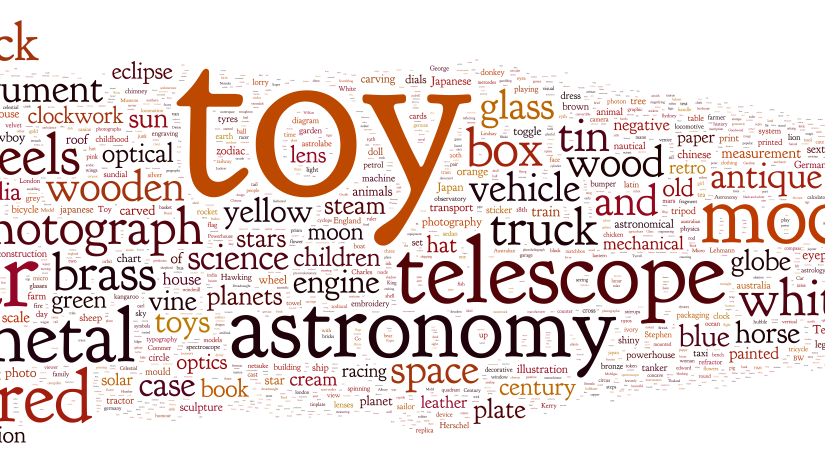
I haven't had a chance to follow up Design constraints and research questions: museum metadata games with a post about the design process for the museum metadata games I've made for my dissertation project (because, stupidly, I slipped on black ice and damaged my wrist), so in the meantime here's a link to an interview Seb Chan did with me for the Fresh+New blog, Interview with Mia Ridge on museum metadata games, and a Wordle of the tags added so far.

There have been nearly 700 turns on the games so far, which have collectively added about 30 facts (Donald’s detective puzzle) and just over 3,700 tags (Dora’s lost data).

Some of the 1,582 unique tags added so far

Design constraints and research questions: museum metadata games

Back in June I posted parts of my dissertation project outline in 'Game mechanics for social good: a case study on interaction models for crowdsourcing museum collections enhancement'. Since then, I've been getting on with researching, designing, building and evaluating museum metadata games (in my copious spare time after work, in a year when we launched three major galleries).

I'm planning to blog bits of my dissertation as I write it up so there'll be more posts over the next month, but for now I wanted to contextualise the two games I'm evaluating at the moment.  In the next post I'll talk about the changes I made after the first solid round of evaluation.

Casual games
The two games, nicknamed 'Dora' and 'Donald' are designed as casual games – something you can pick up and play for five minutes at a time.  Design goals included: an instantly playable game that provides stress relief, supports a competitive spirit (but not necessarily against other people), inherently rewarding experience, simple game play and puts 'fun before do-gooding'.  The games were designed around a specific research-based persona ('Meet Janet', pdf link) – hopefully it's exactly right for some people who are close to the persona in various ways, and quite fun for a wider group.  It won't suit everyone, not least because definitions of 'fun' and expectations around 'games' can be deeply individual.

Design constraints
The games are also designed to test ideas about the types of objects and records that can be used successfully, and the types of content people would be able to contribute about the less charismatic and emotionally accessible reaches of science, technology and social history collections – this means that some of the objects I've used are quite technical, not all the images are great and small variations on object records are repeated (risking 'not another bloody telescope').  While this might match the reality of museum catalogues, would it still allow for a fun game?

The realities of a project I was building in my free time and my lack of graphic design and illustration skills also provided constraints – it had to be browser-based, it couldn't rely on a critical mass of concurrent players to validate actions or content, it had to help the player dive straight into playing and overcome any fears about creating content about museum objects, and it had to use objects ingested through available museum APIs (I selected broad subjects for testing but didn't individually select any objects).

I then added a few extra constraints by deciding to build it as a WordPress plugin – I wanted to take advantage of the CMS-like framework for user logins, navigation and page layout, and I wanted the code I wrote to be usable by others without too much programming overhead.  I'll need to tidy up the code at the end, but once that's done you should be able to install it on any hosted WordPress installation.  I'm making a related plugin to help you populate the database with objects (also part of an experiment in the effectiveness of letting people choose their own subject areas or terms to select playable objects).  I'll talk more about how I worked with those constraints and how they informed the changes I made after evaluation in a later post.

Different games for different purposes
I've been thinking about a museum metadata game typology, which not only considers different types of fun, but also design constraints like:

  • the type and state of the collection (e.g. art works, technical/specialist and social history objects; photographs and other media vs objects; reference collections vs selected highlights; 'tombstone' vs general vs interpretative records)
  • the type of data sought including information curators could add if they had infinite time (detail on the significance of the object, links to other subjects, people, events, objects, collections, etc); information that can be extrapolated from the existing catalogue record; things curators couldn't know (personal history, experiential accounts about the design, manufacture, use, disposal etc of objects); emotional responses; external specialist knowledge; amateur/hobbyist specialist knowledge; synonyms in every day language; terms in other spoken languages

I've also been playing with the idea of linking different game types to different 'life stages' of museum collection metadata.  For example, some games could help a museum work out which of its catalogued items seem more interesting to the public, others help gather tags, create links between items or encourage players to research objects and record new information or links about them, and others still could work well for validating data created in earlier games.  The data I gather through evaluating the games I've designed will help test this model.

So, all that said, if you'd like to play (and help with my evaluation), the two games are:

Donald's detective puzzle – find a fact about an object
Dora's lost data – a simpler tagging game

What would a digital museum be like if there was never a physical museum?

This is partly an experiment in live-blogging a conversation that's mostly happening on twitter – in trying to bridge the divide between conversation that anyone can jump into, and a sometimes intimidating comment box on an individual blog; and partly a chance to be brave about doing my thinking in public and posing a question before I've worked out my own answer…

I've been thinking about the question 'if physical museums were never invented, how would we have invented digital museums?' for a while (I was going to talk about this at GLAM-WIKI but decided not to subject people to a rambling thought piece exploring the question).  By this I don't mean a museum without objects, rather 'what if museums weren't conceived as central venues?'.  Today, in the spirit of avoiding a tricky bit of PHP I have to deal with on my day off, I tweeted: "Museums on the web, social media, apps – stories in your everyday life; visiting physical museum – special treat, experience space, objects?".  By understanding how the physical museum has shaped our thinking, can we come up with models that make the most of the strengths, and minimise the weaknesses, of digital and physical museums? How and where can people experience museum collections, objects, stories, knowledge? How would the phenomenology of a digital museum, a digital object, be experienced?

And what is a 'museum' anyway, if it's not represented by a building?  In another twitter conversation, I realised my definition is something like: museums are for collections of things and the knowledge around them.

Then a bit of explanation: "Previous tweet is part of me thinking re role of digital in museums; how to reconcile internal focus on physical with reach of digital etc" (the second part has a lot to do with a new gallery opening today at work, and casting my mind back to the opening of Who Am I? and Antenna in June).

Denver Art Museum's Koven J. Smith has been discussing similar questions: 'What things do museums do *exclusively* because of tradition? If you were building a museum from scratch, what would you do differently?'. My response was "a museum invented now would be conversational and authoritative – here's this thing, and here's why it's cool".


Other questions: Did the existence of the earlier model muddy our thinking?  How can we make online, mobile or app visitors as visible (and as important) as physical visitors?  (I never want to see another email talking about 'real [i.e. physical] and online' visitors).

So, what do you think?  And if you've come here from twitter, I'd be so thrilled if you bridged the divided and commented!  I'll also update with quotes from tweets but that'll probably be slower than commenting directly.

Anyway, I can see lots of comments coming in from twitter so I'm going to hit 'publish post' now…

[Update – as it turns out, 'live blogging' has mostly turned into me updating the post with clarifications, and continuing discussion in the comments. I find myself reluctant to re-contextualise people's tweets in a post, but maybe I'm just too sensitive about accidentally co-opting other people's voices/content.  If you want to share something on twitter rather than in a comment, I'm @mia_out.]