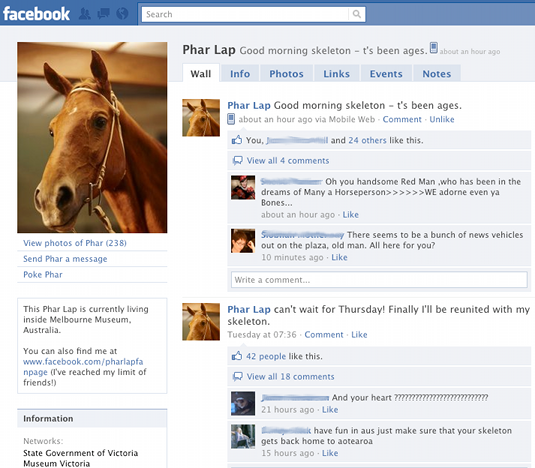
What would a digital museum be like if there was never a physical museum?

This is partly an experiment in live-blogging a conversation that's mostly happening on twitter – in trying to bridge the divide between conversation that anyone can jump into, and a sometimes intimidating comment box on an individual blog; and partly a chance to be brave about doing my thinking in public and posing a question before I've worked out my own answer…

I've been thinking about the question 'if physical museums were never invented, how would we have invented digital museums?' for a while (I was going to talk about this at GLAM-WIKI but decided not to subject people to a rambling thought piece exploring the question).  By this I don't mean a museum without objects, rather 'what if museums weren't conceived as central venues?'.  Today, in the spirit of avoiding a tricky bit of PHP I have to deal with on my day off, I tweeted: "Museums on the web, social media, apps – stories in your everyday life; visiting physical museum – special treat, experience space, objects?".  By understanding how the physical museum has shaped our thinking, can we come up with models that make the most of the strengths, and minimise the weaknesses, of digital and physical museums? How and where can people experience museum collections, objects, stories, knowledge? How would the phenomenology of a digital museum, a digital object, be experienced?

And what is a 'museum' anyway, if it's not represented by a building?  In another twitter conversation, I realised my definition is something like: museums are for collections of things and the knowledge around them.

Then a bit of explanation: "Previous tweet is part of me thinking re role of digital in museums; how to reconcile internal focus on physical with reach of digital etc" (the second part has a lot to do with a new gallery opening today at work, and casting my mind back to the opening of Who Am I? and Antenna in June).

Denver Art Museum's Koven J. Smith has been discussing similar questions: 'What things do museums do *exclusively* because of tradition? If you were building a museum from scratch, what would you do differently?'. My response was "a museum invented now would be conversational and authoritative – here's this thing, and here's why it's cool".


Other questions: Did the existence of the earlier model muddy our thinking?  How can we make online, mobile or app visitors as visible (and as important) as physical visitors?  (I never want to see another email talking about 'real [i.e. physical] and online' visitors).

So, what do you think?  And if you've come here from twitter, I'd be so thrilled if you bridged the divided and commented!  I'll also update with quotes from tweets but that'll probably be slower than commenting directly.

Anyway, I can see lots of comments coming in from twitter so I'm going to hit 'publish post' now…

[Update – as it turns out, 'live blogging' has mostly turned into me updating the post with clarifications, and continuing discussion in the comments. I find myself reluctant to re-contextualise people's tweets in a post, but maybe I'm just too sensitive about accidentally co-opting other people's voices/content.  If you want to share something on twitter rather than in a comment, I'm @mia_out.]

Museums and iterative agility: do your ideas get oxygen?

Re-visiting the results of the survey I ran about issues facing museum technologists has inspired me to gather together some great pieces I've read on museum projects moving away from detailed up-front briefs and specifications toward iterative and/or agile development.

In 'WaterWorx – our first in-gallery iPad interactive at the Powerhouse Museum', Seb Chan writes:

"the process by which this game was developed was in itself very different for us. … Rather than an explicit and ‘completed’ brief be given to Digital Eskimo, the game developed using an iterative and agile methodology, begun by a process that they call ‘considered design‘. This brought together stakeholders and potential users all the way through the development process with ‘real working prototypes’ being delivered along the way – something which is pretty common for how websites and web applications are made, but is still unfortunately not common practice for exhibition development."

I'd also recommend the presentation 'Play at Work: Applying Agile Methods to Museum Website Development' given at the 2010 Museum Computer Network Conference by Dana Mitroff Silvers and Alon Salant for examples of how user stories were used to identify requirements and prioritise development, and for an insight into how games can be used to get everyone working in an agile way.  If their presentation inspires you, you can find games you can play with people to help everyone understand various agile, scrum and other project management techniques and approaches at tastycupcakes.com.

I'm really excited by these examples, as I'm probably not alone in worrying about the mis-match between industry-standard technology project management methods and museum processes. In a 'lunchtime manifesto' written in early 2009, I hoped the sector would be able to 'figure out agile project structures that funders and bid writers can also understand and buy into' – maybe we're finally at that point.

And from outside the museum sector, a view on why up-front briefs don't work for projects that where user experience design is important.  Peter Merholz of Adaptive Path writes:

"1. The nature of the user experience problems are typically too complex and nuanced to be articulated explicitly in a brief. Because of that, good user experience work requires ongoing collaboration with the client. Ideally, client and agency basically work as one big team.

2. Unlike the marketing communications that ad agencies develop, user experience solutions will need to live on, and evolve, within the clients’ business. If you haven’t deeply involved the client throughout your process, there is a high likelihood that the client will be unable to maintain whatever you produce."

Finally, a challenge to the perfectionism of museums.  Matt Mullenweg (of WordPress fame), writes in '1.0 Is the Loneliest Number': 'if you’re not embarrassed when you ship your first version you waited too long'.  Ok, so that might be a bit difficult for museums to cope with, but what if it was ok to release your beta websites to the public?  Mullenweg makes a strong case for iterating in public:

"Usage is like oxygen for ideas. You can never fully anticipate how an audience is going to react to something you’ve created until it’s out there. That means every moment you’re working on something without it being in the public it’s actually dying, deprived of the oxygen of the real world.

By shipping early and often you have the unique competitive advantage of hearing from real people what they think of your work, which in best case helps you anticipate market direction, and in worst case gives you a few people rooting for you that you can email when your team pivots to a new idea. Nothing can recreate the crucible of real usage.

You think your business is different, that you’re only going to have one shot at press and everything needs to be perfect for when Techcrunch brings the world to your door. But if you only have one shot at getting an audience, you’re doing it wrong."

* The Merholz article above is great because you can play a fun game with the paragraph below – in your museum, what job titles would you put in place of 'art director' and 'copywriter'?  Answers in a comment, if you dare!  I think it feels particularly relevant because of the number of survey responses that suggested museums still aren't very good at applying the expertise of their museum technologists.

"One thing I haven’t yet touched on is the legacy ad agency practice where the art director and copywriter are the voices that matter, and the rest of the team exists to serve their bidding. This might be fine in communications work, but in user experience, where utility is king, this means that the people who best understand user engagement are often the least empowered to do anything about it, while those who have little true understanding of the medium are put in charge. In user experience, design teams need to recognize that great ideas can come from anywhere, and are not just the purview of a creative director."


If you liked this post, you may also be interested in Confluence on digital channels; technologists and organisational change? (29 September 2012) and A call for agile museum projects (a lunchtime manifesto) (10 March 2009).

Survey results: issues facing museum technologists

In August 2010 I asked museum technologists to take a survey designed to help me understand and communicate the challenges faced by other museum technologists (as reported in 'What would you change about your workplace? A survey for museum technologists', and as promised, I'm sharing the results (a little later than intended, but various galleries and my dissertation have been keeping me busy).

There were 79 responses in total, (49 complete responses, the rest were partial).  According to SurveyGizmo's reporting the survey had responses from 10 countries.  The vast majority were from the UK (36%) and the US (49%), possibly reflecting the UK and US focus of the email lists where I publicised the survey.  Respondents were based in a wide range of art, history, science, local authority/government, university and specialist museums (in almost any combination you can think of) and had a variety of roles, including content, technical, project managers and managerial titles.  As reported originally, for the purposes of the survey I defined 'museum technologist' as someone who has expertise and/or significant experience in the museum sector and with the application or development of new technologies.

I've done my own coding work on the results, which I could also share, but I suspect there's more value in the raw results.  I'm also sharing the results to the first two questions as CSV files (compatible with most applications) so you can download and analyse the data: CSV: As a museum technologist, what are the three most frustrating things about your job?, CSV: List any solutions for each of the problems you listed above.  Please note that the data in these files is alphabetised by row, so you should not correlate responses by row number.

My thanks to the people who took the time to respond – I hope there's some value for you in this sampling of the challenges and joys of digital work in museums.  I'd love to hear from you if you use the results, either in a comment or via email.

Question 1: As a museum technologist, what are the three most frustrating things about your job?

First response box:

An institutional culture that values curatorial opinion over the expertise of technologists
Bad management
Becoming impossible to do new work AND maintain existing sites.
Bureaucracy
Central ICT department not being supportive
Colleagues who think of things digital as somehow separate and of lesser importance
Committees
Convincing administration of the value of new technology
Difficulty accessing social networking sites/FTP/etc through Council systems
Funding (lack of)
Going over the same ground again and again
I spend a lot of time doing non-tech work, or helping people with basic IT issues
IT department not implementing effective change management and training.
IT dept walls
IT infrastructure – restrictions and problems
Image rights
Institutional IT provision
Justifying new technologies
Lack of Resources (People)
Lack of clear copyright procedure hampers the greatest ideas
Lack of committment reuslting in long drawn out meetings that never go anywhere
Lack of communication
Lack of decision making from senior management at early stages in the project
Lack of interest in updating technology
Lack of planning
Lack of power to influence major decision making
Lack of resources for web tools/infrastructure
Lack of understanding of what we (as technologists) are trying to achieve
Lack of updated skills in co-workers
Lukewarm funding
Overcoming bureaucracy and overly cautious policy to try new technologies in a timely manner
Pace of sign off
People assuming I know everything about every technology
Senior managment attitudes
Trying to encourage change for the greater good
Unreasonable objectives
Varying age of equipment
Working within IT limitations
Working within existing budgets
bureaucratic oversight
clarity & simplicity of goals
data migration
dfdf
fear of change
getting buy in from people who don't understand the technology
imprecise demands
insufficient staff resources
lack of communication between team members
lack of vision
lengh of time from concept to implementation (it is too long)
mmmm
no $$ for training
not being included early enough in planning processes
not enough time
reactionary IT managers
too many stakeholders and a very conservative attitude to sign off
unrealistic expectations
Getting the management of the museum to take the web seriously and use it themselves to try to understand it
The decentralized culture of our Museum. Each department is doing their own thing, which makes it difficult to access needs, plan for improvements, allocate resources and staff efficiently.
The little understanding colleagues have of the challenges faced (e.g. building a professional website is doable in 1 week with a 300€ budget)
Lack of understanding of digital audiences, trends, issues and technologies by those commissioning digital projects (I call it 'and then it needs a website' syndrome
The organizational structure of the museum. The IT Department should be for networking, desktop support and infrastructure but instead they end up being the ones who call the shots about applications and systems.
Integrating our technologies and ideas into the museum's IT infrastructure e.g. wireless hubs, installing software, updating software etc.

Second response box:

"shiny new toy" syndrom
Assortment of operating systems
Bureaucracy
Changing priorites
Enforcing efficient use of storage space (delete your DUPES!)
Excessive review cycles
Gaining buy-in from overworked staff who need to contribute to tech project
Getting curators to take the web seriously and want to use it
Having other people re-invent things I invented 10 years ago
Institutional IT provision
Institutional blindness to the outside world (i.e., "nobody actually trusts Wikipedia")
Interdepartmental Workflow
Internal "Ownership" of information
Justifying the expense/time of trialling and sharing new ideas
Lack of Finance
Lack of appreciation for the amount of work involved
Lack of funding
Lack of medium/long term visions
Lack of shared museum assets (inter and intra)
Lack of understanding of digital media by senior executives
Lack of understanding of my role at more senior levels and by my peers
Non-existent budgets
Ph.D syndrome.
Some staff negativity about integrating new technologies
Stodgy curators
Tempering desire with reality
Time to just 'play' with new technologies
Too many egos
Too many people involved
Too many tasks seen as top-priority without enough support to get them done.
Understaffed and underfunded
Unwillingness to try small cheap ideas (on the understanding that if they don't work you stop)
Upper management not grasping value of online outreach
Working in isolation
board and execs who are focused on shiny objects, not mission
dealing with the ramifications of technology decisions made by non-technical employees
entrenched views on how things should be done
funding and management structures that lead to short term, siloed thinking
inability to ack quickly and be flexible (cumbesome review process ties up projects)
inablility of coworker to understand projects
institutional resources
lack of staff time or positions alotted to technology (two minds are better than one)
mmm
no say over even how our web page is designed
not enough money
poor instructions
sparse training
tendency for time to get sucked into general office work
unprofessionalism
unreasonable expectations
unwillingness to fund projects
Lack of understanding in the wider museum of the work that we do and the potentials of technologies in learning.
People in museum administration often know less about technologies than their counterpart in the private sector.
Lack of training offered on national scale for those who are beyond beginner level with technology but not an expert
Not having admin rights to my computer and not being allowed to connect my own laptop to the work network
The expectation of a high-impact web presence without making the appropriate content available (in time)
Never knowing what others departments are doing, but still being expected to "fix" whatever when it goes down.
The little commitment others (even people asked/hired to do so) have towards social media, even after tons of workshops.
Turf wars – different staff not working toward a consensus; arguments are recycled and nothing is ever finalized
redundancy–for example, entering metadata for an image from an external source and entering it into our DAM
Funding is spread unevenly. New galleries might come with big pots of money but it's much harder to fund work on existing sites and sections.
Lack of IT understanding by other staff in the museum and in some cases a negative attitude to putting stuff online

Third response box:

"non-profit" pay and no insurance
Always defending my position to condescending curators
Assortment of learning curves among staff
Balancing the demands of day to day tasks with the desire to expand IT use
Bending commercial products to our own needs.
Communication barriers
Conflicting messages about the purpose of online – is it to generate income or provide access?
Cross departmental walls
Cultural stigmatism
Curators/educators living in the dark ages!
Difficulty finding funding/support for less visible tech projects (content architecture, etc.)
Division between web/curatorial/education/etc.
Everyone is scared
Explaining complex systems to co-workers with limited tech background
Getting "sign off"
Hard to sell technology (APIs, etc) to staff who just want their event on the homepage.
Institutional IT provision
Keeping up with web science/standards
Lack of by in by senior management
Lack of change management at institutions
Lack of communication
Lack of professional development
Lack of support
Little allowance to "try out" tech tools/software/web
No time to experiment and try out new things
Projects never finished
Reliance on external consultants
Secret stakeholders appearing late in the production cycle
Software provider lack of focus on end users and Web
That every bit of the organisation has to be involved in every project
Too much dependence on content producers, e.g. curators, gallery authors, education staff
Trying to get other colleagues involved in technology!
Willingness of colleague tech adoption
capacity of organizations to take leaps of faith
dealing with art historians
defining projects in terms of ROI
frequent interruptions during thought-intensive work
lack of adminstrative support in the way of $$
lack of forward planning
misunderstanding of implications
mmm
not enough focus on early prototyping before the tech comes in
not enough staff
not enough staff and too many things to do…
not enough time
passive/aggressive behavior
resistance to new technologies on the basis of their perceived danger/risk
strong aversion to risk-taking, which hampers innovation
supporting software that was incorrectly chose (e.g. retrofitting a CMS to act as a DAMS)
user incompetence
wide range knowledgement needed
Magical thinking about technology: somehow hoping projects will be cheap and cutting edge with few resources devoted to them
There's a web/multimedia team, but all the exhibition design is outsourced, so it's difficult to mount integrated digital projects (that work both online and onsite)
disconnects between depts in larger museums, that make it hard to get all those who could contribute to and benefit from digital projects really engaged
Irrational fear of open source; irrational fears concerning access to collection information and even low-res images.
The fact that doing "online stuff" means you have to solve every problem related to technology ("My iPhone doesn't synch my music, help!")
Convincing staff to use project results (this is true for some staff in key positions. Other staff happy to use the results)
my department uses a DAM system, but others outside my department won't use it but want access to the content archived there

Question 2: List any solutions for each of the problems you listed above

First response box:

$$ for training would be easy to get
Better IT training and also digital awareness training for all staff
Better investment
Better organisational understanding of the importance of project management
Better qualified staff – training
Circumnavigating IT when they sya can't do and supporting it all ourselves.
Cloud based
Creative use of budgets – taking parts from several budgets to make a whole
Education
Fewer and smaller
Focusing on the benefits of the new technology when presenting changes to staff
Good management
Greater funding support for equipment
Hiring further staff
IT managers who are less about security and NO and more about innovation
Improve communication by removing large egos
Keeping to meeting agendas and ensuring people involved are enthusiastic about the project
Long term strategy agreed at top levels to ringfence time and money for non-project based work
Lots of demonstrations
Make responsibilities of depts clearer
Meetings, Meetings, Meetings
More independence from IT
More staff!
Much clearer policy on approach to copyright, possibly by museums supporting one another
New, professionally trained management
Sack the lot of them and start again
Strict procedures and continuously stressing how things work and how they don't.
The acknowledgement at senior levels of competence and experience further down the scale
Training in Project Management
Upgrade technology to a consistent level
Willingness to learn
come up with your own
educate administration, show them how other museums are taking advantage, find funding
fundraising
no foreseeable increase in staffing, so no luck here
none in sight
planning
solutions that we have found or solutions we wish for? The questions is confusing.
steel myself to do it once more in a way that means they can't forget it
umm..if I had a solution I'd be rich :)
Adjust the expectations by explaining the process more in depth and always provide more conservative time estimates, and times that by 150%
We are now submitting a business case to our IT department for us to have access to these sites. Hopefully this will be widened in the future as Council's become more aware of the essential part technology plays in museums.
reallocation of institutional resources to recognise changing technological and social environment
Having highly-placed technologists who are trusted by the museum involved in projects at an early state can help significantly to teach the institution the value of technological expertise.
Advocate your work to anyone who will listen, get involved in projects from the beginning – and try not to let technology lead, only support good ideas
Rethinking contracting policies–especially for Web 2.0 services that are free–and approval processes
Look to private sector technology vendors for workflow and project management techniques and tools or hire consultants (voices from outside are often heard louder than those inside).

Second response box:

$$ we are given we do not always get
Allowing staff to make their own decisions
Cost effective training or events or 'buddying up' to share expertise and experiences
Crossover training
Don't tell, stay away from committees until you have something (good) to show
Encouraging positive comment and activity from outside
Establish an agreed level of autonomy and freedom for web projects
Fix to IT issues that take up so much of my time!
Fundraising specifically for technology as an ongoing need–not just project by project
Involvement of Technologists before design
More educated staff about abilities and weaknesses of technology
More funding and resources for projects
More rewarding work environment
More tech-savvy upper management (happened recently)
More training being offered via bodies such as Museums Galleries Scotland
More trust in teams
New, professionally developed board
Outside normzl dept relationships
Priorities either need coherent justification or to be realigned.
Reassigning permissions
Recruit more staff and do more work in house
Remove large egos
Request more specificity and detail
Speaking to people to explain the complexity and time necessary for project?
Streamlining Project Management
The creation of roles at a senior level with understanding of technology
Training for staff
Trying to get a pot on our web page for e-learning which displays and advocates our work.
agreement on acceptable standards for public facing databases
occasionally half-successful compartmentalization of time spent on specialized and general work
question assumptions
shoot the current managers
sponsorships
strong compromise with staff training
technology being an embedded part of the work, like education
would require a wholesale change in Museum culture – not likely to happen quickly
institution-wide training in Word, PowerPoint, Excel etc AND in newer more interesting tools for presentations (eg Prezi), data visualisation (ManyEyes, Wordle) etc
Increase levels of digital literacy through out organisation and sector by training, workshops and promotion
Write in the importance of technology projects to accomplishing the mission in strategic planning and grant documents and form interdepartmental teams of people to address technology issues and raise technology's profile and comfort level within the institutional culture.
make sure to 'copyright' my own inventions and publicise them before anyone else needs to re-invent them
Show them that colleagues in their field are using the same technology, once they're willing to listen, show how the results will help them, then make participation as easy as possible for them.
If, for every bit of unfounded, unresearched opinion, the technologist can counter with facts about how people actually behave in the world outside the museum, over (large stretches of) time this problem can be gradually allayed.
Presenting the case for how technology can do certain things really well and how it is best find the better fit than to force technology to be what it isn't
Our institution could benefit from professional training on effective communication, but it's not in the budget.
Organising lunches and other team activities to continuously explain and inspire people about new and social media

Third response box:

(Sadly) winning awards
Admin-down promotion of tech initiative adoption
Agreement on stakeholders and sign off processes up front – and sticking to that
Be very strict with project deadlines!
Better communications from the top
Developing a Museum Service strategy for everyone to use IT – like V&A have!
Education
Ensuring that people at senior levels support digital projects
Go and do. Prototype to prove point
Good management
Hired more competent users or remove technically-involved tasks from users
I think we need new ways of demonstrating value other than £s or people through the door
Identify internal skills before commissioning outside consultants
Improved communications – more vision
Informal brown-bag lunches where ideas are pitched and potential explained.
Inventiveness!
Longer timelines, adequate staffing levels
Look for oppurtunity to learn more and implement new systems that help with the day to day work
Make it as easy as possible to use the results
Museums need to start thinking more like libraries
No idea how we can make LA central ICt departments more helpful
Outsource all IT relating to web projects
Professional development for staff
Remove large, scary egos
Smile, help them, and complain in silence.
Some inovative young blood in these roles
Technologists in upper management
Try something small as a pilot to reveal realistic benefits and pitfalls
act of God
bringing techies into the development process earlier in a new exhibit etc.
ditto
effective allocation of scarce resources
rewriting job descriptions to incorporate tech initiatives into everyday tasks
specialization
there is no solution for art historians except possibly to keep them out of museums and galleries
time-shifting certain kinds of work to early morning or evening, outside regular hours
Trying to find public outputs of infrastructure-related technology can help with this problem. The way some museums have begun using collections APIs as, in essence, a PR tool, is a good example of this approach.

Selected responses to Question 3: Any comments on this survey or on the issues raised?

Some comments were about the survey itself (and one comment asked not to be quoted, so I've played it safe and not included it) and didn't seem relevant here.

  • Would like to know what other museum staff feel, but am guessing response may be very similar
  • There is still some trepidation and lack of understanding of what it is exactly that digital technology can play in display, interpretation and education programming. Though there are strong peer networks around digital technology, somehow this doesn't get carried over into further advocacy in the sector in general. In my learning department there is some resistance to the idea of technology being used as a means in itself working across audiences, and it instead has to be tied in to other education officers programmes. The lack of space to experiment and really have some time to develop and explore is also sadly missed as we are understaffed and overstretched.
  • Not enough time, money or staff is true of most museum work, but particularly frustrating when looking at the tools used by the private sector. This imbalance may be part of the source of unreasonable expectations – we've all seen fantastic games and websites and expect that level of quality, but museums have 1/1000th of the budget of a video game studio.
  • The interdepartmental nature of many tech projects has challenged us to define under whose purview these projects should be managed.
  • In my organisation I find the lack of awareness and also lack of desire to do things online difficult to comprehend in this day and age. It is not universal, fortunately the Head of Service gets it but other managers don't. I'm fed up hearing 'if its online they won't visit' and I'm afraid I've given up trying to convince them, instead I tend to just work with the people who can see that putting stuff online can encourage visitors and enhance visits for visitors.
  • Being a federal institution, we receive funds for physical infrastructure, but rarely for technical infrastructure. I would say fear around copyright of digitized collections is a barrier as well.
  • Until the culture of an institution of my size changes at the top, it will continue to be a challenge to get anything through in a timely manner.
  • Funding and resources (staff, time, etc.) are the main roadblock to taking full advantage of the technology that's out there.
  • There needs to be a way to build a proper team within the museum structure and make silos of information available.
  • I think the frustrations I raised are exactly the reason why some of us are in the museum sector – for the challenge.
  • We are fortunate in that we have a very forward-looking Board of Trustees, a visionary CEO and a tech team that truly loves what they do. But we – like any non-profit – are always limited by money and time. We've got loads of great ideas and great talent – we just need the means and the time to be able to bring them to fruition! We have actually rewritten job descriptions to make certain things part of people's everyday workflow and that has helped. Our CEO has also made our technological initiatives (our IVC studios, our online presence, our virtual museum….) part of our strategic plan. So we are extremely fortunate in those respects!
  • I am a content creator, rather than a technie, but as my role is digital, everyone assumes I understand every code language and technological IT issue that there is. And I don't.
  • why is it that those who are not involved in our work have so much to say about how we do our work down to the last detail
  • One of the largest problems faced by IT staff in museums is the need to push the envelop of technology while working within very limited budgets. There is always a desire to build the newest and best, but a reluctance to staff and budget for the upkeep and eventual use and maintenance of the new systems. That said, working for a museum environment offers more variety and interesting projects than any for-profit job could ever provide.

Notes from Europeana's Open Culture Conference 2010

The Open Culture 2010 conference was held in Amsterdam on October 14 – 15. These are my notes from the first day (I couldn't stay for the second day). As always, they're a bit rough, and any mistakes are mine. I haven't had a chance to look for the speakers' slides yet so inevitably some bits are missing.  If you're in a hurry, the quote of the day was from Ian Davis: "the goal is not to build a web of data. The goal is to enrich lives through access to information".

The morning was MCd by Costis Dallas and there was a welcome and introduction from the chair of the Europeana Foundation before Jill Cousins (Europeana Foundation) provided an overview of Europeana. I'm sure the figures will be available online, but in summary, they've made good progress in getting from a prototype in 2008 to an operational service in 2010. [Though I have written down that they had 1 million visits in 2010, which is a lot less than a lot of the national museums in the UK though obviously they've had longer to establish a brand and a large percentage of their stats are probably in the 'visit us' areas rather than collections areas.]

Europeana is a super-aggregator, but doesn't show the role of the national or thematic aggregators or portals as providers/collections of content. They're looking to get away from a one-way model to the point where they can get data back out into different places (via APIs etc). They want to move away from being a single destination site to putting information where the user is, to continue their work on advocacy, open source code etc.

Jill discussed various trends, including the idea of an increased understanding that access to culture is the foundation for a creative economy. She mentioned a Kenneth Gilbraith [?] quote on spending more on culture in recession as that's where creative solutions come from [does anyone know the reference?]. Also, in a time of Increasing nationationalism, Europeana provided an example to combat it with example of trans-Euro cooperation and culture. Finally, customer needs are changing as visitors move from passive recipients to active participants in online culture.

Europeana [or the talk?] will follow four paths – aggregration, distribution, facilitation, engagement.

  • Aggregation – build the trusted source for European digital cultural material. Source curated content, linked data, data enrichment, multilinguality, persistent identifiers. 13 million objects but 18-20thC dominance; only 2% of material is audio-visual [?]. Looking towards publishing metadata as linked open data, to make Europeana and cultural heritage work on the web, e.g. of tagging content with controlled vocabularies – Vikings as tagged by Irish and Norwegian people – from 'pillagers' to 'loving fathers'. They can map between these vocabularies with linked data.
  • Distribution – make the material available to the user wherever they are, whenever they want it. Portals, APIs, widgets, partnerships, getting information into existing school systems.
  • Facilitate innovation in cultural heritage. Knowledge sharing (linked data), IPR business models, policy – advocacy and public domain, data provider agreements. If you write code based on their open sourced applications, they'd love you to commit any code back into Europeana. Also, look at Europeana labs.
  • Engagement – create dialogue and participation. [These slides went quickly, I couldn't keep up]. Examples of the Great War Archive into Europe [?]. Showing the European connection – Art Nouveau works across Europe.

The next talk was Liam Wyatt on 'Peace love and metadata', based in part on his experience at the British Museum, where he volunteered for a month to coordinate the relationship between Wikipedia as representative of the open web [might have mistyped that, it seems quite a mantle to claim] and the BM as representatiave of [missed it]. The goal was to build a proactive relationship of mutual benefit without requiring change in policies or practices of either. [A nice bit of realism because IMO both sides of the museum/Wikipedia relationship are resistant to change and attached firmly to parts of their current models that are in conflict with the other conglomeration.]

The project resulted in 100 new Wikipedia articles, mostly based on the BM/BBC A History of the World in 100 Objects project (AHOW). [Would love to know how many articles were improved as a result too]. They also ran a 'backstage pass' day where Wikipedians come on site, meet with curators, backstage tour, then they sit down and create/update entries. There were also one-on-one collaborators – hooking up Wikipedians and curators/museums with e.g. photos of objects requested.

It's all about improving content, focussing on personal relationshiips, leveraging the communities; it didn't focus on residents (his own work), none of them are content donation projects, every institution has different needs but can do some version of this.

[I'm curious about why it's about bringing Wikipedians into museums and not turning museum people into Wikipedians but I guess that's a whole different project and may be result from the personal relationships anyway.]

Unknown risks are accounted for and overestimated. Unknown rewards are not accounted for and underestimated. [Quoted for truth, and I think this struck a chord with the audience.]

Reasons he's heard for restricting digital access… Most common 'preserving the integrity of the collection' but sounds like need to approve content so can approve of usages. As a result he's seen convoluted copyright claims – it's easy tool to use to retain control.

Derivative works. Commercial use. Different types of free – freedom to use, freedom to study and apply knowledge gained; freedom to make and redistribute copies; [something else].

There are only three applicable licences for Wikipedia. Wikipedia is a non-commercial organisation, but don't accept any non-commercially licenced content as 'it would restrict the freedom of people downstream to re-use the content in innovative ways'. [but this rules out much museum content, whether rightly or not, and with varying sources from legal requirements to preference. Licence wars (see the open source movement) are boring, but the public would have access to more museum content on Wikipedia if that restriction was negotiable. Whether that would outweight the possible 'downstream' benefit is an interesting question.]

Liam asked the audience, do you have a volunteer project in your institution? do you have an e-volunteer program? Well, you do already, you just don't know it. It's a matter of whether you want to engage with them back. You don't have to, and it might be messy.

Wikipedia is not a social network. It is a social construction – it requires a community to exist but socialising is not the goal. Wikipedia is not user generated content. Wikipedia is community curated works. Curated, not only generated. Things can be edited or deleted as well as added [which is always a difficulty for museums thinking about relying on Wikipedia content in the long term, especially as the 'significance' of various objects can be a contested issue.]

Happy datasets are all alike; every unhappy dataset is unhappy in its own way. A good test of data is that it works well with others – technically or legally.

According to Liam, Europeana is the 21st century of the gallery painting – it's a thumbnail gallery but it could be so much more if the content was technically and legally able to be re-used, integrated.
Data already has enough restrictions already e.g. copyright, donor restrictions. but if it comes without restrictions, its a shame to add them. 'Leave the gate as you found it'.

'We're doing the same thing for the same reason for the same people in the same medium, let's do it together.'

The next sessions were 'tasters' of the three thematic tracks of the second part of the day – linked data, user-generated content, and risks and rewards. This was a great idea because I felt like I wasn't totally missing out on the other sessions.

Ian Davis from Talis talked about 'linked open culture' as a preview of the linked data track. How to take practices learned from linked data and apply them to open culture sector. We're always looking for ways to exchange info, communicate more effecively. We're no longer limited by the physicality of information. 'The semantic web fundamentally changes how information, machines and people are connected together'. The semantic web and its powerful network effects are enabling a radical transformation away from islands of data. One question is, does preservation require protection, isolation, or to copy it as widely as possible?

Conjecture 1 – data outlasts code. MARC stays forever, code changes. This implies that open data is more important than open source.
Conjecture 2 – structured data is more valuable than unstructured. Therefore we should seek to structure our data well.
Conjecture 3 – most of the value in our data will be unexpected and unintended. Therefore we should engineer for serendipity.

'Provide and enable' – UK National Archives phrase. Provide things you're good at – use unique expertise and knowledge [missed bits]… enable as many people as possible to use it – licence data for re-use, give important things identifiers, link widely.

'The goal is not to build a web of data. The goal is to enrich lives through access to information.'
[I think this is my new motto – it sums it up so perfectly. Yes, we carry on about the technology, but only so we can get it built – it's the means to an end, not the end itself. It's not about applying acronyms to content, it's about making content more meaningful, retaining its connection to its source and original context, making the terms of use clear and accessible, making it easy to re-use, encouraging people to make applications and websites with it, blah blah blah – but it's all so that more people can have more meaningful relationships with their contemporary and historical worlds.]

Kevin Sumption from the National Maritime Museum presented on the user-generated content track. A look ahead – the cultural sector and new models… User-generated content (UGC) is a broad description for content created by end users rather than traditional publishers. Museums have been active in photo-sharing, social tagging, wikipedia editing.

Crowdsourcing e.g. – reCAPTCHA [digitising books, one registration form at a time]. His team was inspired by the approach, created a project called 'Old Weather' – people review logs of WWI British ships to transcribe the content, especially meterological data. This fills in a gap in the meterological dataset for 1914 – 1918, allows weather in the period to be modelled, contributes to understanding of global weather patterns.

Also working with Oxford Uni, Rutherford Institute, Zooniverse – solar stormwatch – solar weather forecast. The museum is working with research institutions to provide data to solve real-world problems. [Museums can bring audiences to these projects, re-ignite interest in science, you can sit at home or on the train and make real contributions to on-going research – how cool is that?]

Community collecting. e.g. mass observation project 1937 – relaunched now and you can train to become an observer. You get a brief e.g. families on holidays.

BBC WW2 People's War – archive of WWII memories. [check it out]

RunCoCO – tools for people to set up community-lead, generated projects.

Community-lead research – a bit more contentious – e.g. Guardian and MPs expenses. Putting data in hands of public, trusting them to generate content. [Though if you're just getting people to help filter up interesting content for review by trusted sources, it's not that risky].

The final thematic track preview was by Charles Oppenheim from Loughborough University, on the risks and rewards of placing metadata and content on the web. Legal context – authorisation of copyright holder is required for [various acts including putting it on the web] unless… it's out of copyright, have explicit permission from rights holder (not implied licence just cos it's online), permission has been granted under licensing scheme, work has been created by a member of staff or under contract with IP assigned.

Issues with cultural objects – media rich content – multiple layers of rights, multiple rights holders, multiple permissions often required. Who owns what rights? Different media industries have different traditions about giving permission. Orphan works.

Possible non-legal ramifiations of IPR infringements – loss of trust with rights holders/creators; loss of trust with public; damage to reputation/bad press; breach of contract (funding bodies or licensors); additional fees/costs; takedown of content or entire service.

Help is at hand – Strategic Content Alliance toolkit [online].

Copyright less to do with law than with risk management – assess risks and work out how will minimise them.

Risks beyond IPR – defamation; liability for provision of inaccurate information; illegal materials e.g. pornography, pro-terrorism, violent materials, racist materials, Holocaust denial; data protection/privacy breaches; accidental disclosure of confidential information.

High risk – anything you make money from; copying anything that is in copyright and is commercially availabe.
Low risk – orphan works of low commercial value – letters, diaries, amateur photographs, films, recordings known by less known people.
Zero risk stuff.
Risks on the other side of the coin [aka excuses for not putting stuff up]
One reason why (science) museums rock

When I started work at the Science Museum a few years ago, after five years with a social history museum and archaeology service, I was curious about how the additional tasks of communicating scientific principles, contemporary science news and the history of science and technology would affect interpretation, collections and exhibitions. With that in mind, I did some research about science museums and came across an article about the impact of the Palais de la Découverte (a science museum in Paris) translated for me as:

In a recent work entitled 'Comment devient-on scientifique?' (How does one become a scientist?) published by Editions EDP, Florence Guichard indicates the results of a survey undertaken in the Ile-de-France: 60% of scientists over 30 and 40% of scientists under 30 claim, without prompting, that the Palais de la Découverte triggered their vocation. Pierre Gilles of Gennes, the winner of the Nobel prize for Physics is one of those 'lovers' of thePalais de la Découverte who was still visiting the place a few years before his death in 2007.

[Update – coincidentally, the day after posting, I came across another reference to the impact of science museums on children's interest in science:] The evolution of the science museum:

When did scientists first become interested in science? A 1998 survey of 1400 scientists, conducted by the Roper Starch organization for the Bayer Foundation and NSF, reported that a respected adult, such as a parent, was the biggest factor in stimulating childhood interest in science. […] a variety of informalactivities had an effect. […] 76 percent said science museum visits

That's pretty amazing.  But ok, for people who aren't scientists, why does science matter?  Well, for a start, the UK needs to keep up with the rest of the world, and there are global problems that we need scientists to help solve.  At about the same time, President Obama stated in his inaugural address that he would "restore science to its rightful place". Ed Yong, among others, answered the question, so 'what is science's rightful place?':

…underneath all of the detail lie some basic principles that science is built upon and these, I feel, ought to be more mainstream than they perhaps are. We should be strive to be unceasing in our curiosity, rational in our explanations and accurate in our communication. We should value inquiry and the power of evidence to change opinions. We should be unflinching in our search for understanding and the desire to test the world around us.

There is no question in my mind that these tenets should act as guides to our lives (albeit not exclusively; they are necessary, rather than sufficient). This is the greatest contribution of science to society. It acts as a stimulant that keeps us from sleepwalking through a wonderland. It is a cloth that wipes away superstition and myths to reveal an ever-closer approximation of the truth. It is a mental prophylactic that shields our minds from the folly of confirmation bias or the lure of unrepresentative anecdotes.

Tell people about the latest discoveries and many will ask what the significance is to their lives. In some cases, there's no way to answer that – they either appreciate it or they don't. But the very question misses an important point. The actual results may not be relevant but the principles that underlie them most definitely are, and they are omnipresent. Curiosity. Investigation. Communication. What could be more human or more pertinent to our casual existence?

The UK curriculum (key stage 1, key stage 3) aims to teach the value of scientific enquiry and perhaps fire a lifelong 'curiosity about phenomena in the world around them', and I suspect science museums make that teaching just a bit easier.  I know that the majority of people I talk to can still remember their school visit to science museums, but I haven't yet asked them what effect it might have had on their lives – does anyone know of any research?

'Go forth and digitise' – Bill Thompson at OpenTech 2010

I've realised events like OpenTech are a bit like geek Christmas – a brief intense moment of brilliant fun with inspiring people who not only get what you're saying, they'll give you an idea back that'll push you further… then it's back to the inching progress of everyday life, but hopefully with enough of that event energy to make it all easier. Anyway, enough rambling and onto my sketchy notes from the talk. Stuff in square brackets is me thinking aloud, any mistakes are mine, etc.

Giving the Enlightenment Another Five Hundred Years, Bill Thompson
Session 3, Track A #3A
[A confession – working in a museum, and a science museum at that, I have a long-standing interest in conserving enough of the past to understand the present and plan for the future, and just because it's fascinating. It was ace to hear from someone passionate about the role of archives and cultural heritage in the defence of reason, and even more ace to see the tweets flying around as other people got excited about it too.]

The importance of the scientific method; of asking hard questions and looking for refutation not confirmation.

But surely history is all about progress – what could go wrong? But imagine President Palin… History has shown that it's possible for progress to go backwards.

What can we do? He's not speaking on behalf of the BBC here, but his job is to figure out what you can do with the BBC's archive. [Video of seeing the BBC charter – the powerful impact of holding the actual physical object is reason enough to conserve things from the past, it's an oddly visceral connection to the people who made it that I've noticed again and again while working in museums and archaeology.]

We need to remember. To remember is to understand, to resist. We need to digitise. Remembering comes along with digitising; our experience of the world is so mediated by bits that unless we makes archives digital in some form, there's a real danger that they will be forgotten, inaccessible. Also need to build mechanisms so that stuff that's created now are preserved alongside the records of the past. We need to do it all. If we do it well, we'll give current and future generations the evidence they need to resist the onslaught of ignorance, the tide of unreason that's sweeping the world. Need to create reasonable digitisation of solid artefacts too.

We need to do it soon 'because the kids may not want to'. The technology exists but thinks there's a real danger that if not done in the next ten years, it won't be done; people won't realise the value of the archives and understand why it has to be done. Kids who've grown up on Google will never do the deep research that will take them to the stuff that's not digitised; non-digital stuff will fall into disuse; conservation/preservation will stop.
Don't let Google do it, they don't value the right things.

Once it's in bits, preserve the data and the artefact; catalogue it, make it findable, make it usable – open data world meets open knowledge world. Access to APIs and datasets is important to make sure material can be found. If you know it's there you can ask for it to be digitised. Build layers on top of the assets that have been digitised.

Need to make it usable so have to sort out the rights fiasco… Need a place to put it all, not sure that exists yet. New tools, services, standards so it can be preserved forever and found in future. Not a trivial task but vitally important. The information in the archives supports true understanding. Possibility of doing something transformative at the moment. [He finished with:] 'Go forth and digitise. And don't forget the metadata'.

Crowdsourcing metadata seems like a good idea; V&A gets a shout-out for crowdsourcing image cropping [with an ad hoc description 'which one of these are in focus' – they might be horrified to hear their photography described like that. I got all excited that other people were excited about crowdsourcing metadata, because creating interfaces with game dynamics to encourage people to create content about collections is my MSc dissertation project.]

OCRing text in digitised images – amazing [I need to find a reference to that – if we can do it it'd instantly make our archives and 2D collections much more accessible and discoverable]

Question re Internet Archive – ans that it doesn't have enough curation – 'like throwing your archives down a well before the invaders arrive' – they might be there in a usable form when you come back for them, they might not be.

Question: preservation and digital archaeology are two different things, how closely are they aligned? [digital archaeology presumably not destructive though]

[And that's the end of my notes for that session, notes on the Guardian platform and game session to come]

'Museums meet the 21st century' – OpenTech 2010 talk

These are my notes for the talk I gave at OpenTech 2010 on the subject of 'Museums meet the 21st Century'. Some of it was based on the paper I wrote for Museums and the Web 2010 about the 'Cosmic Collections' mashup competition, but it also gave me a chance to reflect on bigger questions: so we've got some APIs and we're working on structured, open data – now what? Writing the talk helped me crystallise two thoughts that had been floating around my mind. One, that while "the coolest thing to do with your data will be thought of by someone else", that doesn't mean they'll know how to build it – developers are a vital link between museum APIs, linked data, etc and the general public; two, that we really need either aggregated datasets or data using shared standards to get the network effect that will enable the benefits of machine-readable museum data. The network effect would also make it easier to bridge gaps in collections, reuniting objects held in different institutions. I've copied my text below, slides are embedded at the bottom if you'd rather just look at the pictures. I had some brilliant questions from the audience and afterwards, I hope I was able to do them justice. OpenTech itself was a brilliant day full of friendly, inspiring people – if you can possibly go next year then do!

Museums meet the 21st century.
Open Tech, London, September 11, 2010

Hi, I'm Mia, I work for the Science Museum, but I'm mostly here in a personal capacity…

Alternative titles for this talk included: '18th century institution WLTM 21st century for mutual benefit, good times'; 'the Age of Enlightenment meets the Age of Participation'. The common theme behind them is that museums are old, slow-moving institutions with their roots in a different era.

Why am I here?

The proposal I submitted for this was 'Museums collaborating with the public – new opportunities for engagement?', which was something of a straw man, because I really want the answer to be 'yes, new opportunities for engagement'. But I didn't just mean any 'public', I meant specifically a public made up of people like you. I want to help museums open up data so more people can access it in more forms, but most people can't just have a bit of a tinker and create a mashup. “The coolest thing to do with your data will be thought of by someone else” – but that doesn’t mean they’ll know how to build it. Audiences out there need people like you to make websites and mobile apps and other ways for them to access museum content – developers are a vital link in the connection between museum data and the general public.

So there's that kind of help – helping the general public get into our data; and there's another kind of help – helping museums get their data out. For the first, I think I mostly just want you to know that there's data out there, and that we'd love you to do stuff with it.

The second is a request for help working on things that matter. Linkable, open data seems like a no-brainer, but museums need some help getting there.

Museums struggle with the why, with the how, and increasingly with the "we are reducing our opening hours, you have to be kidding me".

Chicken and the egg

Which comes first – museums get together and release interesting data in a usable form under a useful licence and developers use it to make cool things, or developers knock on the doors of museums saying 'we want to make cool things with your data' and museums get it sorted?

At the moment it's a bit of both, but the efforts of people in museums aren't always aligned with the requests from developers, and developers' requests don't always get sent to someone who'll know what to do with it.

So I'm here to talk about some stuff that's going on already and ask for a reality check – is this an idea worth pursuing? And if it is, then what next?
If there’s no demand for it, it won’t happen. Nick Poole, Chief Executive, Collections Trust, said on the Museums Computer Group email discussion list: "most museum people I speak to tend not to prioritise aggregation and open interoperability because there is not yet a clear use case for it, nor are there enough aggregators with enough critical mass to justify it.”

But first, an example…

An experiment – Cosmic Collections, the first museum mashup competition

The Cosmic Collections project was based on a simple idea – what if a museum gave people the ability to make their own collection website for the general public? Way back in December 2008 I discovered that the Science Museum was planning an exhibition on astronomy and culture, to be called ‘Cosmos & Culture’. They had limited time and resources to produce a site to support the exhibition and risked creating ‘just another exhibition microsite’. I went to the curator, Alison Boyle, with a proposal – what if we provided access to the machine-readable exhibition content that was already being gathered internally, and threw it open to the public to make websites with it? And what if we motivated them to enter by offering competition prizes? Competition participants could win a prize and kudos, and museum audiences might get a much more interesting, innovative site. Astronomy is one of the few areas where the amateur can still make valued scientific contributions, so the idea was a good match for museum mission, exhibition content, technical context, and hopefully developers – but was that enough?

The project gave me a chance to investigate some specific questions. At the time, there were lots of calls from some quarters for museums to produce APIs for each project, but there was also doubt about whether anyone would actually use a museum API, whether we could justify an investment in APIs and machine-readable data. And can you really crowdsource the creation of collections interfaces? The Cosmic Collections competition was a way of finding out.

Lessons? An API isn't a magic bullet, you still need to support the dev community, and encourage non-technical people to find ways to play with it. But the project was definitely worth doing, even if just for the fact that it was done and the world didn't end. Plus, the results were good, and it reinforced the value of working with geeks. [It also got positive coverage in the technical press. Who wouldn’t be happy to hear ‘the museum itself has become an example of technological innovation’ or that it was ‘bringing museums out into the open as places of innovation’?]

Back to the chicken and the egg – linking museums

So, back to the chicken and the egg… Progress is being made, but it gets bogged down in discussions about how exactly to get data online. Museums have enough trouble getting the suppliers they work with to produce code that meets accessibility standards, let alone beautifully structured, re-usable open data.

One of the reasons open, structured data is so attractive to museum technologists is that we know we can never build interfaces to meet the needs of every type of audience. Machine-readable data should allow people with particular needs to create something that supports their own requirements or combines their data with ours to make lovely new things.

Explore with us – tell museums what you need

So if you're someone who wants to build something, I want to hear from you about what standards you're already working with, which formats work best for you…

To an extent that's just moving the problem further down the line, because I've discovered that when you ask people what data standards they want to use, and they tell you it turns out they're all different… but at least progress is being made.

Dragons we have faced

I think museums are getting to the point where they can live with the 80% in the interest of actually getting stuff done.

Museums need to get over the idea that linkable data must be perfect – perfectly clean data, perfectly mapped to perfect vocabularies and perfectly delivered through perfect standards. Museums are used to mapping data from their collections management systems for a known end-use, they've struggled with open-ended requirements for unknown future uses.

The idea that aggregated data must be able to do everything that data provided at source can do has held us back. Aggregated data doesn't need to be able to do everything – sometimes discoverability is enough, as long as you can get back to the source if you need the rest of the data. Sometimes it's enough to be able to link to someone else's record that you've discovered.

Museum data and the network effect

One reason I'm here (despite the fact that public speaking is terrifying) is a vision of the network effect that could apply when we have open museum data.

We could re-unite objects across time and place and people, connecting visitors and objects, regardless of owing institution or what type of object or information it is. We could create highlight collections by mining data across museums, using the links people are making between our collections. We can help people tell their local stories as well as the stories about big subject and world histories. Shared data standards should reduce learning curve for people using our data which would hopefully increase re-use.

Mismatches between museums and tech – reasons to be patient

So that's all very exciting, but since I've also learnt that talking about something creates expectations, here are some reasons to be patient with museums, and tolerant when we fail to get it right the first time…

IT is not a priority for most museums, keeping our objects secure and in one piece is, as is getting some of them on display in ways that make sense to our audiences.

Museums are slow. We'll be talking about stuff for a long time before it happens, because we have limited resources and risk-averse institutions. Museum project management is designed for large infrastructure projects, moving hundreds of delicate objects around while major architectural builds go on. It's difficult to find space for agility and experimentation within that.

Nancy Proctor from the Smithsonian said this week: "[Museum] work is more constrained than a general developer" – it must be of the highest quality; for everybody – public good requires relevance and service for all, and because museums are in the 'forever business' it must be sustainable.

How you can make a difference

Museums are slowly adapting to the participation models of social media. You can help museums create (backend) architectures of participation. Here are some places where you can join in conversations with museum technologists:

Museums Computer Group – events, mailing list http://museumscomputergroup.org.uk/ #ukmcg @ukmcg

Linking Museums – meetups, practical examples, experimenting with machine-readable data http://museum-api.pbworks.com/

Space Time Camp – Nov 4/5, #spacetimecamp

‘Museums and the Web’ conference papers online provide a good overview of current work in the sector http://www.archimuse.com/conferences/mw.html

So that‘s all fun, but to conclude – this is all about getting museums to the point where the technology just works, data flows like water and our energy is focussed on the compelling stories museums can tell with the public. If you want to work on things that matter – museums matter, and they belong to all of us – we should all be able to tell stories with and through museums.

Thank you for listening

Keep in touch at @mia_out or https://openobjects.org.uk/

What would you change about your workplace? A survey for museum technologists

[Update: I've shared the data]

This week I launched a survey designed to help me understand and communicate the challenges faced by other museum technologists.

It's research for a chapter in a forthcoming book on museums on the web and social media in the first instance, but I'd left the terms and conditions fairly open as I wanted to be able to share and/or re-use the data in future – I wasn't sure if this would put people off, but I figured it was better to be upfront than to end up with great data I couldn't share.

Someone wrote to me to ask what the questions were – they didn't feel qualified to take it themselves but couldn't see all the questions without starting the survey.  I figure it'll also help with the bounce rate if I share them, so here you go:

1. As a museum technologist, what are the three most frustrating things about your job?

For this survey, I'm defining 'museum technologist' as someone who has expertise and/or significant experience in the museum sector and with the application or development of new technologies.

2. List any solutions for each of the problems you listed above

3. Any comments on this survey or on the issues raised?

4. What's your main job role? (if you don't mind it potentially being quoted)

5. Please enter your institution name and/or type (e.g. art gallery, history museum, local authority museum, science centre). (if you don't mind it potentially being quoted)

It's pretty simple – 'what are the three most frustrating things about your job' is the main question, the rest are aimed at providing just enough additional information to provide pointers to the effects of different factors. I didn't want to ask people for so much information that they'd be identifiable as I felt that might make people hold back.  I thought about saying 'things other than lack of resources/time/money' as they're pretty much a given and they're not unique to the museum sector, but I figured they're also too important too ignore.
For further context, when I posted it to the MCG and MCN lists I said:

I'm particularly interested in opportunities and problems that arise when (new) technologies meet (old) museums. … Your answers will help build a body of evidence that could help make a case for improvements in the way museums understand the issues and expertise around using technology to engage audiences, or at least help us understand what the solutions might be. And at the very least you get to vent a bit!

I'm running the survey until August 31 and my initial analysis will be completed by mid-September.  If you'd like to take the survey, or know someone who should, the address is http://www.surveygizmo.com/s3/348155/Challenges-facing-museum-technologists (or http://bit.ly/95oGtr if shorter is easier).

Finally, thanks to the person who suggested making the text boxes wider – I've done that now.